Shutterstock

This article was first published by Policy magazine as part of its Business Council of Canada 50th Anniversary Series, Lessons in Leadership: A Canadian Perspective.
It is exciting to see an upsurge in Canada’s reputation around the world. While the country has always been top- ranked on such measures as trustworthiness and quality of life, we now see allies in Europe and Asia looking to us for steadfast and principled leadership in today’s increasingly uncertain world.
As Canada’s top business school, Ivey has an important role to play in developing the next generation of leaders — leaders who are equipped with not only the knowledge and judgment they need to succeed, but who can build on and reinforce values such as integrity, diversity, and pragmatism that are in seemingly short supply at the moment.
Ivey’s purpose is Inspiring leaders for a sustainable and prosperous world, and this is enacted through a highly experiential learning environment where students build their character and skills as leaders in tandem with their knowledge of business.
Alongside our emphasis on the enduring power of principled leadership, we also want to keep our students abreast of what’s changing, so they are prepared for whatever is coming next. And, of course, artificial intelligence is central to this discussion — which then compels us to ponder and explore what the AI revolution means for leadership. Does it change the role of the leader? And do we still need leaders at all in this new AI-enabled world?
Unpacking the role of the leader
Most of us start with the presumption that leadership will remain vital even as AI becomes pervasive. At Ivey, our leadership model emphasizes competencies, character and commitment, all of which feel like distinctly human qualities. The senior executives I speak to across the country all argue that strong leadership is more important than ever.
But it would be complacent to argue that leadership is somehow “immune” to changes that are influencing every other aspect of the workplace. For instance, the emergence of agentic AI in the last couple of years now allows us to use AI to make decisions on our behalf. In fact, there are some practical experiments that are already underway to see how well AI might replace humans in leadership roles. For example, Project Vend is using AI to run vending machines (albeit with mixed results).
So, how should we think about the potential impact of AI on leadership? My view is that we need to harness the power of AI to take on aspects of the work that leaders used to do, so that we can free up time for leaders to accentuate their truly unique qualities. To be specific:
AI provides support for people to do their jobs better
In the words of one senior Google executive I spoke with recently, “AI enables people to do their best work.” We used to think of this as one of the roles of a leader, but much of that effort can now be handed over to AI. For example, employees are using it as a source of information and as a sparring partner for tackling difficult problems. It is even being used for emotional support, with many people now referring to AI as a friend that offers advice. Of course, leaders must continue to provide support to their employees, but some elements of that support may potentially become redundant in an age of generative AI.
AI helps create space for action
Good leadership has always involved ‘letting go’ so that people can take responsibility for their own actions — and feel motivated to perform to their highest level. AI helps to empower people in a couple of ways. First, it’s a productivity tool — studies suggest office workers can free up 20%-30% of the time spent on tedious tasks and redirect that time toward strategic and other tasks they might not have had time for before. Second, AI is good for stimulating creative thinking and brainstorming, helping people to identify new ways to add value in their roles.
Of course, AI can also be used as a tool of coercion — many call center workers and delivery drivers have no discretion in their jobs because of the way their work is controlled algorithmically. But the way AI gets deployed is not pre-ordained — it’s a leadership decision. Which brings us to the two key qualities of leadership that are not under threat.
Human leaders articulate a sense of direction
A key part of the leader’s job is defining and building excitement around a desired future state — and AI doesn’t change that. Of course, GenAI will happily offer a view on your organization’s direction of travel, but its ideas are constrained by the historical data it was trained on, by its lack of capacity to ‘read’ the social context of the moment, and by its lack of human powers of persuasion. All of this suggests a vital and invigorated role for human leadership as AI becomes more pervasive.
Human leaders define moral boundaries
An equally important role of the leader is defining what’s right or wrong and following through on it. Indeed, the essence of Ivey’s work on leader character is that charismatic leaders who attract followers also need a strong moral compass, otherwise they can send people off in the wrong direction.
Does AI help us with moral boundaries? Most people would say no. Even though LLMs are trained to stay within the law, there have been many instances of them enabling immoral and unethical activities by users. There are signs of improvement: for example, Anthropic has written a “Claude Constitution” explaining the values it wants Claude to embody. One of the values they are trying to algorithmically bake in is “balancing honesty with compassion and the protection of sensitive information.” But it’s not clear how successful this effort might be, so human leadership remains needed and central to defining organizational values — and enforcing them.
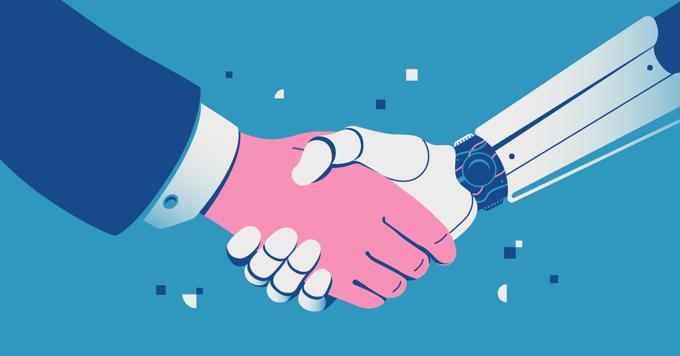
Putting these pieces together, we have an emerging view of how leadership might evolve in the age of AI. We need human leaders to define the purpose of our work and articulate it in a way that people find inspiring; we also need them to live the values of the organization, to define the boundaries we should not cross, and to take responsibility for the incentives and penalties that shape our behavior. At the same time, there is also a huge role for AI in liberating our thinking, enriching our access to information, and providing the technical expertise to help us do the value-added parts of our jobs better.
Human-AI Collaboration
You may have heard the current argument that you won’t lose your job to AI, but you will lose your job to someone who has learned how to use AI. That this argument also applies to leadership. Leaders enable their employees to do their best work — and they can do it most effectively by blending their human qualities with the power of AI. I think there are implications here for all of us, and especially for business schools, to ensure our students develop the leadership skills that make them fit for the business world they will inherit and lead in the years ahead.