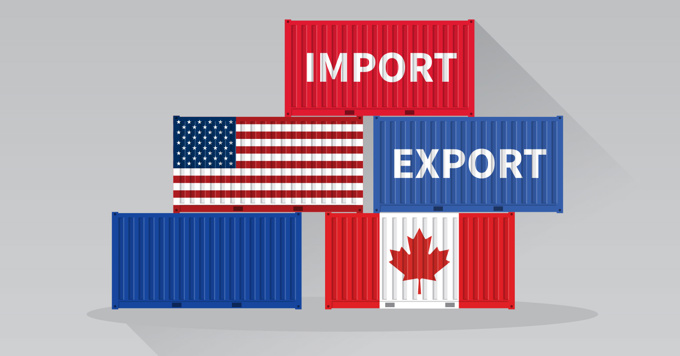
U.S. President Donald Trump recently announced an additional 50 per cent tariff on a wide range of Canadian imports, scheduled to take effect August 19. The Trump administration said the tariffs are a response to Canada's retaliatory and "discriminatory" trade measures.
Ivey BMO endowed Professor of International Business, Andreas Schotter, EMBA ’04, PhD ’09, examines these issues and what they mean for Canadian business in Impact’s “Ask the Experts.”
Ivey Impact: Let’s start at the beginning. What are these new tariffs, why have they been introduced, and how should we understand the claims being made by the U.S. administration?
Andreas Schotter (AS): The U.S. has invoked Section 338 of the U.S. Tariff Act of 1930 to impose an additional 50 per cent tariff on selected Canadian imports, affecting nearly US$20 billion in annual trade. The tariffs are not a blanket measure on all Canadian exports, but they cover a broad range of products, including wine, cement, furniture, electronics, and hockey equipment. Importantly, they apply even to goods that comply with United States-Mexico-Canada Agreement (USMCA) rules. Exemptions include energy, potash, fish, critical minerals, and products already subject to certain national-security tariffs.
Washington says Canada has discriminated against American automobiles, alcohol, and dairy products. While parts of that argument have merit, the picture is more complicated than the administration suggests. The strongest U.S. case relates to alcohol: Canadian provinces removed U.S. wine and spirits from their shelves while continuing to sell products from Europe, Australia, and other regions. That has made it easier for Washington to argue that American producers were being singled out.
The dairy issue, however, is more complicated. The U.S. has raised legitimate concerns about how Canada allocates access to its protected dairy market, but that is different from proving Canada has violated its trade obligations. In the second major USMCA dairy dispute, two of the three panellists rejected the American claims that Canada had breached the agreement.
The automobile complaint also depends on how the sequence of events is framed. Canada’s restrictions were introduced in response to earlier U.S. tariffs, yet Washington now presents those retaliatory measures as the original offence. Ottawa’s position is that it was responding to unilateral U.S. action.
Ivey Impact: What exactly is Section 338, and how does it work?
AS: In plain English, Section 338 is a blunt legal tool dating back to 1930. It allows the U.S. president to impose tariffs of up to 50 per cent on another country's goods if they determine that country is discriminating against American commerce. Those tariffs can take effect as soon as 30 days after a proclamation, and if the alleged discrimination continues, the law even allows certain products to be barred from the U.S. market altogether.
What makes Section 338 unusual is that the punishment does not have to match the alleged offence. A disagreement over American liquor, dairy products, or automobiles can therefore produce tariffs on unrelated Canadian exports, such as cement, furniture, or hockey sticks.
Because Section 338 has rarely been used, there is little legal precedent to define its limits. Courts may eventually review its use, but exporters and importers must deal with the tariffs in the meantime.
Ivey Impact: Which industries and businesses will feel the greatest impact?
AS: Previous tariff rounds concentrated heavily on steel, aluminum, automobiles, and lumber. This round broadens the dispute to smaller manufacturers, consumer brands, retailers, and construction suppliers.
In Canada, the companies most exposed are those that rely heavily on the U.S. market, operate on thin margins, and depend on one or two major American customers.
Consider a Canadian hockey-equipment manufacturer shipping US$100,000 worth of goods to the U.S. A 50 per cent tariff would add US$50,000 to the American importer’s costs. That cost can only be absorbed in four ways:
• The Canadian manufacturer cuts its price;
• The American importer absorbs the cost;
• The customer pays more; or,
• The order is cancelled.
In many cases, the order will simply disappear.
The impact depends largely on how easily a product can be substituted. Wine, furniture, and sporting goods can often be replaced by competitors from the U.S. or abroad. Cement is different: because it is heavy and expensive to transport, American buyers have fewer alternatives and are more likely to absorb the cost.
Remember: the tariff is paid by the American importer, not the Canadian exporter. Who ultimately bears that cost depends on bargaining power between the Canadian seller and the American buyer and whether the product can be sourced easily elsewhere.
Ivey Impact: What will this mean for Canadian consumers?
AS: To be clear, this is an American import tariff, so Canadian consumers will not automatically see prices rise by 50 per cent at the checkout. The more immediate impact in Canada will likely be weaker demand for exports.
If a Canadian company loses a large U.S. customer, it may reduce factory shifts, freeze hiring, delay expansion, or lay off workers. For families, the effects may be felt first through lower income due to fewer hours worked, less job security, and reduced investment in their communities.
These impacts will be especially visible in towns built around export-oriented industries, where a single manufacturer can be the major employer.
Ivey Impact: Is this another political dispute, or a fundamental change in North American trade?
AS: The way I see it, this is both a political negotiation today and a structural warning for tomorrow.
The 30-day delay creates a negotiating window. It puts pressure on Canadian businesses to push Ottawa toward a deal, while giving the White House room to amend or withdraw the tariffs. Canada should use that opening, but without making concessions that permanently weaken its position. A visible, limited, and reversible measure – such as restoring some U.S. wine and spirits to Canadian shelves in exchange for suspending the tariffs – could give both sides a path forward.
But Canada should not dismantle supply management, accept permanent limits on its industrial policy, or rely solely on dollar-for-dollar retaliation. While retaliation may signal national strength, it can also raise costs at home and provide further justification for escalation.
Canada should also try to buy time until the U.S. midterm elections on November 3. A change in congressional control could increase political pressure on the administration and make further trade action more difficult, but it would not automatically remove the tariffs or override the president’s authority under Section 338. The midterms should be viewed as an opportunity – not a strategy.
The larger concern is that businesses can no longer assume USMCA alone provides reliable protection. That shift will change how companies invest and manage their supply chains. They are likely to diversify suppliers, hold more inventory, and move production closer to key markets. When trade rules can change with political decisions, the border becomes a source of business risk, not just a customs checkpoint.
Ivey Impact: Switching gears slightly, President Trump has raised the possibility of tariffs linked to smoke from Canadian wildfires. What legal authority would support such a measure, and is there an economic rationale for it?
AS: Wildfire smoke is a real cross-border problem, but tariffs are not a serious solution.
Smoke creates genuine economic costs, affecting public health, worker productivity, aviation, tourism, and outdoor businesses. Canada and the U.S. clearly have a shared interest in addressing those impacts through prevention, emergency response, and firefighting capacity. The two countries already have a Canada-U.S. Air Quality Agreement.
I view the smoke issue primarily as another negotiating tactic. It expands the range of complaints, keeps pressure on Canada, and gives the administration another issue to highlight domestically. But Canada could turn this into a constructive, face-saving opportunity by suggesting something like a joint North American wildfire initiative involving shared aircraft capacity, cross-border deployment protocols, satellite data sharing, prevention funding, and emergency exercises.
Ivey Impact: What should business leaders watch over the next six to 12 months?
AS: Watch whether USMCA compliance once again buys reliable market access. That is the single most important question.
If Canada offers a limited concession and Washington restores a durable tariff exemption for USMCA-compliant goods, then businesses may conclude that this was an aggressive negotiating episode inside a damaged – but still functioning – trade system.
But, if USMCA-compliant products remain exposed to major tariffs, companies will have to assume that producing in Canada carries a permanent U.S. political-risk premium. That will affect factory locations, investment decisions, supplier choices, and long-term contracts.
There are two dates to watch:
• August 19: when the tariffs are scheduled to take effect, and
• November 3: when the U.S. midterm elections could reshape the political environment.
But I’m not holding my breath.
Businesses should not rely on election outcomes to solve this problem. Even a Democratic Congress would not automatically remove these tariffs. The decisive commercial question is whether Canada can turn any concession into a written, durable, and enforceable USMCA carve-out.
Andreas Schotter is the endowed BMO Professor of International Business at Ivey Business School. His research on the internationalization of firms, digital disruption, boundary-spanning leadership, and the future of work has been published in top management journals and several books, with his insights also frequently featured in national and international media.