
Formula 1 cars are among the fastest machines on earth. Engineered to exceed 350 kilometres per hour, they push the limits of what human ambition and advanced engineering can achieve together.
But with great speed comes great risk. Not just the risk of losing the race, but of losing control entirely.
In boardrooms today, a similar dynamic is playing out. In pursuit of productivity, innovation, and competitive advantage, organizations are pressing hard on AI's accelerator. But with that pace have come high-profile failures: fabricated citations in official reports, chatbots making false promises, and coding agents wiping entire databases.
For every board watching this unfold, a critical question is emerging: how can organizations sustain the speed AI demands without steering into a crash?
According to Hubert Pun, Professor of Management Studies at Ivey Business School, the answer lies in something every Formula 1 driver depends on: the braking system.
The brake that lets you go faster
That's the central argument of Pun's new white paper: governance is the brake that rapid AI adoption needs.
"In F1 racing, the braking system doesn't exist to make cars slower; it exists to make high speeds possible," said Pun. "AI governance serves the same purpose. It's not about limiting innovation; it's about putting the right safeguards in place so organizations can accelerate with confidence."
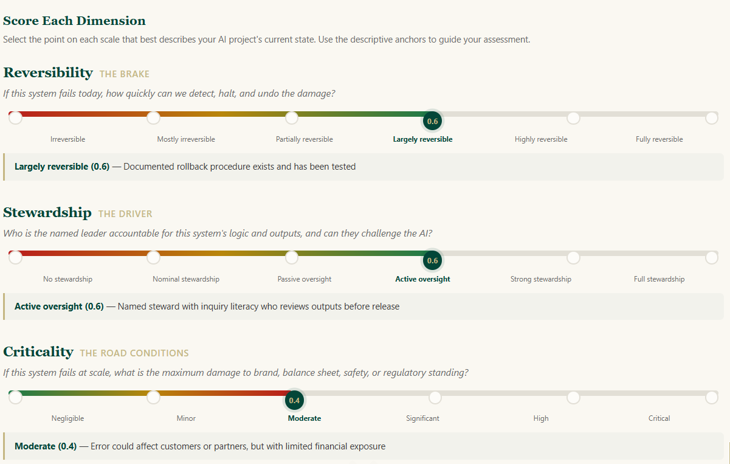
To put that principle into practice, the paper introduces a governance framework that enables company leaders to assess AI initiatives systematically and equips boards with the insight needed for more targeted oversight.
The framework is built around three interconnected dimensions inspired by the driving experience: the brake (reversibility), the driver (stewardship), and the road conditions (criticality). Together, they give boards a practical lens to understand where AI initiatives may require stronger safeguards before they scale.
But a framework alone isn't enough. To keep organizations on course, boards must be ready to take the wheel.
Shifting from passive oversight to active inquiry
Most directors know AI is being used across their organizations. What many lack, however, is the visibility needed to ask the critical questions required to govern it effectively.
That, Pun argues, is where board oversight must evolve.
"A key role for any board director is to ask the questions organizations can't afford to miss," he said. "And there are few areas in business right now where those questions are broader or more complex than AI."
But Pun is clear that this responsibility doesn't mean every director needs to become an AI specialist. It means developing the confidence to evaluate AI through a critical business lens and knowing where to probe deeper—in other words, shifting from passive oversight to active inquiry.
His framework is designed to help boards make that shift.
A framework built for speed—and survival
Just as a Formula 1 team cannot win on speed alone, organizations cannot evaluate AI initiatives based only on their potential. They must also understand the safeguards that allow them to move quickly without losing control.
That requires looking beyond the technology itself and assessing the conditions that determine whether an AI initiative is ready for the track. Pun’s framework examines three:
1. Reversibility (The “Brake”): The ability to detect, contain, and recover from an AI failure before it causes irreversible harm. Pun measures this through time-to-recovery—the time it takes to return a system to a safe state once an issue is identified. This then, in turn, defines an organization’s survival window: the critical period before an AI-driven failure becomes irreversible
“That window might be measured in milliseconds for a live chatbot, days for an internal productivity tool, or weeks for a strategic report,” said Pun.
The board’s question: If this system silently fails or hallucinates today, how quickly can we recover—and is that fast enough?
2. Stewardship (The “Driver”): Clear ownership and accountability for what an AI system produces. Every deployment requires a named individual—not a committee or team—who can move beyond passive oversight to active inquiry: questioning how the system is being used and challenging its outputs. Pun calls this inquiry literacy.
The board’s question: Who owns this system's outputs, and do they have the fluency to challenge the technical team?
3. Criticality (The “Road Conditions”): The potential damage to brand, balance sheet, customer safety, or regulatory standing if the AI fails at scale. Criticality is context-dependent, not tool-dependent: an internal meeting summary and a customer-facing legal disclosure may run on the same technology but carry vastly different levels of risk.
The board’s question: As this tool moves from internal to external use, what triggers are in place to catch failures and escalate oversight?
Putting AI governance to the test
To help organizations put the framework into practice, Pun partnered with Ivey Executive Education to develop a complimentary virtual Governance Readiness Diagnostic.
Designed to be applied quickly at the portfolio level by non-technical leaders, the diagnostic evaluates an organization’s AI initiatives across the three dimensions of the framework—reversibility, stewardship, and criticality—and categorizes them into three governance zones. Green-zone initiatives have the oversight structures required to move forward with confidence; yellow-zone initiatives require additional safeguards before broader deployment; and red-zone initiatives—where accountability is unclear, recovery is too slow, or the consequences of failure are too significant—should pause until governance catches up.
The road ahead
Pun acknowledges that governing AI will never be a one-time exercise. New models, evolving regulations, shadow AI, and changing business uses mean the landscape is constantly shifting.
That’s why he encourages boards to revisit AI governance regularly and treat it as an ongoing strategic capability rather than a compliance checklist.
"No Formula 1 team checks the brakes once a season,” he said. “Boards can't afford to treat AI governance any differently."
Because in the end, the organizations that succeed with AI won't be the ones without brakes, they’ll be the ones who never stop checking them.
To go deeper, download Hubert Pun's new white paper, Accelerating AI-Driven Progress with High-Performance Safeguards: A Governance Framework for Board Members, or pressure-test your organization's AI initiatives with the Ivey AI Governance Diagnostic.