Inside the LEADER Project: Ivey students building opportunity abroad
Each spring, Ivey students participating in the LEADER Project work with local partners in emerging markets to teach entrepreneurship. The experience pushes them to adjust what they know to the context in front of them and to learn from the communities they’re working in. The result is a two-way exchange: local entrepreneurs gain practical tools and frameworks, while Ivey students learn how to listen, adapt, and lead in unfamiliar environments.
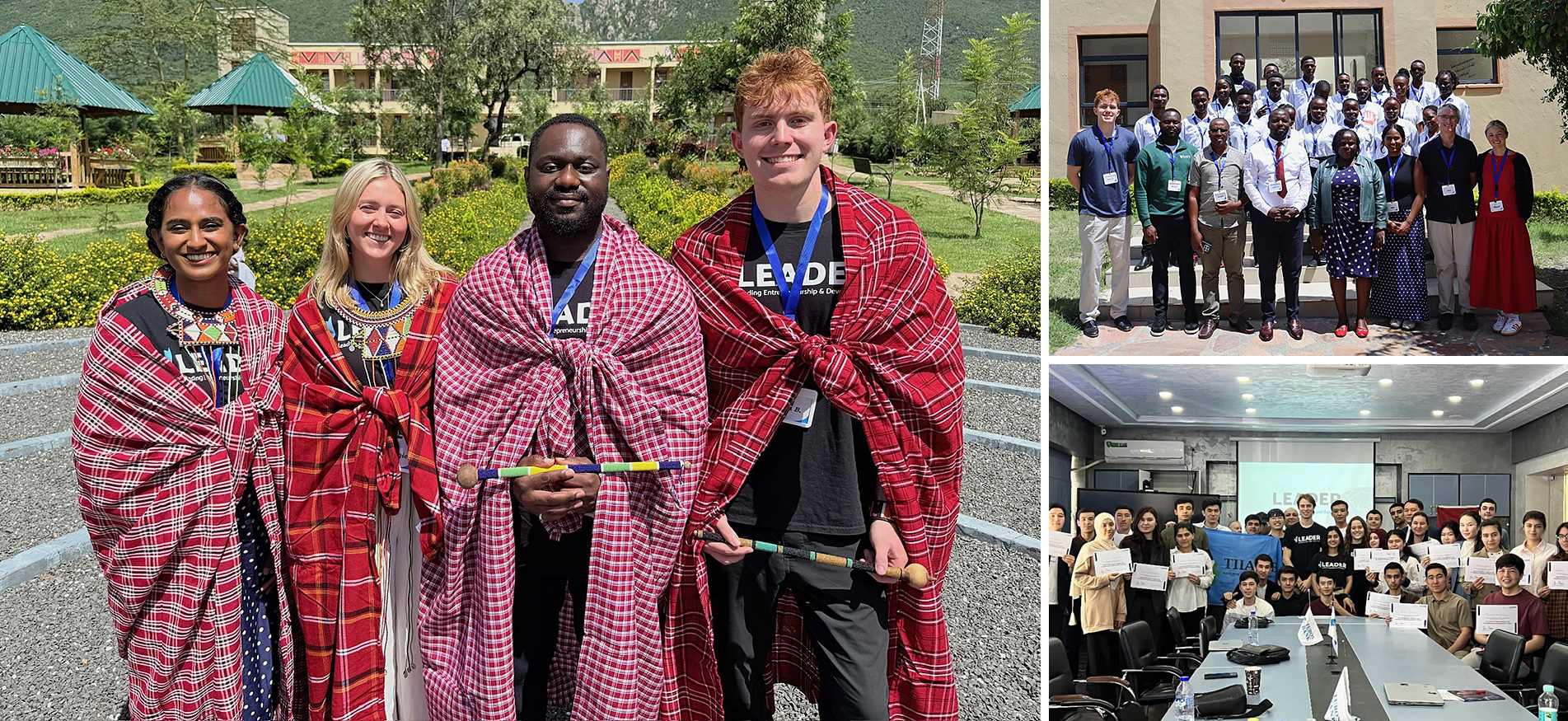
The case was about protein bars, a specialty product marketed to flexitarians. It made sense in the Ivey classroom. But in rural Kenya, where students were ages 18 to 24 and thinking about ventures such as chicken farms, salons, and car washes, it did not resonate.
So, Maggie Kortekaas, MBA ’26, and her team dropped it and rebuilt the lesson around Darling Kenya hair products – something students recognized right away and understood on a personal level.
“It was the first case they worked through, and that familiarity helped build the confidence they needed to actually use the tools and frameworks we’d given them,” said Kortekaas.
On paper, it was a small change – one case replaced with another in the first few days of the program. But it captures something LEADER instructors often find once teaching begins. They arrive with months of preparation behind them, but once class starts, they still have to listen, adjust, and sometimes change course. What works in one setting may not work in another, and the students have to respond to what they hear in the room.
For Dominic Lim, PhD ’09, associate professor of entrepreneurship and LEADER’s faculty adviser, that openness is part of the point.
“Our students do not go to these countries thinking we know these things, so we are going to teach these things to these people,” Lim said. “They usually go to those countries with a really open mind.”
Founded in 1991, LEADER sends Ivey students abroad each spring to teach entrepreneurship with local site partners ranging from universities to chambers of commerce and innovation hubs. Over the years, more than 1,200 LEADER instructors, known as LEADERites, have worked in 23 countries, reaching more than 10,000 entrepreneurs and students. This year, 33 Ivey students and six alumni volunteered on teams at eight sites: India, Montenegro, North Macedonia, Serbia, Thailand, Vietnam, Uzbekistan, and, for the first time, Kenya.
Ivey students begin preparing months before departure by reviewing feedback, revising cases, practising with faculty, and working through logistics with local partners. Once they are in the classroom, they often have to rewrite cases or change their teaching format to better meet their participants’ needs. That preparation also shows that LEADER is more than a trip abroad. Students spend months getting ready, then have to figure out how to make those lessons work for the people in front of them.
Lim said LEADER’s impact is often gradual rather than immediate, showing up over time as participants gain confidence, refine ideas, and build on what they learned.
“I wouldn’t say everybody starts a business out of these programs,” he said. “But I think the important thing is that we are planting those seeds. If you go back there every year and do that again, do that again, do that again, then it really cultivates the landscape.”
Students at six LEADER sites put that approach into practice in very different settings, from helping aspiring founders sharpen business models to building confidence in classrooms where participation did not come easily at first.
LEADER Project: By the Numbers
1991
Founded
35+
Years of programming
23
Countries reached
10,000+
Entrepreneurs and students trained
1,200+
LEADERite instructors
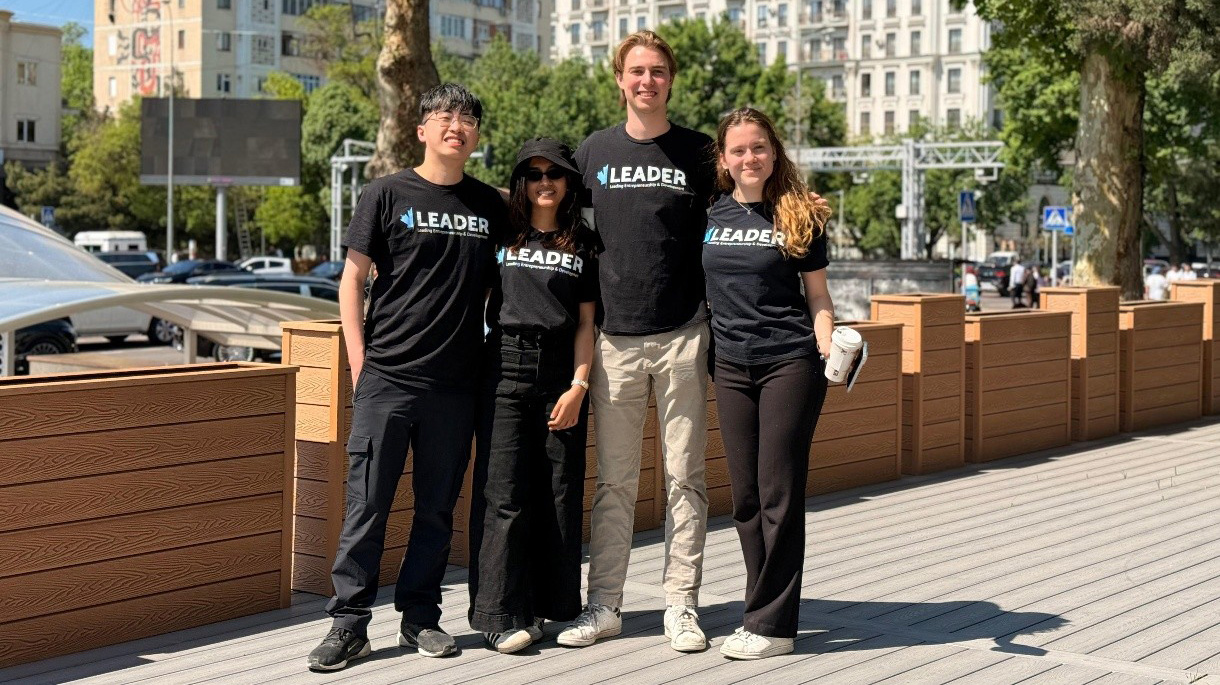
Bob Deng (far left) with his LEADER team
Putting tools into practice
In Tashkent, Uzbekistan, Bob Deng, MBA ’26, worked with a team that partnered with the Tashkent Institute of Irrigation and Agricultural Mechanization Engineers. The program ran as an intensive two-week business course for students and aspiring founders who often had strong technical skills and promising ideas, but less experience turning those ideas into business models other people could quickly follow.
Deng joined LEADER because he wanted to teach, improve his public-speaking skills, and better understand how early-stage businesses take shape. Before the trip, he spent months on LEADER’s Curriculum Committee, reviewing feedback, refreshing cases, and updating teaching materials. In Uzbekistan, he served as his team’s curriculum representative, helping ensure the lessons, examples, and case contexts suited the local environment. The team introduced core business tools and asked participants to apply them to their own ideas. Each participant also left with a curriculum resource booklet covering the lectures, workshops, and tools introduced during the program.
By the final pitches, Deng could see participants starting to use those ideas in their presentations.
“They were actively trying to come up with interesting hooks to grab our attention, and they did a good job translating their ideas into clear, straightforward business stories,” he said.
As he taught, Deng realized he was applying those same principles himself. During a pitching workshop, he encouraged the participants to understand their audience and clarify their core message. He found himself asking the same questions as an instructor, continually assessing whether his lessons were clear and useful for his class in Tashkent.
Deng said some of his assumptions changed quickly once the team arrived. Previous teams had warned his group to be deliberate about encouraging female participation, but he quickly found that wasn’t necessary.
“Our expectations were completely upended,” said Deng. “The female participants were among the most active, confident and expressive people in the room, driving the debates and leading the workshops.”
Getting to know the students
In Podgorica, Montenegro, HBA ’27 candidate Laura Guo learned how to adapt her lessons by getting to know her students better.
She initially expected the important work would happen in lectures and case discussions. But after she began joining students for coffee, those conversations changed how she understood the room.
“Sharing a simple cup of coffee allowed me to connect with the students on a human level. I learned about their lives, their values, and their backgrounds. Ultimately, this completely transformed my teaching,” she said.
Guo’s team worked with the Chamber of Economy of Montenegro, combining lectures in strategy, marketing, and finance with one-on-one coaching. One entrepreneur she mentored was preparing to launch an event-hosting and rental business on her family’s newly developed property. The team visited the site, walked the space, and helped the entrepreneur think through what kinds of events might work there and how to market them.
About two months later, Guo heard back from the entrepreneur that she had officially begun renting out the space and hosting successful events.
“Witnessing that transition from a classroom discussion to a thriving, tangible business was incredibly rewarding,” said Guo.
“It proved just how impactful the practical application of business fundamentals can be.”
The experience also made Guo reflect on what her education has given her.
“I wanted to contribute because I recognize how incredibly privileged we are to have access to an Ivey education,” she said. “Empowering aspiring global entrepreneurs by sharing these foundational concepts was a way to pay that opportunity forward.”

(Front row, l-r) Maggie Kortekaas, MBA ’26, and Glen Webster HBA ’93, MBA ’98; (back row, l-r) Daniel Ebitunmise, MBA ’26, Johnny Beaton, HBA ’26, and Abhi Ravipati, an HBA ’27 candidate.
Finding their voice
Back in Kenya, Kortekaas and her teammates found that the challenge was not just teaching strategy and marketing, but helping students feel comfortable speaking up in class.
The team had been warned that many students might struggle with cold calling, and on the first day only a handful raised their hands. Over the next two weeks, the instructors added presentation practice, class exercises, and lower-pressure ways for students to participate.
By the end, every student was participating.
“On the last day, every single student got up to present, and watching them do it with real pride was an incredible thing to see,” said Kortekaas.
The effect was not limited to students. Teachers at the college also sat in and paid close attention to how the Ivey team taught.
“The teachers told us these were practices they planned to carry forward into their own teaching,” said Kortekaas.
Kortekaas said she has long been drawn to volunteer work, and LEADER gave her a chance to make a bigger impact.
“Prior to my MBA, I found myself looking for opportunities to make an impact,” she said. “I volunteered weekly at my local food cupboard, but I always admired and looked into opportunities to make an impact globally.”
HBA ’27 candidate Ryan Doerr was also drawn to LEADER because he wanted to make a difference in other people’s lives.
“Everything I do, whether it's my professional experiences, extracurriculars, or educational involvement, all follows one motto: I am not on this Earth to only chase individual or personal success, but to use everything I have learned to benefit the lives of other people. When I heard about the LEADER project, it appealed to me like nothing ever before,” he said.
“There is something incredibly fulfilling about helping someone else unlock their potential, and I saw the LEADER Project as a unique opportunity to do exactly that on an international scale.”
While teaching in North Macedonia, Doerr saw students become more comfortable working through financial statements and business decisions. His team worked with Macedonia2025, an organization focused on entrepreneurship and economic growth. Doerr led lectures on financial statements and cash flow for entrepreneurs who, in many cases, had the vision but lacked the tools to build out their ideas.
“Watching someone go from feeling overwhelmed by a financial statement in the morning to confidently walking through a business decision by the afternoon was something I will not forget,” he said.
After one of those lectures, Doerr said he was touched by feedback from two participants who said the session had changed how they thought about finance.
“They said they left feeling genuinely excited and engaged, and that it had changed how they thought about the financial side of their businesses,” Doerr said. “That meant everything to me.”
He said the experience also gave him a deeper appreciation for the case method.
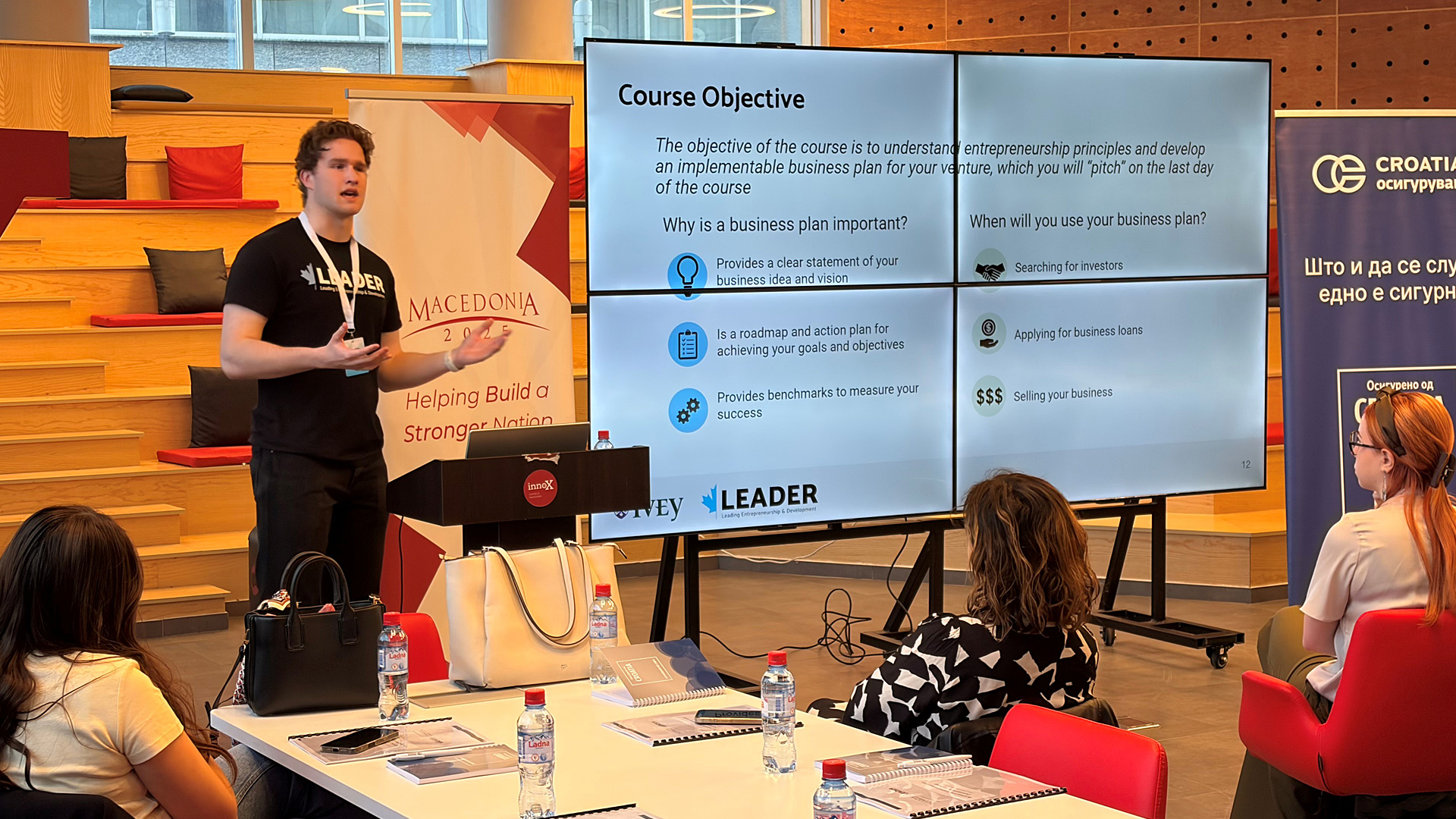
Ryan Doerr teaching
“That is exactly where the Ivey case method becomes so powerful,” he said. “It gives you a way to break down complex business problems, think critically about real constraints, and arrive at practical, actionable solutions. Being able to bring that approach into the room with these entrepreneurs, and watch it click for them, was something really special.”
He said some of his most memorable moments happened outside the classroom. One highlight was during a long evening at a kafana, a traditional Balkan gathering place, when his team spent hours in conversation, with no phones out and nowhere to be.
“In North America, we talk a lot about community, but what I witnessed in North Macedonia was community actually being lived,” he said.
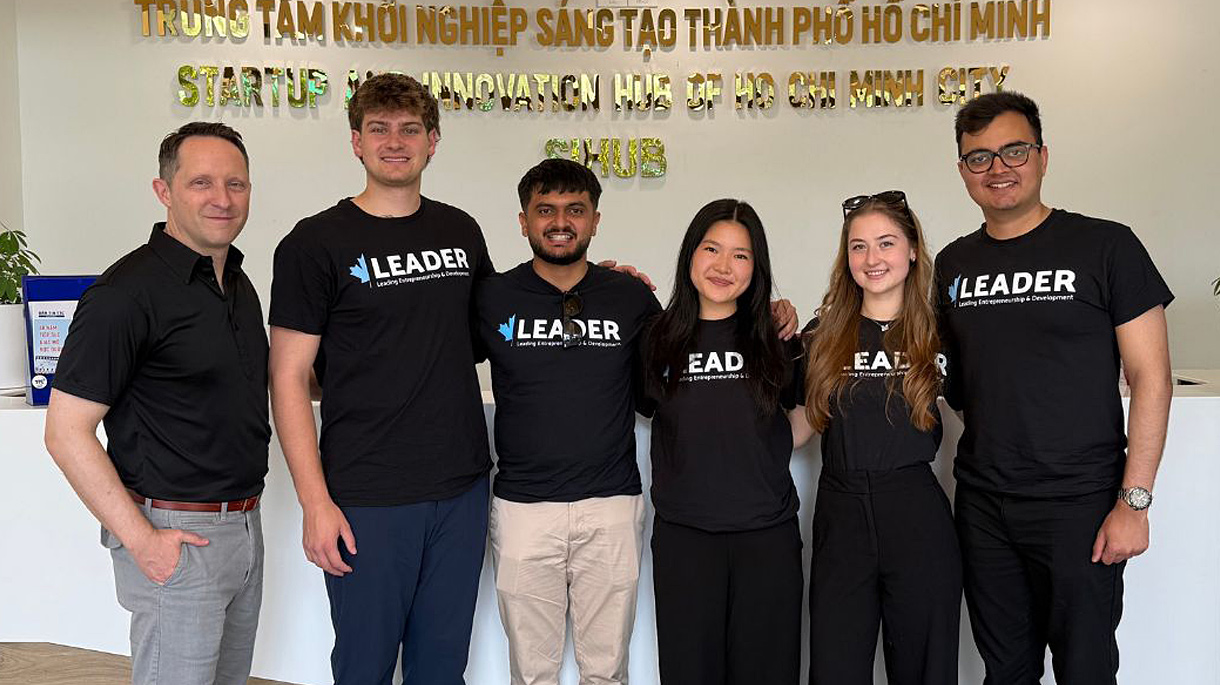
Eva Karpukhina (second from right) with her LEADER team
From strategy to real business
In Ho Chi Minh City, HBA ’27 candidate Eva Karpukhina worked with entrepreneurs building ventures in health care, education technology, e-commerce, and consumer products. Her team taught strategy and marketing tools for assessing markets, competition, and customers, and the participants quickly began applying them to their own businesses.
“The highlight for me was the final pitch competition,” she said. “Several participants brought products from their own ventures for everyone to try, which made the pitches feel especially meaningful and showcased the real businesses and ideas behind their presentations.”
Karpukhina also noticed that participants spoke about entrepreneurship differently.
“Coming from a Canadian business environment, I was accustomed to hearing discussions centred on competition and individual success. In Vietnam, I observed a stronger emphasis on relationships, community impact, and collective growth,” she said.
She was also struck by the number of women in the cohort who were building ventures across a range of industries.
Seeing their ambition, resilience, and commitment to solving meaningful problems challenged my assumptions about entrepreneurship and reinforced the importance of diverse perspectives in driving innovation,” she said.
As a founder herself, Tolu Michaels, MBA ’26, joined LEADER already believing in entrepreneurship’s potential.
“I had seen how the right tools and community can turn ideas into impact,” she said. “When I learned that the LEADER Project involved delivering business education to entrepreneurs in emerging markets, it felt like a chance to not just experience a new culture, but to contribute my expertise in a way no MBA coursework could give me.”
Michaels’ team went to Thailand and partnered with the Asian Institute of Technology, teaching a cohort of 30 participants who ranged in age from 31 to 35 and came from Vietnam, India, Myanmar, Nepal, Pakistan, and the Philippines. The group worked across data analytics, medical engineering, operations, social enterprise, and food science.
Michaels served as the MBA Coordinator for Marketing and Communications for LEADER and later as the Thailand Site Ecosystem Representative. On site, she taught, facilitated case discussions, and coached entrepreneurs one-on-one.
She said one participant – a mother returning to a small social enterprise after several years at home – initially sat quietly at the back of the classroom. But over the course of the program, the participant began contributing to discussions and eventually stood at the front of the room to share her ideas and answer questions.
“Coaching her through that was the most meaningful moment of my LEADER experience,” said Michaels. “And it changed something in me too.”
Michaels said the experience also changed how she saw what LEADER offers Ivey students.
“On the surface, LEADER is known for bringing quality business education to entrepreneurs in frontier markets,” she said. “But what LEADER actually does is put Ivey students in situations where they can see how much leadership they are capable of … And to my surprise, it did not feel like an obligation. It felt like a privilege."
"I went to Thailand to teach entrepreneurship and left with a sharper global lens, new friends, and more confidence as an instructor.”
What Ivey students take home
Karpukhina said the experience strengthened her view that business can do real good when it responds to people’s actual needs.
Guo said she was inspired by the purpose and drive of the entrepreneurs she met and hopes to carry that forward herself.
And Doerr said the experience changed his perspective in a way he could not have anticipated.
“I walked in as an educator and walked out as a student,” he said. “Whether it was the way the entrepreneurs approached problems, the questions they asked that I had never thought to ask myself, or simply watching how they carried themselves through uncertainty, I left with a perspective on business and life that no classroom has ever given me.”