Policy advocacy is no longer an optional skill for business leaders – it is becoming an essential part of how companies operate today. Tariffs can wipe out millions of dollars in value, zoning rules can halt major developments, and sustainability regulations can reshape entire industries. Whether navigating geopolitical tensions, supply chain volatility, or the rapid electrification of manufacturing, businesses must now engage with governments more actively than ever before.
For business students preparing to lead in this environment, policy advocacy isn’t about politics – it’s about protecting value, shaping strategy, and ensuring long-term resilience.
That’s why the new HBA course, Strategy in a Political World – one of the first of its kind in Canada – from Professor Adam Fremeth, HBA '00, E.J. Kernaghan Chair in Energy Policy, brings business leaders into the classroom to show how strategy, regulation, and government decision-making intersect. Speakers this fall offered firsthand perspectives spanning elected office, regulated industries, Indigenous partnerships, and global trade.
Guests included:
- Mike Wallace, Executive Director, London Development Institute;
- Kathleen Sullivan, Vice-President, Government and Industry Relations, Maple Leaf Foods;
- Rachel Stack, Director, Business Development, Bruce Power; and,
- Brian Kingston, EMBA ’17, President and CEO, Canadian Vehicle Manufacturers’ Association.
Together, the speakers demonstrated how political and regulatory forces shape even the most routine business decisions, and why future leaders need to understand the systems behind them.
Policy advocacy as a strategic business tool
With experience as a city councillor, MP, and now lobbyist for London’s largest land developers, Mike Wallace reminded the students that government is not separate from business – it affects decisions every day. He showed this through examples: a naturopathic clinic blocked from opening due to zoning rules, or longstanding restrictions on beer and wine sales that only changed after sustained industry lobbying. Together, they reinforced how government influence is woven into day-to-day business decisions.
Wallace also shared seven rules developed during his years in Ottawa, working closely with industry and government: Know your issue and your audience. Be clear about what you want. Understand objections. Follow up. Bring allies. Never leave anyone out. And start early – well before you need something.
“It's mostly common sense – mostly a sales kind of approach,” he said.
Policy advocacy, he told the students, is built on preparation and long-term relationships.
How policy shocks ripple through entire industries
As Maple Leaf Foods’ Vice-President of Government and Industry Relations, Kathleen Sullivan discussed how public policy shapes every aspect of the food industry. She told how regulations influence pricing, plant operations, environmental standards, labour rules, and trade access – and when those policies shift, there are immediate effects.
Sullivan described one example that showed the stakes. When the U.S. briefly imposed broad tariffs on Canada, Maple Leaf Foods incurred $1 million in costs in just four days. She said the company responded by forming a cross-functional “war room” to coordinate communications, operations, sales, and government engagement.
She also highlighted pressures facing food manufacturers: global logistics disruptions, rising input costs, and new sustainability and greenwashing requirements. Companies must help shape these policies so they are both effective and workable.
“We are agnostic to the existence of regulations,” she said. “What we’re always trying to do is make sure that those are thoughtful regulations that are right-sized.”
Sullivan stressed that it’s important to understand who makes decisions, how rules are enforced, and when to step in.
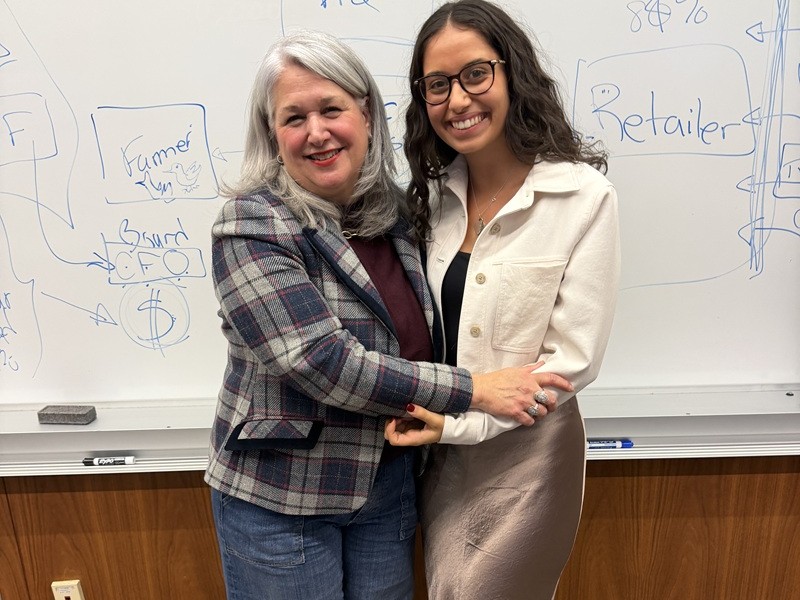
(Photo above) Kathleen Sullivan with HBA student Christina Iliopoulos
Building meaningful relationships with communities
After several classes spent negotiating an Impact and Benefit Agreement with First Nations communities, the students heard from Bruce Power’s Director, Business Development, Rachel Stack. She walked the class through Bruce Power’s engagement with the Saugeen Ojibway Nation and the Gamzook'aamin aakoziwin medical isotopes partnership, showing how the work plays out in practice.
What stood out was Stack’s leadership approach. Instead of entering conversations as the expert, she openly acknowledged her own assumptions and areas of uncertainty – a strategy that helped build trust and deepen dialogue.
HBA2 student Emma Bradacs said the session revealed a different side of leadership, focusing on openness and vulnerability.
“It's a side of leadership we don’t normally see,” she said. “She taught us that you can be vulnerable to build trust.”
Bradac said this approach strengthened the conversation.
“By taking the extra time to really understand where people are coming from, it made the conversation more productive,” she said.
Stack discussed how meaningful Indigenous partnerships require long-term commitment – consistency, transparency, and a willingness to invest in relationships well before any formal agreements are discussed.
For Bradacs, Stack’s example showed how policy advocacy can begin with listening, patience, and understanding.
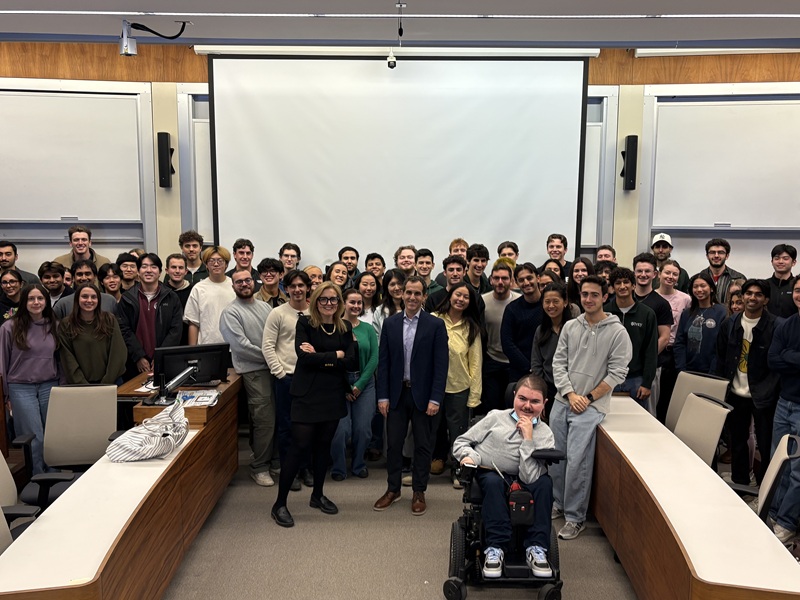
(Photo above) Rachel Stack with students in the course
Advocating through uncertainty in the auto sector
A very different set of challenges emerged in the auto sector, where policy decisions can shift entire supply chains.
As President and CEO of the Canadian Vehicle Manufacturers’ Association (CVMA), Brian Kingston works at the intersection of industry, policy, and international trade – an increasingly volatile space. He explained that Canada’s auto sector is navigating three overlapping disruptions: trade instability, supply chain fragility, and the transition to electric vehicles.
Noting that more than 90 per cent of Canadian-assembled vehicles are exported to the U.S., Kingston said the sector is highly exposed to U.S. policy decisions, and recent tariffs have created significant uncertainty for manufacturers. Auto components often cross the border multiple times during production, meaning tariff costs accumulate at every stage and can quickly affect investment.
He also described how the shift to electrification is reshaping the sector. Automakers are investing heavily in battery production, critical minerals, and new technologies, even as consumer demand and regulatory expectations continue to evolve. Kingston said navigating these pressures requires close coordination among companies, governments, labour organizations, and environmental stakeholders.
Industry associations like CVMA play a central role in that coordination. Kingston described his organization as both “a sword and a shield” for the companies it represents – advancing shared priorities while helping protect firms from unintended policy consequences.
Seeing policy through a new lens
For Bradacs, overall, the course highlighted how closely business and public policy intersect.
“It's really interesting how I didn’t realize how impacted I am by a pipeline… or all these things that seem disconnected but really aren’t,” she said.
Related Articles