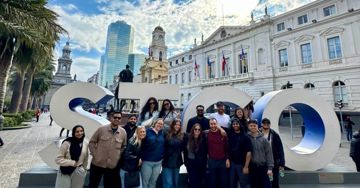
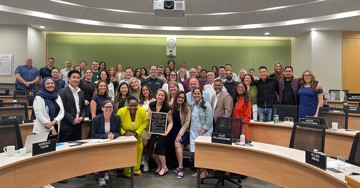
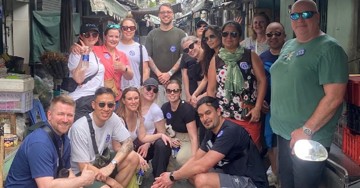
Ivey’s recent EMBA Discovery Expedition to Chile marked a milestone in sustainable travel and a powerful week of global learning. Organized in partnership with The Austral Group, it was Ivey’s first-ever carbon-neutral international trip – and a pilot for Austral that made the experience a hands-on lesson in sustainability.
To reduce the cohort’s footprint, Austral implemented practical measures such as transitioning group transfers to electric buses, encouraging metro use through pre-loaded MetroCards, and selecting venues with strong ESG practices. EMBA participants also contributed data through a post-trip survey to help Austral calculate the group’s final carbon footprint. For emissions that couldn’t be avoided, such as the long flights, Austral will fund a certified project in Chile that reduces an equivalent amount of carbon.
This pilot offers a promising model for integrating sustainability into global learning experiences. For Alexandra Tan, an EMBA ’26 candidate, the trip also provided something more personal: the chance to test assumptions, confront biases, and see how real-world experience can challenge even the most trusted frameworks. In her blog below, she reflects on what surprised her in Santiago – from the efficiency of the metro system to the grit of local entrepreneurs – and how being on the ground reshaped her perspective.
Challenging my assumptions about Chile
Going into Ivey’s EMBA Discovery Expedition in Santiago, Chile, I had assumptions shaped by Political, Economic, Social, Technological, Environmental, and Legal (PESTEL) frameworks and by my own experiences as a child of an expat in China during the late 1990s and early 2000s. I expected something similar to what I remembered of China as an emerging economy: bustling, chaotic, low-cost, and marked by visible gaps in infrastructure.
To avoid misunderstanding, I want to be clear that these expectations came from my personal experience, economic theory, and the biases I carry. Chile turned out to be none of these things, and realizing that was probably the most important learning of all.
Frameworks are useful, but they aren’t reality
As EMBA students, we rely heavily on frameworks like PESTEL to help analyze a country and make sense of its environment. But being there in person exposes what frameworks cannot capture. Chile was not at all “emerging” in the way I had prepared myself for. It was modern, orderly, and full of people who were optimistic and deeply proud of their country.
As part of Ivey’s first carbon-neutral international trip, The Austral Group provided pre-loaded MetroCards to encourage us to reduce our carbon footprint. One evening, I rode the metro during rush hour to dinner, bracing myself for chaos resembling a trip to Costco on a long weekend. Instead, people lined up calmly to enter the station. There was no pushing, no crowding, and trains arrived every single minute! The system operated with a level of precision I dare say Canada can only aspire to.
The experience revealed how I had internalized narratives about “emerging” economies. This experience reminded me that even academically informed assumptions need to be challenged through real-world experience.
Entrepreneurship driven by grit
One of the most memorable moments of the trip was hearing from Felipe Ventura, founder of Eggless, a plant-based mayonnaise brand. Coincidentally, Chile has the highest per-capita mayonnaise consumption in the world, likely due to its strong sandwich culture, which prescribes liberal use of this condiment.
As someone who leads research and development within the health and food products industry, I was immediately fascinated by how simple this innovation seemed to be. Ventura’s journey – starting the business in his parents’ home and scaling production with resourcefulness and grit – was inspiring. It captured the essence of Chilean entrepreneurship. Despite adversity, whether from political tension or regulatory complexity, founders in Chile innovate and do so with pride. It is a pride in being Latin American, being part of the Organisation for Economic Co-operation and Development (OECD), and in knowing what Chileans can bring to the world despite having long been framed as a region of instability, inflation, and inequality.
Being there and hearing directly from various entrepreneurs revealed a side of Chile that no framework could highlight: innovation emerging from necessity, and ingenuity shaped by constraint.
A lesson in curiosity and humility
I left Chile with a clearer understanding of how culture, policy, and economic conditions shape entrepreneurs. The experience reminded me of how limited classroom frameworks can be without real-world context, making it essential to stay curious and humble – qualities I believe we could all use more of.
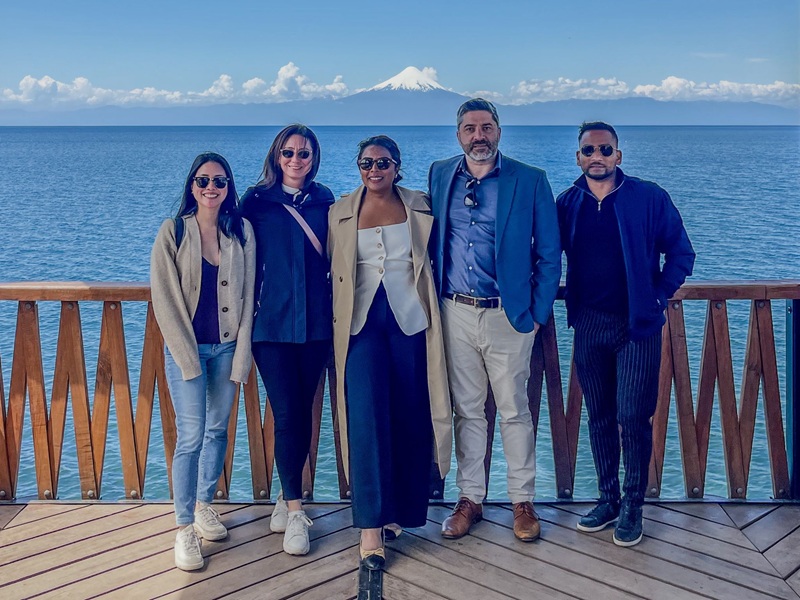
(Photo above) Alexandra Tan (left) and fellow EMBA participants with Osorno Volcano in the background.
Related Articles