Inside Ivey
Step into the world of Ivey Business School through the eyes of its students. Whether navigating the program, embracing leadership opportunities, or forging lifelong connections across the globe, these firsthand stories showcase the ambition and impact of Ivey students. Real voices, real experiences, and real insights into life at one of the world’s leading business schools.
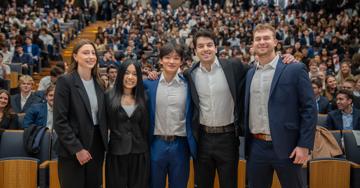
When four Ivey HBA students took the stage at the recent 36th annual Scotiabank International Case Competition (SICC), they weren't just competing – they were representing their school, their section, and their country on a global stage.
Held March 24-28 at Ivey, the competition brought together 13 international teams from five continents, challenging participants to tackle real-world business problems – from decarbonizing public transit to scaling AI-powered health-care delivery – under intense time pressure and before panels of experienced judges.
For Isaac Irwin, London Luyks, Tristan Nemcek, and Shane Weinberger, the experience was a test of everything Ivey's case method had prepared them for. The team finished second overall, behind Simon Fraser University's Beedie School of Business. In this Q&A, they reflect on how they prepared, worked together, and what they learned from the experience.
Q&A with Isaac Irwin, London Luyks, Tristan Nemcek, and Shane Weinberger
What does preparation for an international case competition like SICC look like behind the scenes?
(Tristan) As Ivey students, we are fortunate to learn using the case method every single day in class, meaning there was little prep needed to adjust to the types of cases we were presented with during the competition. However, with the time pressure and collaborative nature of case competitions, especially SICC, it was crucial to be organized and have full trust in your teammates. Luckily, competing with my section mates, London and Isaac, made this easy, as we developed great relationships with one another throughout the year. Shane’s friendly personality, great sense of humour, and dedicated work ethic made him an amazing contributor to the energy of our team.
As a team, we took the initiative to do a practice case and presentation together, to ensure we understood everyone's work habits, strengths, and presentation styles. This allowed us to hit the ground running when the first case was introduced.
One difference I noticed in this case competition compared to others I have done before was the international focus. We had to adopt a global mindset and address the issues with solutions that delivered international impact. It challenged us to think bigger, broader, and better, providing a greater impact on more people.
How did your team develop its dynamic and approach to solving cases under pressure?
(London) Our team felt that it was important to establish everyone’s preferred working styles and goals for this competition before the first case was released. We coordinated time before the competition to run a practice case simulation, recreating the timeframe and expectations of the real competition. This allowed our team to understand how each member works under pressure, and to assign informal roles for each person during the competition. Through this practice session, we determined that the most crucial stage for our team to succeed is ideation and decision-making. This is a time for each team member to share thoughts on the case and debate the best path forward. From there, we found that creating the slides was the quickest part for us.
Can you walk us through what it’s like to receive a case and prepare your solution within a tight timeline?
(Isaac) Navigating a case is a very exciting experience, especially when you’re working with such a
strong group of people. After taking the time to read through the case on our own, we shared our initial assessments and thoughts. We then came to a consensus on the problem and proposed our solutions.
This prompted a period where ideation took over, and we explored one another’s creativity. That being said, it can still get stressful! This stage typically takes the most time because we are trying to deliver elaborate and expansive ideas concisely and compellingly.
That being said, once we had put our narrative into a storyboard and agreed on the presentation style, it became a performance, which is the most fun part!
What was the most intense or memorable moment of the competition?
(Shane) One of the most memorable moments came immediately after the final case was released, when our team dove into a rigorous debate on our recommendation. With a little more than eight hours to deliver, we spent more than half that time stress-testing ideas, challenging assumptions, and refining our decision. Every point had to be defended, and nothing was taken at face value. It was demanding, but also one of the most rewarding parts of the experience.
That kind of rigorous debate is rare, and it was a privilege to work alongside a team so deeply committed to competing and representing Ivey on an international stage.
SICC brings together top teams from around the world – how has that global element shaped your experience?
(Tristan) The global element added a really fun and unique twist to the case competition. Being able to connect with the teams from different areas of the world to learn about their backgrounds was exciting. I really enjoyed sharing stories and connecting with new people during breaks, meals, and social events. I was able to learn and grow as a person by working through the cases, but I learned even more from the people around me.
Also, being from the host country, I felt proud to teach others about Canada and show them around the place we call home.
Did you notice differences in how teams from different schools or countries approached the same problem?
(London) For sure! I think one of the really unique aspects of this competition is the fact that you get to witness different perspectives and different approaches. Firstly, it was interesting to see which decision each team went with and how creative or risky that decision was. I think this reflects different levels of risk tolerance across cultures, and how that can impact the decisions teams make.
Additionally, presentation styles and formats varied. Some teams took a very performance- based approach, creating a big spectacle, whereas others took a very professional and composed approach.
What’s one skill you’ve strengthened the most through this experience?
(Isaac) One skill we all strengthened was receiving feedback from one another. When somebody proposes an idea that they have put a lot of thought into and may personally identify with, it can be hard to hear that it won’t be the core topic of our narrative.
That being said, being able to separate constructive criticism from a personal comment goes a long way, and helped us work together to build the best possible presentation. Being able to voice our insights in a way that invites conversation and builds upon one another really enabled us to tackle the case topics creatively and realistically.
How has competing at this level changed the way you think about solving real-world business problems?
(Shane) Competing at this level has reshaped how I think about solving real-world business problems by emphasizing the level of scrutiny required behind every recommendation. During a feedback session, one of the judges described the approach as balancing “stars and stones” – clearly articulating the upside of an idea while also rigorously challenging it.
It’s not enough to highlight benefits or key success factors. You have to pressure-test assumptions, anticipate risks, and defend the idea from every angle. I also learned that the deeper challenge lies in choosing which stones to throw. Executives operate under time constraints, so it’s critical to focus on the risks and assumptions that matter most.
That discipline ensures a solution is not just compelling in theory, but truly defensible, feasible, and executable in practice.
What does it mean to represent Ivey on this kind of global stage?
(Tristan) It was such an honour to not only represent Ivey, but also to be able to wear the Canadian flag and compete against the best in the world. When you're at Ivey, it can be easy to get caught up in the ecosystem, and it's only in moments like this that you realize you are working alongside some of the smartest people in the world. They push you to improve and be a better version of yourself, which pays dividends in moments like this.
It’s a very surreal feeling, and somewhat pressure-filled, but it's an opportunity we took with immense pride to represent the country and the School well. We could feel the support when we took the stage.
Unfortunately, the end outcome wasn’t exactly what we hoped for, but the learning and memories that came from this week will last a lifetime!
Looking back, what advice would you give to future students hoping to compete at SICC?
(London) Put yourself out there, and take every opportunity to showcase your skills. My team and I were selected by a faculty member who recognized our strengths in public speaking. This reflects our work both inside and outside the classroom, so showing up every day with professionalism and being ready to contribute to discussions is the first step. From there, get involved in clubs and other opportunities that will allow you to develop your leadership and communication skills. I recommend taking the time to learn more about your professors and expressing your interest in getting involved whenever you can.
Related Articles