Hudson’s Bay was once a staple of the retail experience. Its recent closure is a reminder of how much shopping has changed — not just in which stores survive, but in what customers experience when they walk through the door.
Service has declined, costs have risen, and customers are increasingly left to navigate stores on their own. In many cases, shoppers now scan their own items, bag their own groceries, and complete transactions with minimal human interaction.
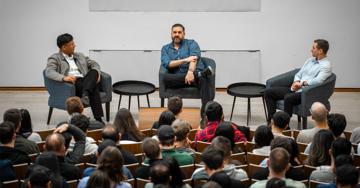
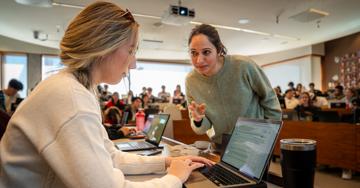
So when Johnny Alfonso, founder of Reliable Robots, visited Guneet Kaur Nagpal’s HBA2 Digital Marketing Analytics class on March 26, he posed a simple question: If customer service has been fading for decades, what might bring it back?
His answer is already appearing in stores and restaurants: robots that glide through aisles greeting customers, deliver meals to tables, promote products on digital screens, and give directions to shoppers. Some can even sing "Happy Birthday"or guide customers through unfamiliar environments in ways traditional retail has struggled to replicate.
Alfonso’s team even brought a service robot into the room, giving students a chance to see and interact with the technology firsthand.
As the robot moved across the floor, it displayed animations, and sang "Happy Birthday." Some students took out their phones to capture the moment. The demonstration made the concept more tangible – something the students could see and test in real time.
Watch the classroom demo below.
“There have been hundreds of thousands of installations of these types of robots around the world, across Europe, North America, and pretty heavy in the Asia Pacific,” Alfonso said.
For Kaur Nagpal, bringing that perspective into the classroom was intentional.
“I wanted students to see that beyond operations, there’s a huge marketing opportunity here in terms of value creation,” she said.
From operations to experience
Drawing on more than a decade of experience in automation and robotics, Alfonso framed service robots as a way to shift how work gets done. He described how automation can rebalance work – not eliminate jobs – by taking on repetitive, non-value-adding tasks such as walking back and forth, stocking shelves, or moving items.
He pointed out that in a typical retail or hospitality setting, employees spend a lot of time on those kinds of activities. Reducing that time can allow staff to focus more on interacting with customers, especially in industries where margins are tight and expectations are high.
“Nobody’s suggesting to get rid of all the people and replace everybody with robots … It’s like a hybrid environment,” he said. “Robots don’t replace people – they support them. If a restaurant closes, all the jobs are gone, so this may be a tool to help businesses before they hit bottom and are out of business.”
A new marketing channel
Beyond operational efficiency, the session demonstrated how robotics can reshape marketing itself.
Through videos and real-world examples, Alfonso showed how robots could be used to create more engaging in-store experiences – communicating promotions, guiding customers through large retail spaces, and providing additional information.
In one example, a robot in a grocery aisle could show recipes or product demonstrations tailored to nearby items, helping customers make decisions without needing assistance from staff. The students also offered additional suggestions for creating interactive promotions, such as using robots for in-store scavenger hunts or QR-based discounts.
Alfonso described this as the “mobility of things,” where products, services, and information can be delivered at the right time and place within a physical space.
The session also explored the limitations of automation. While robots can deliver consistent messaging and reduce labour costs, Alfonso stressed they cannot fully replace human interaction, particularly when customers have complex questions or need personalized advice.
Learning through exposure
For many students, the session challenged their assumptions about both the technology and its applications
“I’ve seen these robots before, but I didn’t really understand why businesses would use them,” said HBA2 student Anjie Li, who had previously encountered service robots in a restaurant in China, where they delivered food and even sang to customers. “It was interesting to learn how they can automate non-value-adding tasks so workers can focus on customer-facing work.”
Other students pointed to additional use cases, including accessibility – such as helping customers who do not speak English to navigate stores or find products more easily. They also discussed the potential for data collection and more personalized in-store experiences.
For Kaur Nagpal, that kind of exposure is key.
“When students are exposed to emerging technologies in class, they’re more likely to adopt and talk about them in their organizations,” she said. “There’s a lot of information asymmetry… Once you realize what’s possible, you start seeing use cases everywhere.”
An emerging opportunity
While service robots are still relatively new in many North American retail settings, Alfonso said adoption is growing quickly, and the biggest barrier is no longer the technology, but how businesses choose to use it.
“The biggest challenge that’s happening right now is in the imagination of the businesses,” he said.
Related Articles