When Mishka Danchuk-Lauzon enrolled in Ivey’s new Graduate Diploma in Management (GDM), she wasn’t trying to move out of health care. In her fourth year as manager of pharmacy services at a mid-sized rural hospital, she was looking for business skills her pharmacy training had never covered.
“All of my training has been health-care focused,” she said. “You don't really learn the skills that you might need, like reading financial statements – you kind of learn them on the job. I thought this was a good time to go into the program and develop those skills.”
She joined the inaugural cohort of Ivey's GDM, launched in 2025 as a pathway to the Accelerated MBA for professionals without a business background.
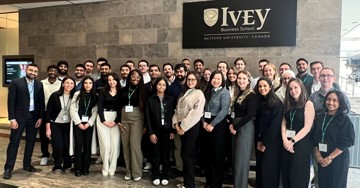
Over four months, the cohort brought together professionals from a wide range of industries and backgrounds.
David Wood, HBA ’97, MBA ’12, Faculty Director of the GDM program, said that diversity was one of the inaugural cohort’s greatest strengths.
“The students brought different industries, professional experiences, vocational backgrounds, and perspectives into the classroom, which made the case discussions richer and gave everyone an opportunity to see business problems through a much broader lens,” he said.
Sebastian Santillan, a GDM student who works in industrial automation sales for manufacturing clients, said that variety was apparent in class discussions.
“There are a lot of people coming in from the energy sector, from startups, from health care. and life sciences,” he said. “As you go through the cases and you're participating in class, you get a lot of different perspectives that, from a sales or automation viewpoint, I just would have never thought about as being a problem.”
Learning to think differently
Fellow GDM student Bi-ru Amy Yeung, a program manager at a genomics funding agency with a background in science, said the shift from a traditional academic mindset to case-based discussion stood out.
“I have a master's in science. My entire background has been in neuroscience, physiology, and cell molecular biology,” she said. “Being able to apply [a theory] into an actual example and walk through how the application works makes it easier for you to actually apply it in your real-life job ... I think it's more effective than simply just trying to read a textbook.”
Classmate Estefania Suasti Cevalos, a team lead in operations at Bell working on AI initiatives, said she was struck by how quickly she could take an idea from class back to work.
“It's not just conceptual – it's hands-on,” she said. “We don't have to wait one year to apply what we're learning. It's like, next Monday you can go and try it, and if it doesn't work, I say to the professor, ‘I tried this, and it didn't work, so how do I adjust?’”
Building confidence
The program also gave the students more confidence contributing to conversations that once felt outside their expertise.
“I hope students leave the GDM with greater confidence in their ability to tackle complex and ambiguous business problems,” said Wood. “More importantly, I hope they have learned to slow down, consider different perspectives, ask better questions, and make decisions based on a more complete understanding of the organization rather than simply their own functional expertise.”
GDM student Api Jaseharan, who works in the medical device industry, said he is often the youngest person in meetings at his company, but going through the program has already changed how he shows up.
“I can be in planning situations where leadership is in the room, high visibility. I feel more confident in those situations,” he said. “If I'm in a meeting and they're talking about what they're doing, I can actually ask a question or comment, and it will be relevant. It's not like I'm making a fool of myself.”
Danchuk-Lauzon has already started applying what she learned to her work.
“Doing the accounting and finance classes has helped me read my variance reports, do my budget, and bring that back to try to find more opportunities for efficiency,” she said.
A capstone on disruption
The program ended with a five-day capstone bootcamp, Managing Disruption Strategically, taught by Romel Mostafa, Assistant Professor of International Business and Director of Ivey's Lawrence National Centre for Policy and Management.
Working in teams, students examined how companies including Cineplex, Shopify, Magna, WestJet, and Canadian Tire responded to major disruptions and periods of uncertainty. They then applied scenario-planning tools to explore what might come next, considering forces such as artificial intelligence (AI) and other emerging technologies, changing consumer behaviour, and geopolitical and trade uncertainties.
Building on their analysis, the students developed future strategic optionalities and identified the conditions under which each option would become viable or necessary. They developed contingency plans that outlined required investments, capabilities, and organizational change, while identifying key trigger points and early-warning indicators to guide when to stay the course, accelerate, or pivot.
“In doing so, the students shifted their attention from the daunting task of anticipating possible futures to developing actionable strategies that enable organizations to remain agile, resilient, and prepared to act as conditions evolve,” said Mostafa.
The students also engaged directly with industry experts to explore how organizations can turn emerging technologies into value while navigating the challenges of adoption, governance, and scale. A panel with Aneta Osmola, VP, Global Data and AI Risk at Scotiabank, and James Stojanov, EMBA ’23, VP of AI Strategy and Growth at AXL: Human Potential, offered complementary perspectives on AI adoption in large organizations and scaling innovation in startups.
Additionally, students examined a case on Armilla AI focused on AI safety, insurance, and scaling an AI startup in Canada, brought to life by a visit from its protagonist, Karthik Ramakrishnan, MBA ’09 and Ivey AI Fellow.
Suasti Cevalos said these discussions mirrored debates already underway at her organization.
“Sometimes I think we jump too fast, and sometimes too late,” she said. “For cloud [computing], we jumped too fast. Right now, with AI, I think we're going too slow.”
The conversations pushed students to consider AI alongside the uniquely human skills of critical thinking and judgment in creating value, while the boardroom simulation of their capstone presentations required them to defend their conclusions in real time – putting those skills to the test.
The ability to think and act amid uncertainty is at the heart of the course, said Mostafa.
“You may not be able to plan for all eventualities. After all, the only constant is change. But remember, fortune favours the bold… and the astute – and the course aims to sharpen both,” he said.
For Wood, the inaugural cohort set the tone for what the program can become.
“I could not have asked for a better inaugural cohort,” he said. “They embraced a new program, worked extremely hard and created the kind of supportive, engaged learning community we hoped the GDM would become; seeing the quality of their work in the final capstone was a particularly rewarding way to finish the year.”
Looking ahead
For some students, finishing the GDM is only the first step. Danchuk-Lauzon, Jaseharan, Santillan, Suasti Cevalos, and Yeung are among those planning to continue into Ivey’s AMBA. They said the GDM’s pace and workload gave them a clearer sense of what to expect.
“What excites me most is the opportunity to create a much stronger foundation for students before they enter the AMBA,” said Wood. “The GDM allows students to develop their business fundamentals, become comfortable with the case method, and build a strong learning community, which means the AMBA can begin at a higher level and focus even more on integration, leadership, and increasingly complex management challenges.”
As the first cohort to move through the program, the students have also had a chance to help shape what comes next, sharing feedback on everything from pacing to how the courses build on one another.
“I always thought of the GDM as a four-year bachelor's in business that’s condensed into four months,” said Yeung. “But the way the GDM is structured is very well set up for us.”
For Jaseharan, being part of a brand-new program was part of the draw.
“I'm someone who doesn't mind being thrown into the fire,” he said. “What has been valuable is that all the coordinators and profs are really receptive to adapting on the fly.”