Four years into Russia’s full-scale invasion of Ukraine, leaders and workers continue to operate under extreme uncertainty, disruption, and risk. Yet organizations across the country keep showing up, rebuilding, adapting, caring for their people, and sustaining essential services.
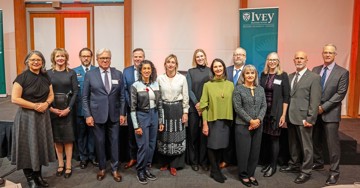
That was the focus of a recent Ivey Publishing webinar – which also marked the launch of a new co-brand partnership with Ukrainian Catholic University – on resilience over time and what leadership requires when stability and predictability are absent. Titled Four Years of Resilience: Purpose, Community, and Leadership from Ukraine, the session was moderated by Gerard Seijts, professor of organizational behaviour at Ivey, and Sofiya Opatska, vice-rector of strategic development at Ukrainian Catholic University.
The partnership will build a sustained collection of cases and learning materials that bring leadership experiences in times of crisis into classrooms around the world.
The webinar discussion brought together educators, business, and policy perspectives, including panellists joining live from the cities of Kyiv and Lviv in Ukraine.
A case about rebuilding, and what it symbolizes
The session opened with a discussion on an upcoming Ivey Publishing case authored by Seijts and Opatska about an OKKO civilian gas station in Korotych in Ukraine’s Kharkiv region that was destroyed in an aerial attack on November 7, 2025. The case demonstrates lessons in building resilience, including the importance of purpose and staying connected through community hubs.
“Case studies of countries at war are not typically part of the curriculum of undergraduate and graduate programs at business schools. However, I do believe that such events have lots to offer in terms of deep personal leadership and leadership processes,” said Seijts. “The full-scale invasion and the horrors of war have bent Ukrainians, but not broken them. The story of the bombed gas station is just one of many examples of the spirit of Ukrainian courage, defiance, strength, resilience, and a deep sense of stubbornness.”
Seijts added that the case reinforces a central leadership theme discussed at Ivey.
“In our classes and our discussions around leadership, we often talk about the importance of purpose or having that north star in whatever we do. I believe in the case of Ukrainians today, it is dignity and freedom,” he said.
Opatska framed the case within a broader pattern across Ukraine.
“OKKO is one of the examples of economic and business resistance. Over four years, there are so many examples from very small companies to big organizations that see their purpose and their role much more than just the profit in society right now,” she said. “Companies became, for Ukrainians, an element of this stability. No matter what happens, we rely on them.”
The case is scheduled for publication in the coming weeks as part of the Ivey Publishing Organizational Behaviour and Leadership and Human Resource Management collections.
The session then turned to case protagonist Andriy Kostyuk, corporate secretary on the Board of Directors at OKKO Group, who described what rebuilding represents in practice.
“It is not just about business. It’s part of the living infrastructure of the cities. Gas stations are so-called points of resilience. People are coming not just for fuel. They are coming to spend some time near the electricity generator, where you have Wi-Fi connection, and where you can have a coffee. It becomes something to fulfill basic needs, and to give people a sign of optimism, a sign of hope,” said Kostyuk.
Lessons to apply in business education
The webinar also featured reflections from former Canadian Ambassador to Ukraine, Larisa Galadza, who served in Kyiv during multiple crises, including the pandemic and the early months of the invasion. She spoke about how leadership shifts under prolonged stress.
“My leadership style needed to change. It needed to become more clear and more direct, because that’s what people want in a crisis. When you have a sense of purpose, it’s much easier to know what the right thing is to do,” she said.
Galadza also highlighted a defining feature of Ukraine’s business response.
“Businesses have seen themselves as part of the solution. They didn’t wait for someone to sign a contract with them. They didn’t wait for someone to put together a strategy. They said, what can I do? What is the right thing for me with my capacities and my resources to do? And they did it.”
Andy Hunder, president of the American Chamber of Commerce in Ukraine, was also a panellist on the webinar. He described how leadership shifts when crisis becomes constant.
“Every morning, the first question I ask is, is my team alive? Is everyone safe? Leadership now is understanding what people are going through," he said. "Empathy is very, very important. It’s better to over-communicate than not communicate at all. Trust has also been such an important and vital component of management more so than ever.”
New partnership captures leadership experiences
In closing the webinar, Violetta Gallagher, director of product and publishing at Ivey Publishing, spoke about the significance of the new partnership.
“This partnership is really more than just publishing. It’s about building a sustained collection that captures lived leadership under extreme conditions and ensures that these stories are told with accuracy, dignity, and care by the people closest to the reality,” she said.
Related Articles