Artificial intelligence (AI) is no longer a future trend for business leaders. It is already embedded in how organizations operate, compete, and make decisions. The real challenge now is not whether AI will transform the workplace, but how leaders apply it responsibly, sustainably, and with sound judgment.
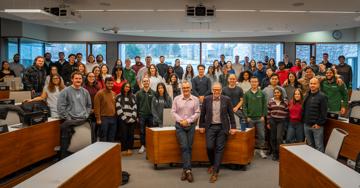
That challenge framed Leading with AI, a three-day workshop held Jan. 7–9 for Ivey MBA students as part of the Leading Critical Issues course. Led by Fredrik Odegaard, associate professor of management science at Ivey, the workshop pushed students to move beyond hype and fear and examine what effective AI leadership looks like in real organizational settings. Through case-based learning, expert panels, and an intensive AI hackathon, the students explored how leaders can integrate AI into their organizations in practical and responsible ways.
Industry perspectives
The workshop opened with a presentation from Paul Rogozinski, EMBA ’26, co-founder and CTO of Dare To Dream Games. Drawing on his experience in the gaming industry, Rogozinski described AI as a force that leaders will need to navigate carefully.
“AI is probably the fastest-moving general-purpose technology any of us will ever encounter in our lives and careers,” he said.
Rather than focusing on fears of job loss or replacement, Rogozinski framed AI as a leadership and change-management challenge.
“The challenge isn’t the technology itself. It’s how people, teams, and cultures adapt to it,” he said.
Using examples from the gaming sector – where development costs are high, timelines are long, and competition is intense – he cautioned against adopting AI simply because investors or competitors expect it.
He also cautioned against expecting AI investments to immediately improve the bottom line because efficiencies do not always translate into overnight business transformation.
Following the opening session, the students moved into case-based group work, using generative AI tools to address real business problems, including a telecom churn scenario. The focus was less on the technology itself and more on how the tools could support sound business decision-making.
Ethics and governance
A panel on AI ethics brought together industry and academic perspectives to discuss issues such as responsibility, governance, and sustainability.
Panellists included David Marotte, leader of data and artificial intelligence at KPMG; Aimee van Wynsberghe, professor of applied ethics of artificial intelligence at the University of Bonn; and Glendon Hass, MSc ’18, director of AI, data, and automation at Bronson AI.
The discussion centred on the gap between how quickly AI is advancing and how slowly organizations and regulations are adapting.
“AI adoption is accelerating, but governance and accountability must keep pace,” said Hass. “Leaders can’t control how fast technology moves, but they can control the frameworks they use to make decisions.”
He emphasized that AI implementation is not a one-time effort.
“In this environment, you need to stay open to constant evolution. That means budgeting properly for change management and being prepared not just to deploy AI, but to manage and retire systems as your needs change,” he said.
Van Wynsberghe urged leaders to challenge assumptions about AI’s environmental impact and to consider sustainability in context.
“One hour of video streaming consumes significantly more energy than a single interaction with a generative AI model,” she said. “The issue isn’t whether we should use technology at all, but whether leaders understand the trade-offs they are making.”
Marotte emphasized that AI investments must be closely tied to business outcomes.
“AI is not a magic pill … Leaders need to be clear about where it actually improves a business process, and where it doesn’t,” he said.
Commercialization and real-world constraints
A second panel focused on AI commercialization and what it takes to scale responsibly in data-intensive and highly regulated environments. The panel featured Rogozinski alongside Neil Lane, MBA ’11, co-founder and CEO of sports analytics firm Stathletes, and Michael Page, EMBA ’20, director of AI commercialization at Unity Health Toronto.
Lane stressed the need for flexibility in a fast-moving space.
“The way you do things today is going to change tomorrow,” he said. “If you get set on a decision, that’s the wrong mindset – especially in today’s world of AI.”
Page drew on his experience applying AI in health care, where decisions can have life-or-death consequences. He described how AI “scribe” tools reduce paperwork for physicians, but do not lead to more patients being seen or shorter wait times. Instead, the benefits often show up elsewhere, such as in work-life balance.
“The physicians now can save about 30 per cent of their week not doing paperwork,” he said. “And what are they doing with that 30 per cent? They’re going home to have dinner with their kids.”
Page said this means leaders need to think differently about AI’s return on investment, since gains may appear in staff well-being and retention rather than traditional productivity measures.
And Rogozinski stressed that AI should be used to support better decision-making, not to replace people.
“If I put AI everywhere in the company, half of my employees are terrified that they’re going to be replaced,” he said. “You can’t just look at the numbers, you have to understand the people and their fears.”
The AI hackathon
Those ideas were put into practice during the workshop’s AI hackathon, where 130 students, working in 25 teams, built 25 functioning AI-enabled applications in less than 24 hours, each addressing a real-world business challenge. Four finalist teams presented their solutions to faculty and industry judges.
The winning team included Avneet Chohan, Alan Hwang, Hank Lu, Lucksha Srirangarajan, and Shankar Vishweth for Interview Buddy, an AI-enabled tool designed to support interview preparation and feedback.
A People’s Choice Award, selected by students, went to Princess Adeniran, Arham Ali, Tilak De, Harmiksha Patel, and Calvin Zehr for their idea for Plato, an AI-based meal and diet recommendation app to help with nutritious meal plans.
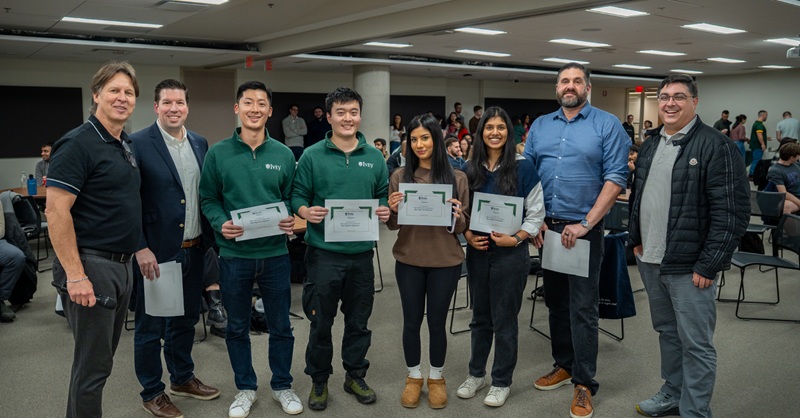
(Photo above) The hackathon winners and judges (l-r): Fredrik Odegaard, Michael Page, Alan Hwang, Hank Lu, Avneet Chohan, Lucksha Srirangarajan, Paul Rogozinski, and Neil Lane.
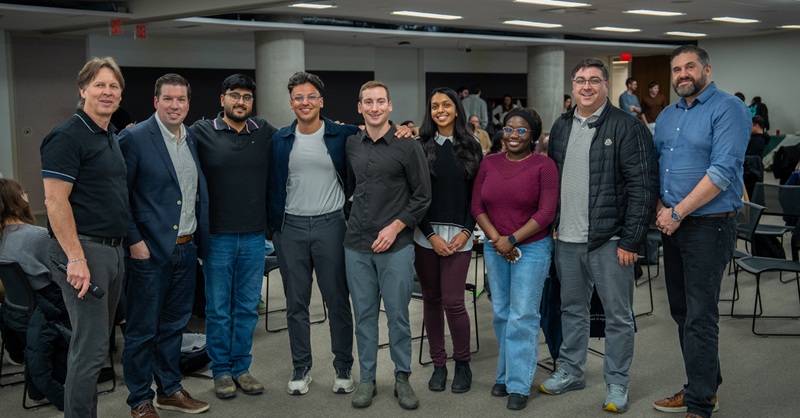
(Photo above) The People’s Choice Award winners and judges (l-r): Fredrik Odegaard, Michael Page, Tilak De, Arham Ali, Calvin Zehr, Harmiksha Patel, Princess Adeniran, Neil Lane, and Paul Rogozinski.
Related Articles