Ian Haase, MBA ’10, says he never loved school and didn’t know what he wanted to do with his life. Western University alum Sydney Robinson, in contrast, followed a carefully charted path through engineering and biomedical innovation, driven by a passion for math, science, and problem-solving.
Two entrepreneurs. Two very different journeys. But both learned that success doesn’t start with an idea – it starts with a problem.
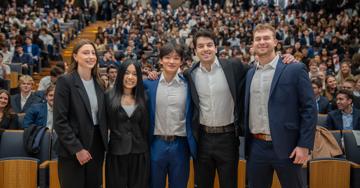
During a recent panel moderated by Eric Janssen, HBA ’09, MBA ’21, an entrepreneurship lecturer at Ivey, Haase and Robinson offered HBA1 students a candid look at what it takes to build a company. The discussion came as the students prepared for their final Learning Through Action project: partnering with an entrepreneur to tackle a real business challenge.
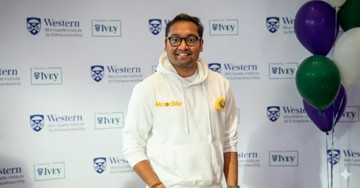
Haase is Co-Founder and Chief Financial Officer of Appello, a technology platform that helps construction companies manage operations. Robinson is co-founder and CEO of Vessl Prosthetics Inc., a medical equipment manufacturer developing self-adjusting prosthetic solutions.
Two paths to entrepreneurship
For Haase, entrepreneurship was something he recognized only in hindsight. As a teenager, he consolidated neighbourhood flyer routes and hired friends to help. In university, he knocked on doors offering services to earn money.
He said his first venture – commercializing infectious disease software – “failed miserably,” but it shifted his mindset.
“Once you’ve built something for yourself, and then someone pays you money for that, that’s a very infectious feeling,” he said.
That drive led him to co-found Motif Labs, a cannabis extraction company launched during the early days of legalization. The company navigated regulatory hurdles, rapid growth, and the uncertainty of the pandemic before being acquired in 2024.
Today, at Appello, Haase is solving a different problem: helping industrial and commercial construction companies move from paper-based systems to real-time digital operations.
Robinson’s path was more structured. After studying mechanical engineering and completing a master’s degree in biomedical engineering at Western, she joined the university’s Medical Innovation Fellowship, where engineers and clinicians work together to identify unmet needs in health care.
While shadowing a prosthetist at a diabetes clinic, she noticed a recurring issue: amputees frequently returned because their prosthetic sockets no longer fit comfortably. The body changes size throughout the day – but the socket itself is static.
Rather than jumping straight to a solution, Robinson focused on understanding the problem.
“We had a really good understanding of the problem – a less good understanding of what the solution was going to be – but a really good understanding of the problem,” she said.
The clarity led her to co-found Vessl Prosthetics Inc., which has developed an adjustable prosthetic socket system designed to adapt as the body changes.
The reality behind the venture
Both founders were candid about the emotional realities of entrepreneurship.
For Robinson, the best part is the people — her team and the prosthetists and patients they serve. The hardest part is how all-consuming it can be.
“You wake up at 5 a.m. and your heart is racing and you’re thinking about it,” she said.
Haase said the control and flexibility can be both the best and most challenging aspects of building a company.
“Work-life balance kind of goes out the window, but it’s for all the right reasons,” he said.
They acknowledged that luck plays a role — whether regulatory shifts that unlock a market or external shocks that derail projections — but emphasized resilience.
“Over the course of building a business, you’re going to experience both good luck and bad luck,” Haase said. “It’s just continuing to work hard and execute to get through whatever it is.”
Janssen reminded the students that meaningful ventures are rarely overnight successes.
“Anything worth doing takes five to 10 years,” he said.
From ideas to execution
When asked what kinds of problems students could realistically help solve, both founders emphasized action over theory.
Robinson encouraged students to look beyond the “next step” and think ahead – helping entrepreneurs prepare for what comes after the immediate milestone.
Haase advised the students to observe businesses in action – even sitting in on team meetings –and pointed to a near-universal pain point: sales.
“It doesn’t matter the size of the company you have. Sales is always a problem,” he said.
For students considering their own ventures, Robinson’s advice was simple: stay curious. Haase encouraged them to embrace artificial intelligence (AI) to test and build ideas more efficiently than ever before.
“There’s never been a better time to be an entrepreneur because of AI,” he said. “The people who are leveraging and harnessing this technology are going to be the ones building.”
Related Articles