The path to global net zero runs through a small number of industries that are rarely top-of-mind: cement, steel, trucking, fertilizer, mining – the so-called "hard-to-abate" industries. Worse, these industries are caught between the high cost of decarbonization and need to provide low-cost commodities that are essential to the modern economy.
That tension is the focus of The Decarbonizer’s Dilemma, a Corporations and Society course that challenges Ivey HBA students to consider what it will take to build a low-carbon solution and bring it to market at scale
“Companies in these industries are often stuck between being profitable today and investing in low-carbon futures that are not yet cost-competitive,” said course creator Michael Raynor, MBA ’94. “We can make things cheap but high carbon, or low carbon but too expensive – that’s the dilemma. The goal is to break that trade-off.”
Breaking the cost-carbon trade-off
Launched in January 2025 by Raynor, an associate professor in the Sustainability and the Strategy area groups, the course asks students to wrestle with the same trade-offs facing executives today: short-term financial constraints versus long-term decarbonization goals.
Although low-carbon alternatives in industries like cement or steel already exist, Raynor said they often come at a significantly higher cost, making widespread adoption difficult without changes to market incentives.
Rather than treating decarbonization as a compliance issue, the course frames it as a problem of strategy and innovation, asking students to think about how companies compete today while preparing for a very different future.
Raynor said he wants students to think at the intersection of strategy, innovation, and sustainability. An award-winning author, he brings that perspective into the classroom. Raynor is widely known for his work on innovation, including co-authoring The Innovator’s Solution, which builds on the theory of disruptive innovation and how new technologies reshape markets. In the course, he applies those same principles to a different context – asking how proven approaches to innovation can help bring low-carbon technologies to market in industries where cost, scale, and adoption remain significant barriers.
A shift in perspective
Stephen Kinsey, an HBA ’26 candidate, took the course in its inaugural offering last year, and found it changed his perspective on the problem almost immediately.
“I took the course to gain a fresh perspective on how global systems operate,” he said.“Initially, I viewed decarbonization as a matter of regulatory compliance, but the course fundamentally changed my perspective, reframing it as a strategy and innovation challenge.”
For Yifei Ma, an HBA ’26 candidate who also took the course last year, the experience helped unpack what had felt like a straightforward issue.
“Before the course, my understanding of decarbonization was quite surface-level. I saw it as a prisoner’s dilemma where companies prioritize profit over emissions reductions. The course helped me understand the underlying systems and incentives that shape those decisions,” he said. “I learned to see decarbonization as an asset rather than a liability – something that can transform corporations for the better.”
Ma said the class often felt more like a debate than a traditional lecture, with Raynor pushing students to defend their assumptions and think through competing perspectives.
Learning through real-world decisions
Now in its second year, the course is expanding its case-based approach with new material on current industry challenges.
Raynor has published a case on New Flyer Industries, a Winnipeg-based manufacturer navigating diesel, hybrid, battery, and hydrogen technologies as customers decarbonize at different speeds. A case on Brimstone, a green cement company, is entering publication, and cases on the Toronto Transit Commission and Talus Renewables are under development.
Together, the cases explore how companies manage competing technologies and navigate uncertainty in capital-intensive industries.
“These aren’t hypothetical problems. These are decisions companies are making right now, with real capital at risk,” said Raynor.
The course is designed to help students evaluate trade-offs, challenge assumptions, and distinguish between solutions that are promising in theory and those that can succeed in practice.
Pressure-testing ideas
To complement the case work, students hear directly from practitioners working on these challenges.
Chemical engineer Paul Martin, founder of Spitfire Research Inc., challenged students to question common assumptions in decarbonization, including overly optimistic narratives about emerging technologies – from hydrogen to new industrial processes.
“We had a big party for 300 years on fossil fuels,” said Martin. “The physics is pretty clear. It’s fact-based, and it has to be mitigated.”
Drawing on decades of experience, Martin said many ideas don’t hold up when tested against scientific and economic realities.
From the investment side, Murray McCaig, MBA ’99, co-founder and managing partner of ArcTern Ventures, showed how those ideas are evaluated in practice.
Using examples including Harbinger, a company focused on electric vehicles for commercial fleets, he outlined how investors assess emerging climate technologies – from product-market fit to scalability – and the risks involved in backing them.
“I love taking heavy amounts of risk and looking for big wins,” he said.
He also pointed to companies such as Palmetto, which is expanding access to residential solar, and Mosa Meat, a pioneer in cultivated meat, as examples of how innovation is reshaping both energy and food systems.
Together, the sessions reinforced a key point: progress depends on solutions that work at scale.
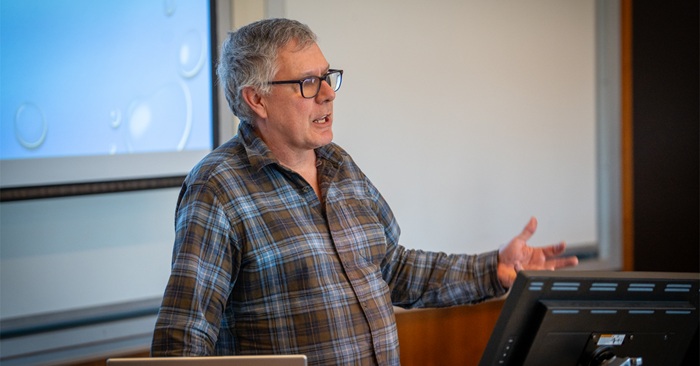
(Photo above) Paul Martin speaking to students
The mindset to lead
Beyond frameworks and cases, Raynor said he hopes the course helps students develop the mindset needed to lead through uncertainty.
“Hope can leave you disappointed. A more productive mindset is courage and commitment,” he said.
He encourages students to see transformation as a layered process – from pilot projects to viable businesses to broader industry change.
For Kinsey, that perspective has already stuck.
“The course taught me to think more deeply about the systems and incentives shaping real-world challenges, and those lessons will stay with me long after graduation,” he said.