Finance and social impact are often treated as opposites. This year’s Leading Critical Issues Challenge, an annual case competition built around unresolved business problems, asked Ivey MBA students to test that assumption by examining how finance can help move money toward some of society’s hardest problems, from underserved communities to cleaner transportation.
Held September 2-4, the Challenge asked the students to use systems thinking to examine one of two business cases. Section 1 teams explored how Calvert Impact could respond to growing concerns and confusion around sustainable investing among brokers, advisors, and asset managers. Section 2 teams examined how Avondale Private Capital could address operational and reliability challenges in the EV charging market. Working in teams, the students developed recommendations before presenting their ideas to a panel of judges. The top teams from each case then advanced to a final round, where one winner was named for each case.
Looking beyond the immediate problem
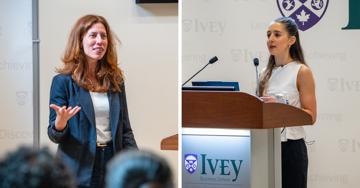
Before tackling their cases, the students were introduced to systems thinking in a session with Patricia Hein, assistant professor of sustainability, who led this year’s Challenge. The approach asks problem-solvers to look beyond the immediate issue and consider the broader system in which it exists.
"One of the key things I hope students take away from the critical issues competition is the ability to zoom out before zooming in," said Hein. "We often feel more inclined to focus on one component of a complex problem and jump straight to conclusions. But we often forget to try to understand the larger system first that the organization operates in. Engaging in this broader way of thinking can help us to generate better ideas and to develop an action plan that can have clear impact when addressing a complex challenge."
On Day 2, the two case protagonists spoke directly with the students about the challenges their organizations are facing.
Keeping capital moving
Derek Strocher, CFO of Calvert Impact, introduced the students to the organization’s role as an intermediary between capital markets and communities and projects seeking investment.
Founded on the belief that capital markets should be accessible to underserved communities, Calvert Impact pioneered a way for average retail investors – not just wealthy ones – to channel their money into opportunities including affordable housing, microfinance, and renewable energy.
Strocher told the students the central risk facing Calvert Impact is not a lack of demand for the kinds of projects it supports, but confusion among the brokers, advisors, and asset managers who connect investors with products. He described how recent court decisions, regulatory changes, and public debate have contributed to uncertainty, which in turn slows the flow of capital to projects and communities that need it.
He challenged the students to think creatively about how Calvert Impact could cut through that confusion and help advisors and asset managers feel confident recommending its products.
Strocher said his career in finance and impact investing had convinced him that environmental and financial considerations do not have to be in opposition.
“What was the right decision for the environment and what was the right decision financially could actually be the same thing,” he said.
Building trust in electric vehicle infrastructure
The second case focused on a different challenge within the energy transition.
Greg Donovan, HBA ’08, founder of Avondale Private Capital, introduced the students to Avonhead Electric, an Avondale subsidiary focused on financing and insuring electric vehicle (EV) infrastructure. He described how a microfinance project in Ghana during his HBA program helped spark his early interest in using finance to solve practical problems – a theme that has continued through his career.
Avondale’s broader mission is to help increase the flow of institutional capital into the real economy and the energy transition. Donovan described the firm as an intermediary that works to understand the barriers slowing capital deployment, then develop financial and insurance solutions to address them.
The case centred on how the unreliability of EV chargers has become a barrier to investment and adoption. He explained that poor installation, equipment failures, and software integration issues can leave chargers inoperable, undermining confidence among building owners, municipalities, investors, and consumers. Avonhead is developing a warranty program intended to address those concerns, but the company is now considering how to build and scale the program effectively.
Donovan encouraged the students to dig into the risks surrounding emerging asset classes and think about how those risks could be addressed to make investments more viable. For Avonhead, the issue ultimately came down to reliability.
“If you install a charging station, it better work, right?” he said.
Congratulations to the winners
Calvert Impact Case winner: Team 4 (Ev Cook, Iqbal Badruddin Jamal, Joseph Mardini, Daniel Priezjev, Laila Saili, Akul Wadhawan, and Yu Zhou)
Avondale Private Capital Case winner: Team 5 (Hieu Duong, Mayura Pamidimukkala, Jiamin Ren, Michelle Rodriguez de Paz, Matthew Tewkesbury, and Kevin Wong)
Thank you to the judges
The Challenge was evaluated by judges from Ivey faculty, alumni, and the broader business community:
- Diane-Laure Arjaliès;
- Valen Boyd, Ivey PhD candidate;
- Charlene Currie, EMBA ’12;
- Vinicio Di Iorio, postdoctoral research associate;
- Shamsa Hidayat, MBA ’22;
- Rob Klassen, MBA ’89;
- Jamil Kolachi, MBA ’19;
- Jimmy Lam, MBA ’22;
- Adam McEniry, MBA ’05;
- Michael Raynor, MBA ’94;
- Stephanie Ruegger, Ivey PhD candidate; and,
- Liza Straker, MBA ’95.
Related Articles