Overview
Malawi
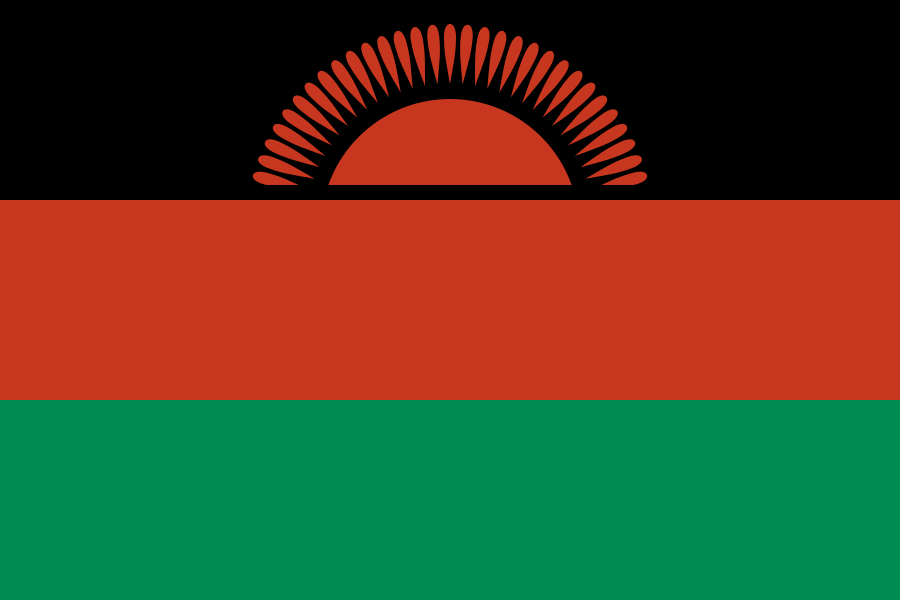 Malawi lies along the East African Rift Valley in southeastern Africa, between Zambia, Tanzania, and Mozambique. It covers about 118,500 km² and has about 22.2 million people. Lilongwe is the capital. Lake Malawi, which accounts for more than one-fifth of the country’s area, runs along most of the eastern border. Highlands and plateaus rise on either side of the rift, and the Mulanje Massif in the south reaches about 3,000 m. Britain established a protectorate over the territory in 1891, later named Nyasaland, and from 1953 to 1963 it formed part of the Federation of Rhodesia and Nyasaland. Malawi gained independence in 1964 under Hastings Banda, whose one-party rule lasted until multiparty elections in 1994. Malawi is a presidential republic. The next general election is due in 2030. Lake Malawi is estimated to hold up to 1,000 fish species, more than any other lake in the world, and nearly all are found nowhere else. English is the official language, and Chichewa is widely spoken. Christianity is the predominant religion, and Islam is a significant minority.
Malawi is a low-income country whose economy depends heavily on agriculture. Tobacco accounts for more than half of merchandise export earnings, and tea and sugar are other main exports. Agriculture employs about 65% of the workforce. In 2025, Malawi’s GDP per capita was approximately US$672, and real GDP grew by 1.9%.
Source: World Bank. (2026). World Development Indicators, from https://data.worldbank.org/country/malawi
Institutions
Institutions with at least one Faculty Member Registered with Ivey Publishing
- Malawi College of Accountancy
- Catholic University of Malawi
- Mzuzu University
- University of Livingstonia
- University of Malawi
- Lilongwe University of Agriculture and Natural Resources
- Malawi University of Science and Technology
- Malawi University of Business and Applied Sciences
- Blantyre International University
- Millennium University
- DMI-St John the Baptist University
- University of Blantyre Synod
Source: Ivey Publishing. 39C Accounts by Country. Provided by Adrianna Gleam-Fossaceca, Ivey Publishing, August 11, 2026.
Cases
Ivey-Copyrighted Cases in or involving Malawi
Ivey Publishing and the 39 Country Initiative welcome additional case submissions that deepen understanding of Malawi’s businesses, institutions, industries, and broader economic and social context.
| Case | Authors | Published / Revised | Product Number | Pages |
|---|---|---|---|---|
| Tackling the Elephant in the Room: Sustainability Under Strain | Tulsi Jayakumar | Jun 26, 2026 | W49384 | 16 |
| Sunrise Power: Charting Growth in Unexplored Areas | Sanjeev Kumar Prasad | Jun 26, 2017 | 9B17M093_P | 14 |
| Malawi Business Action Against Corruption | Oonagh Fitzgerald, James Ng’ombe | Oct 4, 2007 | 9B07M037 | 18 |
| Where Have You Been? An Exercise to Assess Your Exposure to the Rest of the World’s Peoples | Paul W. Beamish | Nov 27, 2025 | W48085 | 11 |
Source: Ivey Publishing. Retrieved October 23, 2026, from https://www.iveypublishing.ca/s/
Workshops
Workshops Provided to Institutions in Malawi
The 39 Country Initiative’s most substantial outreach to date has centered on faculty development through in-person case-teaching workshops. The first workshop in Malawi took place on October 17, 2025, in Limbe. David Sharp, Professor Emeritus of Managerial Accounting at Ivey, led a case-teaching workshop at
− Malawi University of Science and Technology.
Photos from the workshop can be found at https://www.ivey.uwo.ca/39country/news/2025/10/malawi/.
The workshop was attended by faculty members and students from the university’s business faculty. Following the workshop, Bennett Kankuzi, Associate Professor and Head of the Department of Computer Science and Information Technology at the Malawi University of Science and Technology, described the content as eye-opening and noted faculty interest in adopting the case method. Opportunities remain to extend this engagement and reach a wider number of institutions in Malawi.