Overview
Senegal
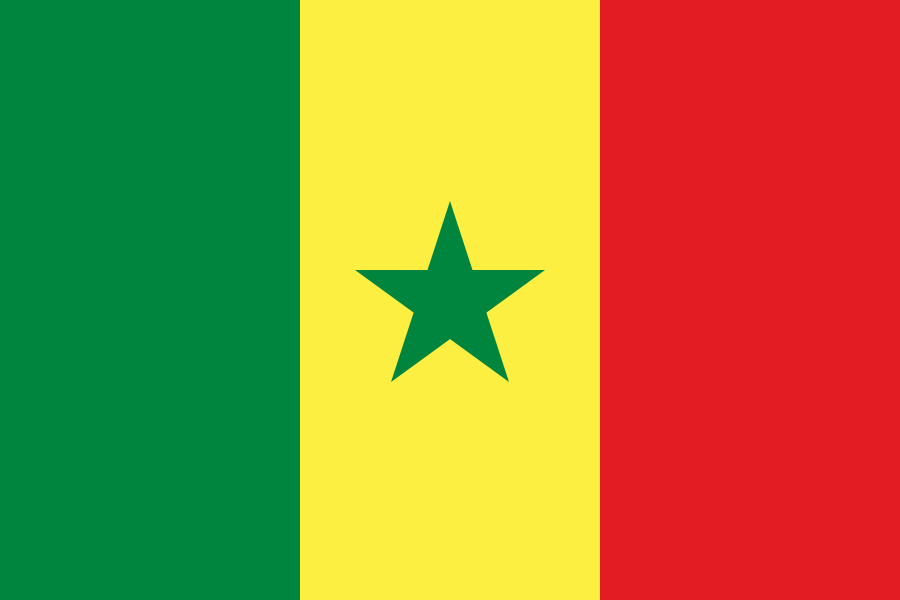 Senegal is the westernmost country on the African mainland. It lies on the Atlantic coast and borders Mauritania, Mali, Guinea, and Guinea-Bissau, while The Gambia forms a narrow enclave along the Gambia River that nearly divides Senegal in two. It covers about 196,700 km² and has about 18.9 million people. Dakar, the capital and largest city, sits on the Cap-Vert peninsula. The land is mostly low-lying: the semi-arid Sahel covers the north, where the Senegal River forms the border with Mauritania, while wetter savanna and forest cover the southern Casamance region. Senegal gained independence from France in 1960 and is a presidential republic that has never experienced a military coup. Senegal is a lower-middle-income country. Oil production from the offshore Sangomar field began in 2024, and exports of liquefied natural gas from the Greater Tortue Ahmeyim field, shared with Mauritania, began in 2025; gold is another major export. Agriculture employs about 30% of the workforce. In 2025, Senegal’s GDP per capita was approximately US$1,955, and real GDP grew by 6.7%.
Source: World Bank. (2026). World Development Indicators, from https://data.worldbank.org/country/senegal
Institutions
Institutions with at least one Faculty Member Registered with Ivey Publishing
- BEM Dakar Bordeaux Management School
- Centre Africain d’Études Supérieures en Gestion
- Centre d’Étude Régional pour l’Amélioration de l’Adaptation à la Sécheresse
- Cheikh Anta Diop University
- Institut Supérieur de Management
- International School of Management Dakar
- University Gaston Berger of Saint-Louis
- University of the Sahel
- Université Alioune Diop de Bambey
Source: Ivey Publishing. 39C Accounts by Country. Provided by Adrianna Gleam-Fossaceca, Ivey Publishing, August 11, 2026.
Cases
Ivey-Copyrighted Cases in or involving Senegal
Ivey Publishing and the 39 Country Initiative welcome additional case submissions that deepen understanding of Senegal’s businesses, institutions, industries, and broader economic and social context.
| Case | Authors | Published / Revised | Product Number | Pages |
|---|---|---|---|---|
| Haumana Bars: Navigating Social Entrepreneurship | Natalia Aguilar Delgado, Alexia Pittarelli, Sidi Ba | Oct 20, 2025 | W43610 | 12 |
| Where Have You Been? An Exercise to Assess Your Exposure to the Rest of the World’s Peoples | Paul W. Beamish | Nov 27, 2025 | W48085 | 11 |
| Technologies Ecofixe: Green Wastewater Treatment for Africa | Roxanne Lavoie-Drapeau, Gwyneth Edwards | May 5, 2020 | 9B20M079 | 14 |
| City Water Tanzania (A): Water Partnerships for Dar es Salaam | Oana Branzei, Kevin McKague | Jun 15, 2007 | 9B07M025 | 17 |
| City Water Tanzania (B): Privatizing Dar es Salaam’s Water Utility | Oana Branzei, Kevin McKague | Jun 15, 2007 | 9B07M026 | 6 |
| City Water Tanzania (C): The Private Sector Experiment | Oana Branzei, Kevin McKague | Jun 15, 2007 | 9B07M027A | 3 |
| City Water Tanzania (C): Striking a Deal | Oana Branzei, Kevin McKague | Jun 15, 2007 | 9B07M027B | 4 |
| City Water Tanzania (D): Things Fall Apart | Oana Branzei, Kevin McKague | Jun 15, 2007 | 9B07M028 | 6 |
Source: Ivey Publishing. Retrieved October 24, 2026, from https://www.iveypublishing.ca/s/
Workshops
Workshops Provided to Institutions in Senegal
The 39 Country Initiative’s most substantial outreach to date has centered on faculty development through in-person case-teaching workshops. The first workshop in Senegal took place in December 2019. Elie Chrysostome, Professor of International Business at Ivey, led a French-language case-teaching workshop at
− BEM Dakar.
Photos from the workshop can be found at https://www.ivey.uwo.ca/news/news-ivey/2020/february/ivey-case-teaching-workshops-improving-business-education-in-africa/.
Following the workshop, Ahmadou Diakhate, Director of Initial Programs and Accreditations at BEM Dakar, said it fostered collaboration among faculty and gave students access to cases in French. Opportunities remain to expand this engagement and reach more institutions in Senegal.