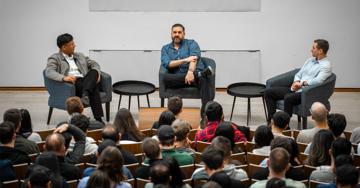
Inside a Career Management Essentials class at Ivey Business School, MBA students are being asked to imagine three versions of their future.
Not one preferred path with two backup plans. Three real possibilities, each worth exploring.
One builds on the path they are already on. Another asks what they would do if that path disappeared. A third asks what they might pursue if constraints like money, reputation, or other people’s expectations didn’t matter.
For many students, that third version is the hardest to say out loud.
But that hesitation is part of the point. The exercise focuses on reflection rather than choosing a path. The goal is to help students see what sits underneath their choices: what they value, what they’re drawn to, what they’re afraid to consider, and what possibilities they may have ruled out too quickly.
For Ivey’s Career Management team, that kind of reflection has always been central to career development. But in a job market increasingly shaped by artificial intelligence (AI), it’s taking on new importance.
“Anyone can now use AI to put together a polished resumé, tailor a cover letter, or prep for an interview in minutes. That means strong materials aren't the differentiator they used to be,” said Jennifer Baytor, Director, Career Management Coaching and Programming. “The real work moving forward is figuring out what you actually offer, where you can add value, and then telling that story in a way that feels specific and true to you.”
That’s the work Ivey’s Career Management team is trying to deepen through a new AI career agent pilot with the MBA ’27 cohort.
Seeing more than one possible future
The three-versions exercise is based on Odyssey planning, a framework from Designing Your Life by Stanford professors Bill Burnett and Dave Evans. It asks students to imagine multiple futures, including one that may feel less conventional or practical.
In the process students are asked to consider all three versions of the future seriously enough to learn from them.
For MBA ’27 candidate Bella Anwan, the exercise connected her career ideas to her lived experience. Originally from Nigeria, she had seen firsthand the gap in access to resources between major cities and smaller communities. That experience shaped how she thinks about impact and the kind of work she wants to do.
Her three paths included returning to consulting and working at an early-stage startup. But the version shaped by the fewest constraints connected most directly to that earlier experience: travelling to underserved communities to help develop solutions.
“I thought it was achievable … but maybe not in the short term,” she said.
After hearing feedback from her peers, the idea began to feel more feasible.
“I really enjoy helping people and organizations become better,” she said.
Watch below how MBA students are using a new AI career agent to explore multiple paths – and what it looks like in practice.
Other students described a similar shift.
“It involves a lot of reflection on who I am, what my goals are, what I want to do at work,” said MBA ’27 candidate Tanya Singh. “Initially, my thoughts were really scattered, and now they have come together into a story.”
That movement from scattered thinking to a more coherent story is the work Ivey’s career curriculum is designed to support. Across Career Management Essentials classes, coaching conversations, networking, and recruiting preparation, students generate a great deal of insight about themselves. The challenge is helping them hold onto those insights and use them when they’re making real decisions.
That is where the AI career agent comes in.
Making reflection easier to carry forward
Across their Career Management Essentials classes, students use an AI-enabled tool to capture their reflections as they develop. The tool, co-developed with James Kruck, Learning Experience Designer with Ivey’s EdTech team, asks students to record their thinking on a multitude of questions, for example:
What does success mean to you? What are you unwilling to lose in pursuit of it?
What strengths would you be disappointed not to use in your work?
What scope of impact motivates you? What kinds of challenges do you want to work on?
When they’re ready, those reflections are used to generate a personalized career agent of their own, shaped by both the students' inputs and the coaching principles the Career Management team uses with students.
The agent is not designed to make career decisions for them. It is designed to help make earlier reflection usable.
A student can return to the agent while preparing for a networking conversation, thinking through a role, revising a resumé, or trying to understand why a particular path does or does not feel right. It can help surface patterns, connect experiences to possible directions, and point students toward options they may not have known to consider.
In that sense, the agent is less a shortcut than a way of keeping the deeper work in view.
“Students bring such a wealth of experiences into the program,” said Alex Elias, Associate Director, Career Coaching. “Our classes help them actually see all of that clearly before they’re in recruiting mode, instead of trying to figure it from moment to moment. The agent just gives them a way to carry that work forward outside the classroom.”
That portability matters because career insight is often developed in one moment and needed in another. A student may name an important value in class, recognize a strength in a coaching conversation, or hear something in a networking meeting that changes how they understand an industry. But when the pressure of recruiting arrives, it is easy to default to what’s familiar, visible, or expected.
The agent gives students a way to return to what they have already learned about themselves.
Using AI to make the human work deeper
The pilot also reflects a broader question facing business schools and career teams: what should AI do in the career development process, and what should remain human?
For Ivey’s Career Management team, the answer is not to use AI to replace coaching. It is to use AI to support the parts of career development that help students arrive at coaching conversations with more clarity, more language, and more material to work with.
“AI is changing how students apply for jobs, and a lot of it is making candidates sound the same,” said Baytor. “What we want is the opposite. We want students to show up with a clearer understanding of their strengths, what they care about, and the story they are trying to tell. The tool is there to support that work, not smooth away what makes each student distinct.”
When AI can help students organize their thinking, identify patterns, and revisit earlier reflections, coaches can spend more time on the work that requires human judgment: helping students interpret what they are seeing, sit with uncertainty, make tradeoffs, and decide what a choice means for them.
“The harder conversations. The moments of doubt. The decisions that don’t have a clean answer, but instead invite more questions,” Baytor said. “That’s where coaching matters most, and that’s where we want our team focused.”
Elias describes the role of AI in similar terms.
“AI gets to be the ally,” he said. “And then as coaches, we get to deepen and make more meaning of those conversations that AI can’t handle.”
It is a different way of thinking about technology in career development. Rather than treating AI as a tool for producing faster applications, the pilot uses it to help students carry self-knowledge into the moments when it matters most.
Choosing with more of themselves in the decision
The shift is already changing how some students think about their futures.
“I really thought I knew what I wanted to do, but I could see there were different things I wanted to explore,” said MBA ’27 candidate Fisayo Adeyemi. “I care more about the impact I want to make, and not just about making money.”
That kind of clarity matters in any job market. In one increasingly shaped by AI, it may matter even more.
As application materials become easier to generate, students need more than polished language. They need to understand what they are trying to say. They need to know which opportunities fit, which ones stretch them in the right ways, and which ones pull them away from what matters most. They need to be able to tell a story that is not only well written, but true.
For Ivey’s Career Management team, that’s the larger purpose of the pilot. The goal is not to point students toward a single path or give them a more efficient way to apply for jobs. It is to help them see more possibilities, take more of those possibilities seriously, and make decisions with a clearer sense of who they are and where they might contribute.
“When you’re dealing with complexity, sometimes the easiest answer is to go back to what’s familiar,” Baytor said. “We don’t want students to do that. They are the future leaders of this world, and we want them to feel like they have a sense of how they might uniquely be positioned to tackle the challenges ahead.”
In an AI-shaped job market, Ivey’s Career Management team is teaching students that self-understanding can be the key to standing out.