When Edward Rogers, Executive Chair of Rogers Communications, reflected on what separates winning teams from the rest, his answer was simple – and familiar to the students in the audience: culture.
Speaking during the keynote panel with longtime sports broadcaster Paul Jones, Rogers emphasized that sustainable success in sport is built through collaboration and trust.
“Our president, CEO Mark Shapiro, has always been adamant that culture matters,” he said. “Most people don’t know what it means, but it does matter.”
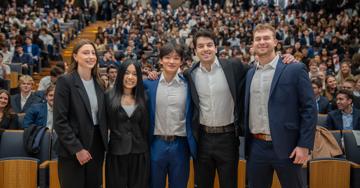
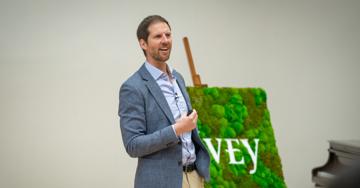
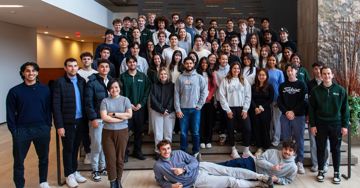
That idea – that leadership principles travel seamlessly between sport and business – framed the 2026 Ivey Sports Leadership Conference, held January 23–24 at Ivey Business School. With the theme Fueling the Next Generation: The Leaders of Tomorrow, the student-run conference brought together industry leaders, alumni, and students to examine how sport is evolving and how future leaders can shape the industry.
Across two days, the conference explored leadership in sport across the talent pipeline, corporate partnerships, venue innovation, and Canada’s growing role on the global stage ahead of the 2026 FIFA World Cup. The conference opened with remarks from Ivey Dean Julian Birkinshaw, while Western University President and Vice-Chancellor Alan Shepard introduced the closing keynote. Organized by a student executive team led by conference co-chairs Oliver Rebanks and Matt Rosati, both HBA ’26, the event connected students directly with industry leaders and featured a record-breaking case competition.
Culture, leadership, and long-term success
The conference culminated with the keynote session featuring Rogers and Jones – both Western University graduates – who discussed the future of Toronto sports and what sustainable success looks like behind the scenes.
Reflecting on the Toronto Blue Jays’ recent World Series run, Rogers emphasized the importance of people.
He also stressed the importance of staying the course and avoiding constant changes to players or strategy, particularly when external pressure mounts.
“In sports, when you have a bad season, there’s a lot of pressure. Someone has to be cut. We’ve got to change something,” he said. “But if you switch gears every year or two and collapse to the external pressure, it won’t work.”
Rogers pointed to player development as an example of how culture and long-term thinking intersect, citing Blue Jays catcher Alejandro Kirk as a long-shot prospect who later became a key contributor.
“It’s easy to pick a superstar,” he said. “But the true winners in sports are the development side – the scouting side – growing talent.”
Reflecting on his early career, including working alongside his father, Ted Rogers, he emphasized the value of exposure to different roles.
“There’s no job too small,” he said. “Getting as many perspectives as you can is immensely helpful.”
Alumni perspectives on leadership
Leadership pathways were also explored during the alumni panel, From Western to the Big Leagues. The session featured Western graduates Lisa Ferkul, Todd Humphrey, and Christine Simpson, alongside Ivey alum John Chayka, HBA ’14.
Moderated by Simpson, a features reporter with Amazon Prime Monday Night Hockey, the conversation focused on the non-linear paths that led each panellist from the classroom to senior roles across professional sport, media, and global entertainment.
For Chayka, who co-founded a hockey analytics company while still a student at Ivey before becoming general manager of the Arizona Coyotes, the foundation built through the HBA program continues to shape how he approaches leadership and decision-making. He now runs JKC Restaurants and JKC Capital with his wife, Kathryn Chayka, HBA ’14.
“Making decisions under pressure, being able to slow your heart rate down when things are moving fast – having a really sound decision-making process in those situations – those Ivey trainings, for me, really resonate,” he said.
While Chayka focused on decision-making in high-stakes environments, Humphrey, Founder, Highmark Sports Group, discussed the importance of resilience and relationships over the course of a career.
“Two words pop out for me: relationships and grit,” he said. “Building meaningful, longer-term relationships, and not being transactional, matters over the long run.”
Ferkul, Chief Revenue Officer with Toronto Tempo, highlighted the importance of reliability and execution early in one’s career.
“I have a saying that came from my time at the bank: be essential,” she said. “Every time I was given a task, no task was too big or too small, and I executed with excellence.”
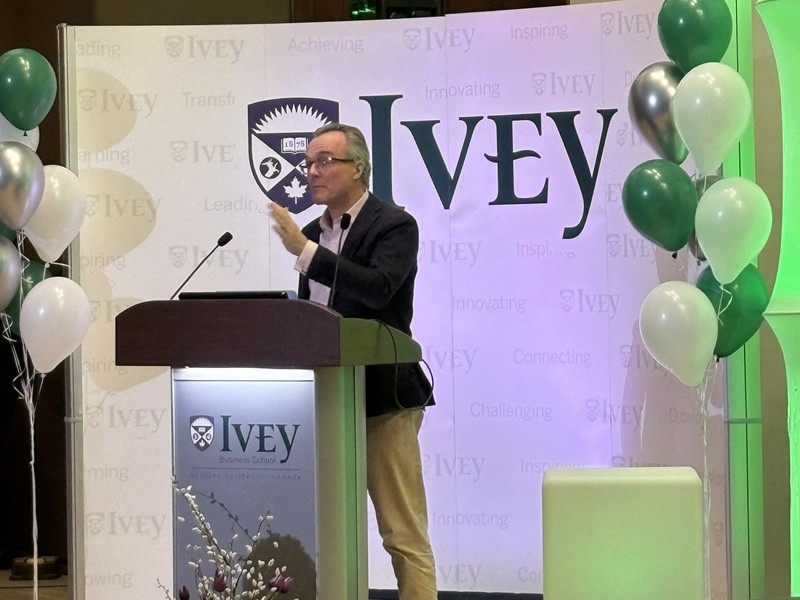
(Photo above) Julian Birkinshaw at the Ivey Sports Leadership Conference
Canada and the 2026 FIFA World Cup
A session on planning the 2026 FIFA World Cup explored what it means for Canada to host the world’s largest sporting event.
Dwayne De Rosario, former Canadian professional soccer player and now FIFA Ambassador, and Sandra Gage, executive director of commercial operations for FIFA World Cup 2026, spoke about the opportunity the event represents for the country and its communities.
“It’s going to be the greatest show on Earth,” said Gage. “This is something that really can unite the country.”
De Rosario highlighted how hosting the World Cup reflects the growth of soccer in Canada and the opportunity to showcase that progress on a global stage.
“My goal has always been to prove to the world that we do have soccer players here, and we do have talent,” he said. “We’re now seeing that come full circle.”
Jones made a similar point during the keynote discussion, noting that while attracting top talent to Canada was once seen as a challenge, athletes across leagues now increasingly view cities like Toronto as premier destinations.
Looking ahead
As the conference closed, Rogers returned to the idea that leadership is ultimately measured by the people it develops.
“Your legacy as a leader is how many leaders you leave behind,” he said. “Always be on the lookout for talent. Never judge a book by its cover – and you’ll find some real gems.”
The Ivey Sports Leadership Conference (ISLC) is co-founded by the Chayka Family and Golf Canada, including Ivey alumni leaders such as Laurence Applebaum, HBA ’94, and John and Kathryn Chayka, HBA ’14, alongside the support of numerous corporate partners. ISLC 2026 was presented in partnership with Ivey Executive Education, TD, and Rogers Sports & Media.
Related Articles