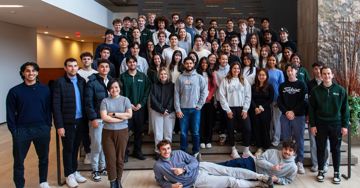
Ivey’s HBA1 students put theory into action during the Winter Case Competition, applying strategic analysis, judgment, and teamwork to complex, real-world challenges – including how future business leaders can navigate competition, public trust, and policy in Canada’s evolving economy.
The competition, which ran January 7-9, challenged student teams to respond to two demanding cases over multiple rounds. Four finalist teams advanced to present their recommendations to a panel of faculty and executive judges.
Round one: values, partnerships, and public trust in the non-profit sector
In the opening round, student teams stepped into the role of external strategic advisers to the Heart and Stroke Foundation, examining how the organization could evolve its corporate partnership strategy without compromising public trust or mission alignment. Teams were evaluated on their ability to balance revenue sustainability, transparency, and long-term social impact.
Finding purpose through impact
At the competition kick-off, Melanie Rodriguez, HBA ’14, vice-president of corporate philanthropy and partnerships at the Heart and Stroke Foundation of Canada and the executive featured in the opening-round case, addressed the students. She encouraged them to see the competition as an opportunity to explore how their business skills translate into the non-profit sector.
“More and more not-for-profits are looking to business leaders to join them, to enhance their ability and reach and their impact,” she said, noting that teams’ recommendations would be shared with the Foundation’s leadership and could help inform future partnership decisions.
Rodriguez also spoke about the complexity of partnership decisions in the non-profit sector, where leaders must balance long-term revenue goals with organizational values and public trust as corporate–non-profit relationships continue to evolve.
Round two: competition policy and market power in Canada
In the second round, teams tackled a case examining competition policy, market dominance, and innovation in Canada’s digital economy. Students were asked to analyze the implications of private enforcement under Canada’s Competition Act and consider how regulatory decisions shape fairness, consumer choice, and technological progress.
Together, the two cases challenged students to think not only about strategy and performance, but also about the broader responsibilities of organizations operating in complex economic and social systems.
As the finalist teams prepared to present, Matthew Sooy, HBA Faculty Director, opened the final round by acknowledging the challenge of the case and encouraging students to embrace the complexity of issues where business, policy, and technology are evolving in real time. He said the day offered a rare opportunity for students to engage directly with leaders actively shaping those conversations.
Embracing competition as future business leaders
Students then heard from Matthew Boswell, former Commissioner of Competition, Competition Bureau of Canada, who spoke about the critical role competition plays in driving innovation, productivity, and consumer choice in Canada. Boswell said Canada has historically tolerated high levels of market concentration – to the detriment of economic growth – and emphasized that competition is a foundational pillar of a healthy capitalist economy.
“Fundamentally, Canada needs more competition, and the lack of competition hurts our economy overall,” he said.
Boswell encouraged the students, as future business leaders, to view competition not as a constraint, but as a force that strengthens markets and organizations when pursued responsibly and within clear legal guardrails.
“You should embrace the challenge of vigorous competition and recognize that it is a fundamental pillar of a well-functioning capitalist economy,” he said.
The final stage
Finalist teams then presented their recommendations to a panel of faculty and senior leaders from the Competition Bureau of Canada, including Boswell. Other final-round judges included:
- Brandon Schaufele, director of the Ivey Energy Policy and Management Centre and an associate professor of business, economics, and public policy at Ivey;
- Sharon Burnett, senior advisor to the Commissioner of Competition, Competition Bureau of Canada; and,
- Mike Hollingworth, deputy commissioner of the Competition Promotion Branch, Competition Bureau of Canada.
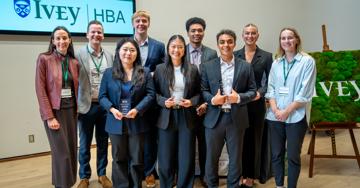
Congratulations to the winning team
Section 3 Team 3
- Olivia Buston;
- James Dowd;
- Melissa Huang;
- Calvin Luo;
- Evangella Schloo; and,
- Colin Weth.
Related Articles