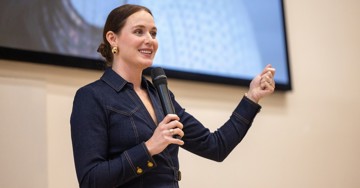
During his keynote address, performance psychologist Daniel Lerner asked Ivey’s HBA students if they had ever felt stressed in the past few months – and nearly every hand went up. But when he followed with a second question – who would willingly choose a stressful day tomorrow – the room fell quiet, and no hands were raised.
That response, though common, is both flawed and limiting, said Lerner, a strengths-based performance coach who has worked with elite performers ranging from musicians to athletes.
Speaking at Ivey’s 2026 HBA Character Leadership and Resilience Conference, hosted by the Ian O. Ihnatowycz Institute for Leadership, Lerner challenged the assumption that stress is something to manage or eliminate. Instead, he argued that stress can enhance performance and is often a prerequisite for meaningful growth.
Moments that shape people most – such as learning a new skill, pushing through uncertainty, or navigating transition – are rarely comfortable, Lerner said, encouraging the students to harness stress as their superpower.
“You are not stressed out about something that doesn’t matter to you,” he said.
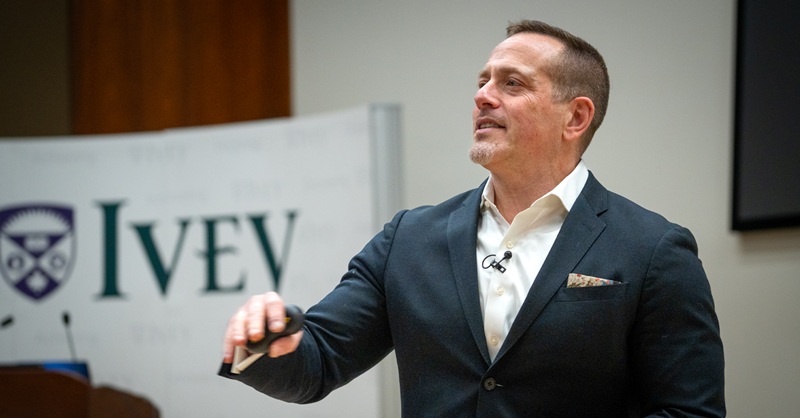
(Photo above) Daniel Lerner speaking to HBA students
From stress to growth
The annual conference focuses on character and resilience, encouraging HBA students to think about leadership, judgment, and integrity under pressure. Through the event’s activities, students explored how to cultivate resilience and courage in their everyday lives, empower and support others around them, and identify opportunities in their own leader character development through taking the Leader Character Insight Assessment.
Later in the day, closing keynote speaker and Olympic rower Jeremiah Brown brought those ideas to life through his own experience, sharing how he overcame doubt and committed himself to an audacious goal: earning a spot on the Canadian men’s eight rowing team despite never having rowed before.
Brown was working in finance when he happened to watch the men’s eight race at the Beijing Olympics – a moment that prompted him to ask what might be possible if he committed to a challenge that demanded everything he had to give. On his first day in a boat, Brown said he fell into the water repeatedly – a humbling starting point for someone who would become an Olympic medallist just four years later.
“Your potential has to be pulled out of you,” he said. “You have to ask yourself who you might be if you actually push yourself.”
Between the two keynote sessions, students participated in a faculty-led Invictus workshop that examined character, resilience, and leadership under adversity through clips from the film Invictus, which portray the actions and leadership of Nelson Mandela. The workshop reinforced the conference’s central message: that resilience and character leadership are not fixed traits, but capabilities developed through reflection, challenge, and commitment.
How mindset shapes performance
Lerner grounded this message in research from positive and performance psychology, describing how athletes, performers, soldiers, and students perform best when stress is viewed as enhancing rather than harmful.
“We tend to limit ourselves based on how we perceive something,” he said. “Calm doesn’t necessarily mean higher levels of performance, but reframing stress as excitement can make you more confident and resilient.”
Rather than trying to avoid or distract themselves from stress – strategies that can undermine performance over time – Lerner encouraged the students to work with it. He outlined three steps: acknowledge it – it is what it is; welcome it – you’re stressed because you care; and utilize it – stress is designed to enhance.
(Above) Watch a video interview with Daniel Lerner
Building resilience
While Lerner focused on how mindset shapes performance in the moment, Brown’s story illustrated what it takes to sustain effort over time.
He described the mental fortitude required to push through what he called “major exit points” in his four-year Olympic journey – moments when quitting felt logical and even reasonable. During those times, Brown said he committed to a time horizon rather than an outcome: a defined period during which he would stay, even if progress felt slow or uncertain.
“It’s not fake it until you make it. It’s do it until you are,” he said. “If you’re not prepared to give something real time, you’re not serious about what you say matters to you… You might feel like you’re holding on by a thread, but sometimes that’s exactly where you need to be in that moment of your goal arc.”
(Above) Watch a video interview with Jeremiah Brown
Beyond bouncing back
Discomfort, Brown said, is often part of building character – not something to rush past.
That broader understanding of resilience was introduced earlier in the day by Dusya Vera, PhD ’02, executive director of the Ian O. Ihnatowycz Institute for Leadership. In her opening remarks, she emphasized that resilience is not simply about bouncing back, but about growing through adversity without compromising one’s values.
“It’s the capacity to grow through adversity while maintaining your integrity,” she said.
Lerner also pointed to studies showing that performance improves under the right amount of stress – not too little, not too much – and that mindset can influence physical outcomes. In one experiment, participants performed better on tests simply by being told that the body’s stress response can improve performance. In another, people were able to read smaller letters – literally seeing better – when they were asked to imagine themselves as pilots in a flight simulator, a role that demands heightened perception.
Character is not built alone
In addition to mindset, Brown stressed the importance of surrounding yourself with people who believe in you. In rowing, he noted, eight athletes move as one – and no one succeeds alone.
“Your potential is found in others – your teammates, your coaches, the people who are willing to push you when you wouldn’t push yourself,” he said. “When someone believes in you, that’s rocket fuel.”
Brown closed by urging the students to think beyond short-term wins and consider what might be possible over the long run.
“You’re here to do something – to build a career, to build a competency,” he said. “And that takes years.”
He left the students with the lesson his Olympic journey taught him most clearly.
“You’re always more resilient than you can ever know,” he said. “It’s not about the result. It’s about getting through the journey.”
Related Articles