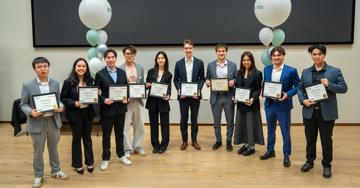
At Toronto's CIBC Square, Ivey's MSc in Management: Digital Management students closed out the Ivey Digital Innovation Studio (IDIS) doing exactly what it was designed for – tackling live CIBC challenges and pitching recommendations to industry leaders who may one day hire them.
The July 8 sprint also marked the fifth anniversary of the partnership between Ivey and one of Canada's largest banks. (For a deeper look at what the five-year partnership has produced, read the accompanying case study, Five Years of Digital Innovation with CIBC).
Working in 14 teams, the MSc students explored one of three strategic questions: how CIBC could build an innovative and adaptable culture in the artificial intelligence (AI) era, what untapped banking opportunities it should pursue, and which disruptive technologies or trends may be underappreciated by banks today.
Rachel Fernandes, Director, Enterprise Innovation, Global Technology, Data & AI at CIBC, said the themes mirrored real challenges CIBC is currently facing.
“Part of the reason why we love working with Ivey and with the students specifically is because they have a different perspective on the world from us,” she said. “Students or Gen Z – the way they interact with their banks, the way they interact with each other, how digital they are, their values when it comes to what makes them trust an organization – those are really important insights for us as well.”
David Colby, Senior Vice-President of Enterprise Technology at CIBC, said IDIS is a two-way exchange. The students gain experience solving real business problems while CIBC gets fresh ideas, new thinking, and a chance to identify future talent.
“Over the last five years, we have hired more than 13 of the students from this program into CIBC in either a full-time or contract role,” he said.
That hiring pipeline was on display at this year's event. Among the CIBC team members helping host the day was Emma Xie, MSc ’25, who participated in IDIS as a student last year and now works on CIBC’s Enterprise Innovation team.
James Maeng, Senior Director, Enterprise Innovation, Global Technology, Data & AI, at CIBC, said the partnership gives the bank perspectives it wouldn't get from internal conversations alone.
“This is hands down not only the most fun way, but the best way to actually see emerging trends and technologies come to life,” he said. “If you really want to know the impact of AI and emerging trends and technologies, I will show you a video of presentations from five years ago and then show you yours, and your mind will break.”
Maeng added that the students bring a rare mix of viewpoints – as current users of digital services, future clients, and outsiders not limited by how banks have traditionally framed the problem.
“We get to learn a lot about what we don’t know – and that's probably one of the most dangerous things that can happen when you stay inside your four walls,” he said.
Five years of growth
For Fernandes, the five-year mark is a chance to look back at how far the partnership has come.
“It's really special that it's already been five years,” she said. “I remember the first year. CIBC Square was so new, we were re-learning how to create in-person experiences and technology was growing at a pace we hadn't seen before. It's been really cool to see how the team has been able to evolve the program.”
Having former IDIS students like Xie on the team has changed how the bank designs the experience.
“Now she gets to build out the problem statement, and I would ask, ‘Emma, was this hard for you last year? Should we change this part?’ It’s good to have that real end-user feedback when we're building,” said Fernandes.
A three-sprint journey
The CIBC sprint is the most visible stage of IDIS, but it's also the last step in a longer three-sprint journey. Students first worked with one of four not-for-profits: Alzheimer Society Southwest Partners, United Way Elgin Middlesex, Youth Opportunities Unlimited, or Boys and Girls Club of London. In the second sprint, they worked with SAS or Southlake Health before applying their skills to enterprise-scale challenges with CIBC in the final sprint.
Matthew Josephson, an MSc ’26 candidate, said moving between organizations of different sizes was one of the most useful parts of the IDIS experience.
“The transition of smaller companies to bigger companies was really cool,” he said.
Fellow classmate Ruby Song said the mix of sectors helped her decide where she wants to go next.
“Across the whole session I got to see how different sectors work. I can know better where I wanted to go after this,” she said.
Working across three very different organizations also challenged students to spend more time understanding the problem before reaching for a solution.
Tiana Lee, an MSc ’26 candidate whose team won the New Banking Opportunities theme, said that was the biggest lesson from IDIS.
“The most critical part of doing these projects was describing the problem, and identifying the problem was key, instead of just throwing out a tech solution,” she said.
For fellow MSc student Subah Bhatia, whose team won the Enterprise AI Adoption theme for a guided AI workflow idea, the CIBC sprint was less about AI itself than about the people who would have to use it.
“Our challenge was a lot more about people, behaviour, culture, and systems more than it was about AI or technology, necessarily,” she said. “It was a very people-focused approach.”
Her teammate, Minelle Chowdry, said one of the hardest parts was resisting the obvious answer.
“We shouldn’t go after what we think the norm would be, rather, we should take more of a people’s approach,” she said.
(Video above) MSc students discuss the IDIS experience
From ideas to impact
Some of the connections built through IDIS are already extending past the sprint itself. Josephson said a group of MSc students is planning a fall fundraiser, called 5K4Good, to support the four not-for-profits from the first sprint. The run is expected to take place on October 3 in London, with proceeds intended to support the organizations and, potentially, help advance some of the ideas students proposed.
“We worked for these four different not-for-profits,” said Josephson. “We’ve just built AI solutions, but obviously these AI solutions cost money, so we could raise money, and that goes towards them, and to hopefully maybe implement some of our solutions that we gave them.”
For Warren Ritchie, MSc Faculty Director, those outcomes are exactly what IDIS is designed to achieve.
“I am impressed. I'm not surprised,” Ritchie told the cohort at the final awards ceremony. “I know what you can do in three weeks. Now you know what you can do in three weeks. You did it in sprint one, you did it in sprint two, and now you've done it again.”
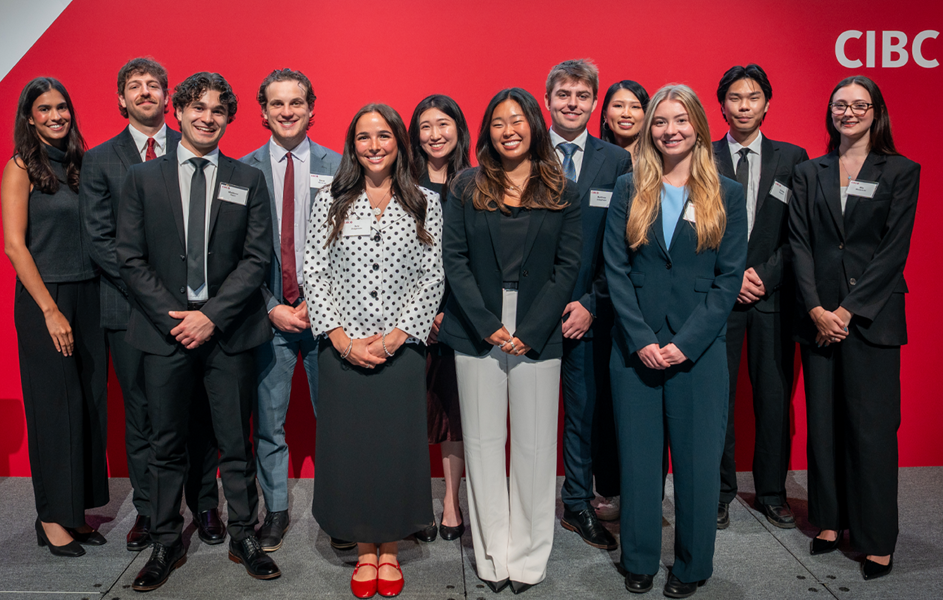
(Photo above) The 5K4Good team: Front row (l-r): Matthew Razvi, Ava Dlugolecki, Tiana Lee, Angela Cicurskis; Back row (l-r): Isabel Pogue, Nathan Moore, Drew Wawrow, Mimi Wang, Matthew Josephson, Sally Yan, Aidan Huynh, and Mia Morassutti (missing: Fares Fadl)
Congratulations to the IDIS winners
Congratulations to the three winning teams, one for each theme:
Enterprise AI adoption – Team 5: Subah Bhatia, Minelle Chowdry, Chloe Ha, Krystal Li, and Ziyi Wang
New banking opportunities – Team 6: Anthony Cao, Evan Hao, Shaamini Krishnan, Bo Wu, Chloe Zhang, and Angel Zheng
Upcoming disruption – Team 14: Aidan Huynh, Tiana Lee, Isabel Pogue, Rita Wen, and Eason Wu
View photos of the winners below
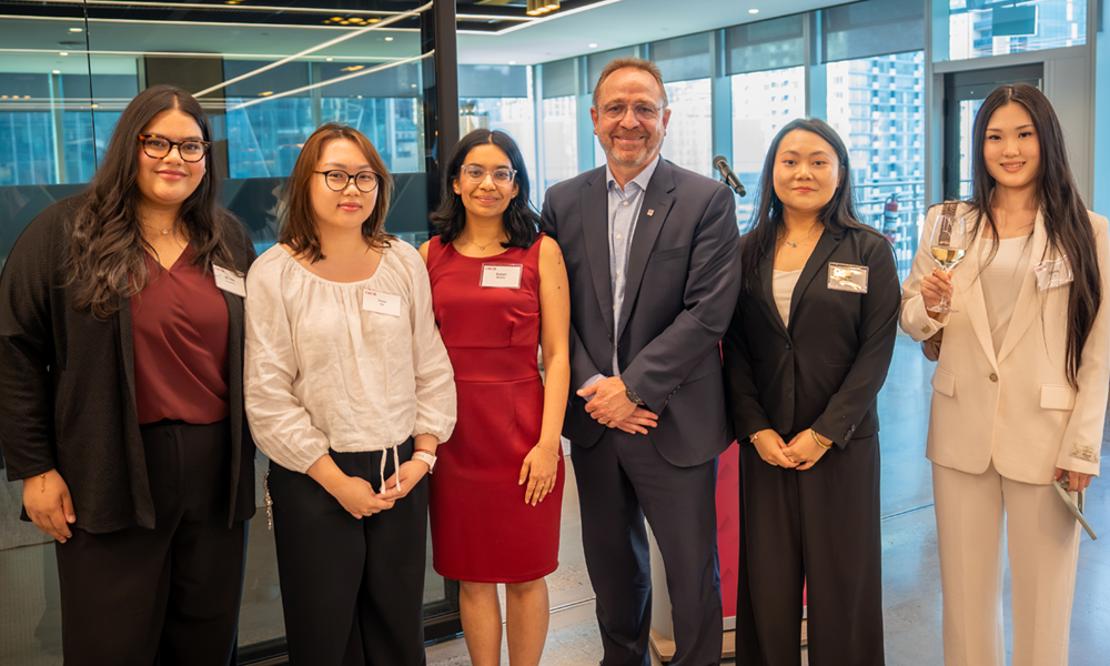
Team 5 with David Colby (l-r) Minelle Chowdry, Chloe Ha, Subah Bhatia, David Colby, Ziyi Wang, and Krystal Li
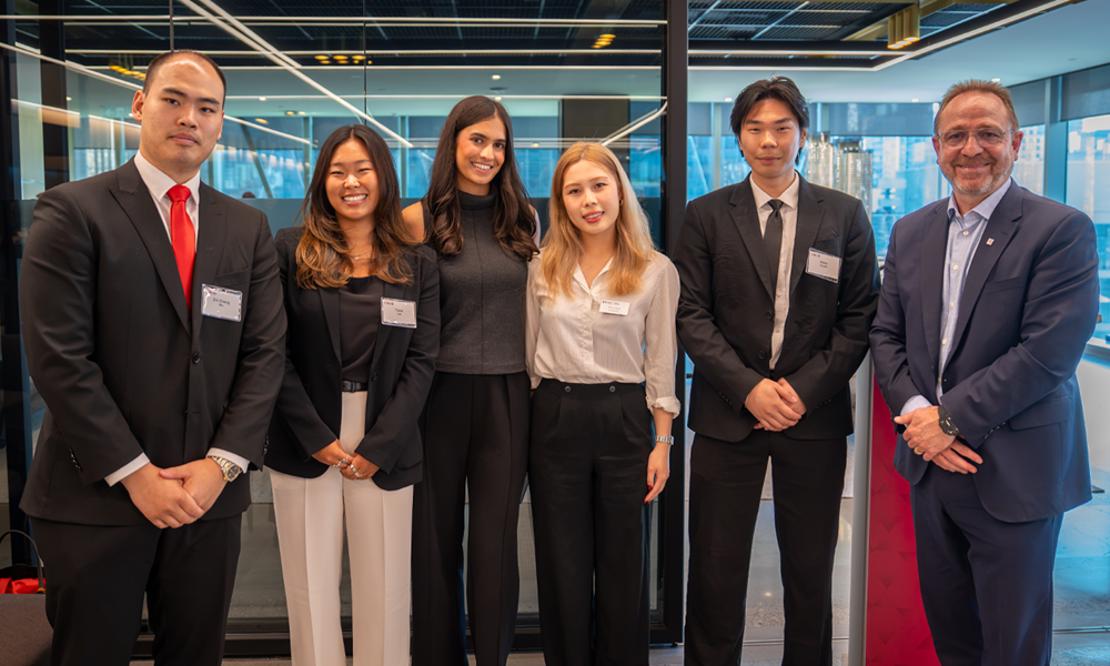
Team 14 with David Colby (l-r) Eason Wu, Tiana Lee, Isabel Pogue, Rita Wen, Aidan Huynh, and David Colby
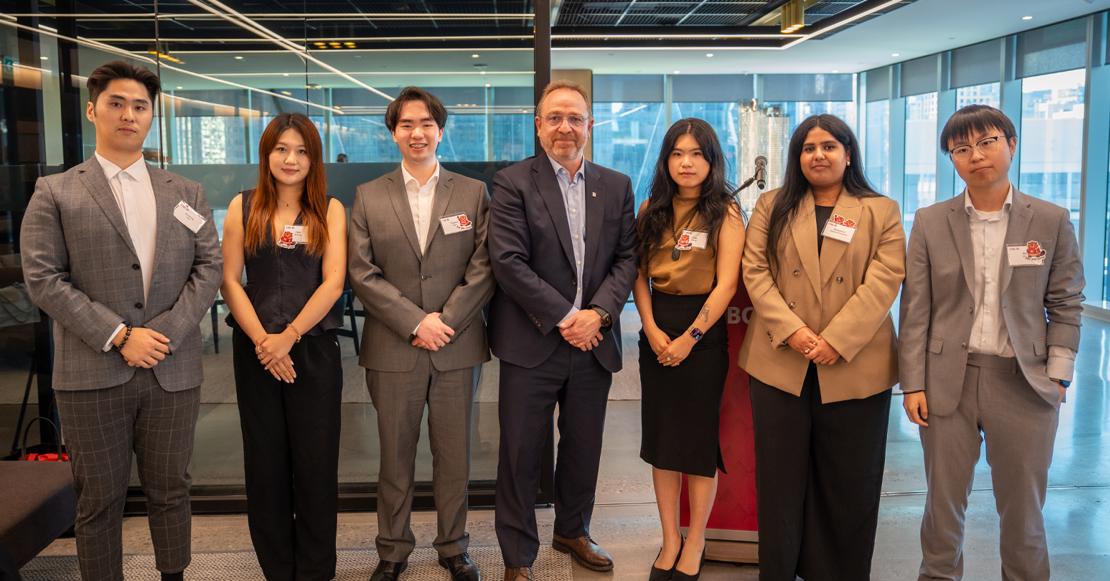
Team 6 with David Colby (l-r) Anthony Cao, Angel Zheng, Evan Hao, David Colby, Chloe Zhang, Shaamini Krishnan, and Bo Wu
Related Articles