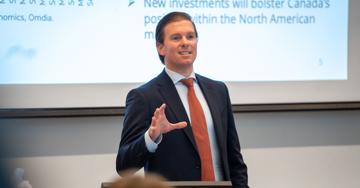
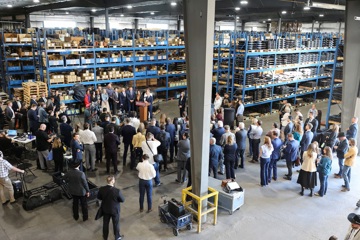
Standing at Cenovus Energy's Christina Lake facility in northern Alberta, Christina Iliopoulos, HBA ’26, got a firsthand look at the scale and complexity of Canada's energy industry.
“The scale at which the industry operates is difficult to conceptualize when you are in the classroom, and having the opportunity to be in the field really puts everything into perspective,” she said.
Iliopoulos was one of 24 students from 20 universities across Canada selected for the inaugural Ivey Energy Summer School in Energy Policy, Business, and Economics. Over five days in Banff in early June, the students explored the challenges shaping Canada's energy future through lectures, simulations, discussions with industry leaders, and a visit to one of the country's flagship energy operations.
Addressing a gap in energy education
The experience was designed to address a long-standing gap identified by leaders at the Ivey Energy Policy and Management Centre. Despite energy's critical role in Canada's economy, many students have limited exposure to the sector in their university studies.
“Energy is critical to the Canadian economy… It's one of the largest industries. It is our largest export sector,” said Brandon Schaufele, Director of the Ivey Energy Policy and Management Centre and associate professor of business, economics, and public policy at Ivey. “There is a real gap between the courses students are able to take at their university and their ability to learn about the Canadian energy sector… The University of Alberta has lots of classes. Beyond that Alberta core, it's tough to get a background on the energy sector in Canada.”
The Summer School, which is fully funded for participants, was designed to help close that gap. Organizers say it is the first program of its kind in Canada. About 200 students applied for the 24 available spots, with participants selected from disciplines including business, law, engineering, economics, public policy, and urban planning.
For Adam Fremeth, HBA '00, E.J. Kernaghan Chair in Energy Policy and associate professor of business, economics, and public policy, the need for such a program has been clear for years.
“For at least a decade we've heard from leaders in the sector that students and new graduates could have a deeper appreciation of the sector and the opportunities that are in it,” he said.
While comparable programs exist in the U.S. and Europe, Fremeth noted Canada has lacked a similar offering.
“This was something that was a serious void here,” he said.
A national cohort by design
Fremeth and Schaufele intentionally recruited students with an interest in energy rather than deep prior experience. Participants came from universities stretching from Victoria to Newfoundland and represented a wide range of academic disciplines.
“They're coming from different academic backgrounds and interests, and that provides for a unique base for conversation and discussion,” said Fremeth.
Ivey also partnered with energy scholars from across Canada, including David Brown, Canada Research Chair in Energy Economics and Policy at the University of Alberta, and Jennifer Winter, Professor in the Department of Economics and the School of Public Policy at the University of Calgary.
“We didn't want it to be exclusively Ivey-focused,” said Schaufele. “We wanted to bring Ivey to Canada in a lot of ways.”
Learning from industry leaders
Throughout the week, the students explored energy markets, business strategy, public policy, and environmental challenges. They also heard from senior leaders across the sector, including Mark Maki, President and CEO of Trans Mountain; Erica Young, President of Versant Power; and Jason Abbate, Senior Vice-President at Cenovus Energy.
A key goal of the program was to highlight the trade-offs embedded in energy decisions.
“Energy involves a trade-off between affordability, environmental impact, and reliability,” said Schaufele. “Trade-offs require people to make hard decisions, and you can only make hard decisions with the correct information.”
The guest speakers also shared insights into their career paths, giving students an opportunity to discuss leadership, professional development, and the future of Canada's energy sector.
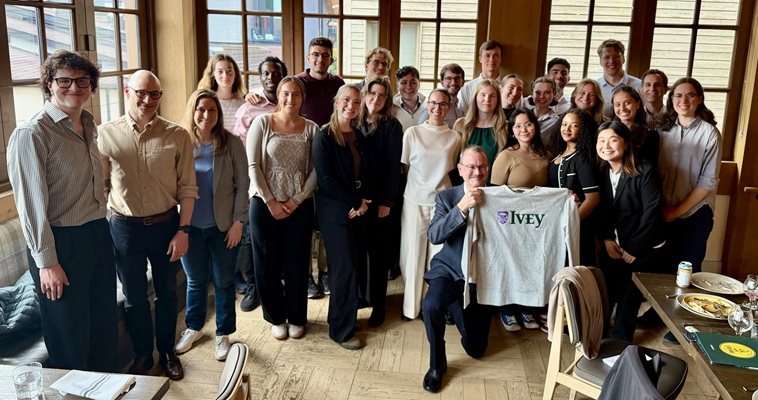
(Photo above) A visit from Mark Maki, President and CEO of Trans Mountain
From the classroom to the oil sands
The program concluded with a visit to Cenovus Energy's Christina Lake facility, where classroom concepts came to life.
“When people think oil sands, they think of the mines and these huge mines with tailings ponds. Christina Lake is not that,” said Schaufele. “Christina Lake is at the forefront of technology. It is the most efficient SAGD (steam-assisted gravity drainage) facility in Canada, and it has the lowest environmental impact of all SAGD facilities… The students got to see what a modern oil and gas facility looks like.”
The visit also highlighted the role Indigenous communities play in the sector and how those relationships are integrated into modern energy development.
“We spent four days in the classroom engaging with discussions and case studies and simulations and lectures,” said Fremeth. “Then it all came to life at the end when we flew up to the oil sands and visited the Christina Lake project.”
Lessons beyond the classroom
For Simon Hungate, HBA ’26, the site visit demonstrated how the concepts discussed throughout the week translate into real-world operations.
“The program was an excellent complement to what we learned at Ivey,” he said. “It allowed us to apply concepts from the classroom while developing a much deeper understanding of Canada's energy sector.”
Hungate said the program provided a foundation in how Canada's oil and gas sector operates, how electrical grids function, how major energy projects are financed, and the role Indigenous communities play across the industry.
“The highlight for me was visiting Christina Lake in the oilsands, where we toured a massive SAGD operation,” he said. “That experience gave me a much greater appreciation for the scale, technology, and complexity of Albertan oil and gas production.”
For Iliopoulos, the experience broadened her understanding of the sector.
“Reflecting on our time in Banff, the program truly highlighted the scale of Canada's energy industry and the important role it plays across the global economy,” she said. “As an Ivey and Chemical Engineering dual degree student, I developed an interest in the energy sector early in my undergraduate experience, and the Ivey Energy Summer School took my understanding far beyond the classroom.”
Hungate said the experience helped connect academic learning with the business, operational, and policy considerations that shape decision-making in the sector.
“The program helped connect what we learned academically with the real-world business, operational, and policy considerations that shape investment and decision-making in the energy sector, which no doubt will be useful in starting my career,” he said.
The program reinforced Schaufele's confidence in the students entering the field.
“The quality of the students was exceptional,” he said. “If these are the types of leaders we have in the sector going forward, we're well placed. We're in safe hands.”
Applications for the 2027 Ivey Energy Summer School will open in December 2026 and close Jan. 31, 2027.