The Ivey Business School hosted more than 100 scholars in the field of entrepreneurship at the inaugural Canadian Entrepreneurship Research Conference (CERC) from May 29–30, 2026.
The conference – held in partnership with the Journal of Business Venturing and sponsored by Ivey Research and the Morrissette Institute for Entrepreneurship Powered by Ivey – brought together faculty researchers and PhD candidates from across Canada, the U.S., and Europe to share their research, discuss areas of interest, and explore opportunities for collaboration.
A major focus of the conference was critical research questions about entrepreneurship in Canada, said Daniel Clark, associate professor of entrepreneurship at Ivey and the J. Allyn Taylor & Arthur H. Mingay Chair in Entrepreneurship. Clark was the lead organizer of the conference.
“The unique Canadian entrepreneurship environment will get critical attention as opposed to being on the periphery. We don’t do entrepreneurship the same way the Americans or Europeans or any number of other geographies do, and developing a community around that conversation is critical,” Clark said.
Denis Grégoire, Rogers—J.A. Bombardier Chair of Entrepreneurship at HEC Montreal, delivered the keynote address. Building on themes from Prime Minister Mark Carney’s speech at the 56th World Economic Forum, Grégoire encouraged researchers to use their work to help Canada discover new market opportunities, connect economic growth with sustainability, and tackle the nation’s productivity crisis. Grégoire is also an associate editor of the Academy of Management Journal and is the associate director of Creative Destruction Lab–Montreal.
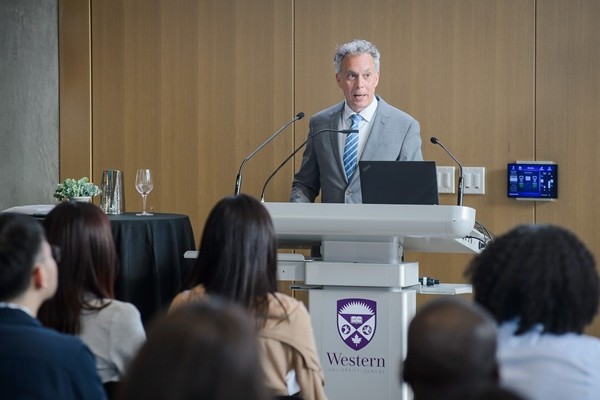
(Photo above) Denis Grégoire of HEC Montreal delivering the keynote address
A response to geopolitics
The origins of the conference also reflect recent changes affecting academic travel to the U.S., which hosts a majority of research conferences in entrepreneurship and the larger field of business and general management.
“We have a number of scholars at Ivey and across the country that didn’t feel comfortable going to the U.S. conferences this year, so we asked the question, what would a Canadian conference look like, and could we put it together?” said Clark.
That is especially true for PhD candidates.
“With everything that is happening south of the border these days, many academics – and PhD students in particular – may be less able or less willing to travel to the U.S. for research projects and conferences,” said Janice Byrne, associate professor in entrepreneurship at Ivey and the Corus Entertainment Chair in Women in Management.
Byrne also led the conference’s PhD Consortium held at Ivey on May 28.
“It’s important to give doctoral students that opportunity to meet each other and meet more senior scholars in their field – form those vital early career connections, talk about the field, their work, and exchange ideas, experiences and knowledge,” said Byrne.
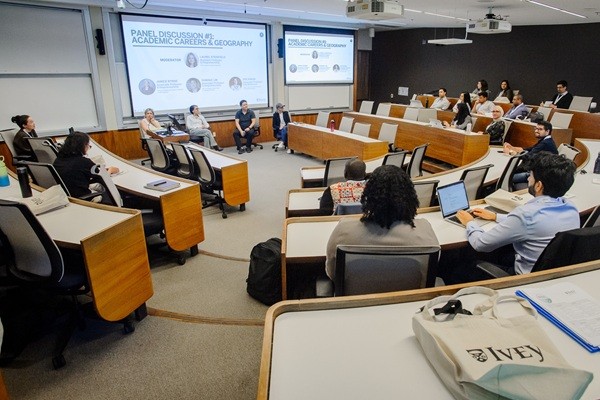
(Photo above) A faculty panel at the Doctoral Consortium
History of advancing entrepreneurship research
The Canadian Entrepreneurship Research Conference is part of a longer tradition of Ivey and the Morrissette Institute’s leadership in supporting the growth and advancement of entrepreneurship research.
In 2014, Ivey and Morrissette Entrepreneurship hosted the Babson College Entrepreneurship Research Program and Conference (BCERC) in London, Ontario. It marked the first time this illustrious research conference was held in Canada since 1988. Other important conferences include the 2018 JBV Special Issue Symposium on Prosocial Organizing and the 2024 Academy of Management Perspectives Symposium. Ivey’s entrepreneurship faculty group was also central to the formation of the Great Lakes Entrepreneurship Network (GLEN) in 2011 with Indiana University, University of Illinois, University of Minnesota, Ohio State University, Syracuse University, and University of Wisconsin.
“We have tremendous entrepreneurship scholars across Canada, and a particularly strong concentration here at Ivey. It only made sense to leverage our unique strength and position within Canadian entrepreneurship, through both Ivey and the Morrissette Institute, to bring together our entrepreneurship community,” said Clark.
Clark hopes the conference becomes an ongoing fixture in the entrepreneurship research calendar that continues to foster collaboration among Canadian scholars.
Byrne compared the conference to the ‘collision space’ created for students pursuing new venture ideas at Western’s Ronald D. Schmeichel Building for Entrepreneurship and Innovation.
“I think entrepreneurship researchers in Canada would benefit from having more of those ‘collision spaces’ right now,” said Byrne. “A place or space to develop new ideas, launch new projects, discuss solutions and make real impact. I hope this first CERC can be the start of that collision space for entrepreneurship researchers in Canada.”
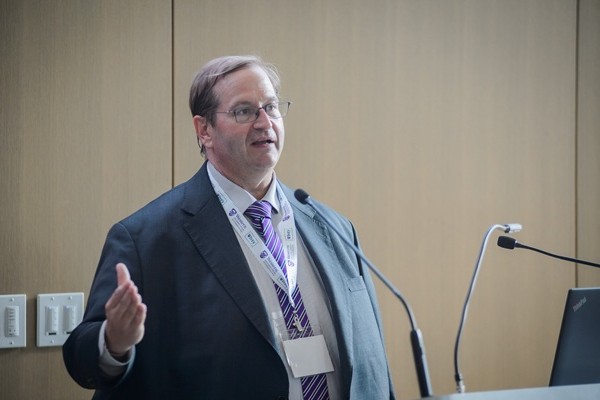
(Photo above) Daniel Clark addressing attendees at the 2026 CERC
CERC awards
The conference also included a number of awards for paper submissions from the Doctoral Program and Main Conference:
Doctoral program
- Best Abstract: “How Early-Stage Ventures Achieve Product–Market Fit: Configurations of Co-Creation Under Uncertainty,” by Muhammad Syed from York University
- Most Innovative: “Effectual Co-Creation: Entrepreneurial Creativity and Judgment in the Age of AI,” by Nora Zabarah from the University of Ottawa
- Impact Award: “Entrepreneurship in the Crossfire: How Women Entrepreneurs Cope with Indeterminate Dangers in Conflict Zones,” by Omima Elkailani from the University of Alberta
- Canada Strong: “Exploring Perspectives on the Certification of Social Enterprises,” by Aoife Cummins, Andrea Baumann, Mary Crea-Arsenio and Benson Honig from McMaster University
Main conference
- Canada Strong: “Conditional Legitimacy and Self-Built Supports: Racialized Women Entrepreneurs in Canada,” by Besma Soltan from Trent University
- Best Paper: “From Vulnerability to Resilience: State Fragility and Gendered Entrepreneurship in MENA,” by Kylie Heales from the University of Saskatchewan
- Best Reviewer: Samira Jafari from the University of Alberta