For the past two decades, Kevin Mako, HBA ’07, has been helping entrepreneurs create physical products through the design firm he incorporated while at Ivey, Mako Design + Invent.
However, Mako’s longevity and success were not built on simply helping startups design prototypes that worked. His vision was larger. He wanted to help startups succeed – moving them from idea to prototype to store shelves with products that could sustain a healthy business.
And that is what made Mako’s venture a global leader in the field.
Mako Design + Invent was launched right out of university, with $50,000 of debt and six weeks' cash flow.
It was sink or swim for Mako.
Every deal made was another lease on life – and meant additional months of rent in the downtown Toronto condo he shared with two roommates. In fact, for 10 years, Mako lived in his dual-zoned, condo-turned-office at 46 Fort York Blvd. in downtown Toronto.
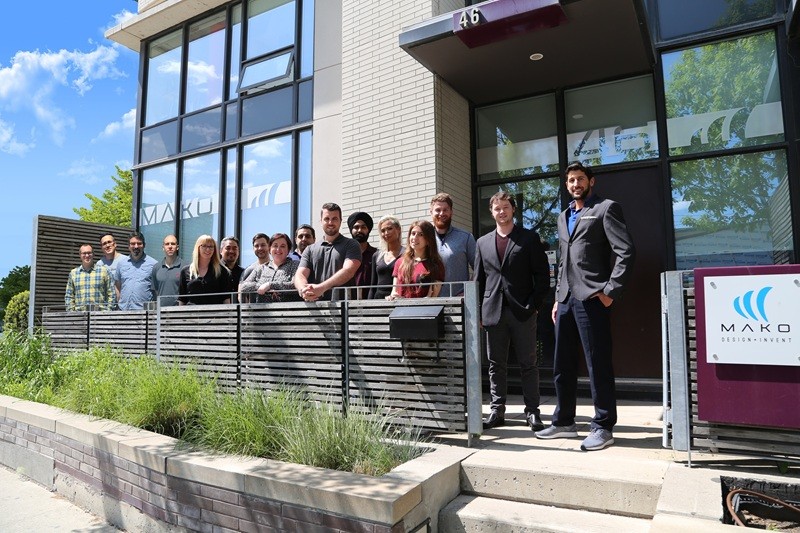
(Photo above) The Mako Design + Invent team
As the business grew and his roommates vacated, more and more of the two-floor space was converted into office space. Mako even had a Murphy bed installed that would flip up into the wall to become his daytime office.
“There was no work/life balance. It was always one,” he said.
And there was no overnight success for Mako. It was slow and steady organic growth, with no investors, no debt, and no co-founders.
That degree of independence is often romanticized by outsiders who don’t fully appreciate how difficult it is to grow a business purely through cash flow.
“A lot of the work I do now is fundraising, so that people don’t have to go through the headaches I went through,” he said.
Mako built the company over 17 years, helping more than 1,500 startups around the world create successful products like Moonlite, which was later acquired by Spin Master Toys, and Alchemy Grills. Along the way, Mako had built one of the leading hardware design firms for startups.
Then came the big moment: Mako Design + Invent was acquired by TriMech Group/Sentinel Capital for an eight-figure sum in 2024.
Building something new
When Mako set about creating his design firm, he noticed something missing in the space. Almost all design firms worked solely with large corporations.
The sentiment was that if you raise venture capital and pair it with software, they might take a closer look, he said.
And therein lay the opportunity: an underserved niche – hardware design for startups.
But creating something new is hard. Mako had to learn on the go, make mistakes along the way, and work through unexpected challenges that were partly the reason his vision was the road less travelled.
A majority of startups, especially in the hardware space, are not well-funded. That has been exacerbated by the rush of investors going to software and less tangible technology, which promises exponential growth uninhibited by physical boundaries. Adding to that is the fragility of startups. There might not be a second product or project if the first one doesn’t land.
With those challenges in mind, Mako had to be lean with his margins. Over 10 years, Mako slowly built capacity and expanded the company’s expertise in all verticals of hardware, from combs to underwater fish cameras, from a sketch all the way to full-scale production.
Yet the slow and methodical approach allowed Mako to create and refine a process – one that became the company's major selling point.

(Photo above) Kevin Mako receiving the Top 40 Under 40 Award
“That's what becomes very valuable to a buyer. It's not only what you've accomplished from an EBITDA (earnings before interest, taxes, depreciation, and amortization) perspective, but also what you've accomplished in terms of systems, brand, reputation, and processes,” said Mako.
Throughout his entrepreneurial journey, Mako was open to the possibility of having the company acquired. Deals would come and go – many of them were usually competitors looking for information, deal hunters, or tire kickers.
But Mako Design + Invent wasn’t the typical venture considered for acquisition. As a company serving startups exclusively, it had no large corporate customers that would usually signify recurring revenue.
“We weren't reliant on any single customer. Our biggest customer would be less than five per cent of overall revenue. But we were extremely stable. We had this presence and all these assets that weren't quantifiable,” said Mako.
Eventually, a deal came his way through a U.S. private equity group, Sentinel Capital, which had acquired global software and hardware firm, TriMech Group, back in 2022.
After almost two decades of running the company alone, Mako wanted to manage the exit himself – something he does not recommend to other founders, but a challenge he wanted to try once in his life.
Not many ventures get to this stage of their life cycle, but it’s fair to say that acquisition deals are hard and extremely delicate. They are often revealing, and most buyers are looking for any excuse to bring down the sale price.
To make things harder, Mako said he threw down the gauntlet to get the deal done in six weeks to get ahead of the highly publicized potential capital gains tax increase.
After a bit of dithering back and forth, the game was on, and he spent the next 40 days working 20 hours a day to get all the documentation ready to close the deal. In the last two weeks, he scrambled to bring in deal-closing lawyers and accountants, and at 11:52 p.m. – eight minutes before the deadline – the deal was signed.
But what comes after the biggest deal of your life? Retirement? Time on the beach? Well, waterfront properties are certainly part of Mako’s current occupation, but more in his role as a developer than as a leisure seeker.
During his time building Mako Design + Invent, he had invested a lot of his earnings in buying and developing property. He described it as an investment focus, explaining that he doesn’t like the stock market and prefers investments he can help grow. Since the acquisition, Mako Property Corp. has become his main business, through which he now owns more than 50 properties across Canada, the U.S., Nicaragua and the Bahamas.
But Mako hasn’t left the design world either. He still runs the podcast he developed at the old firm, The Product Startup Podcast. He also regularly consults and mentors entrepreneurs on the business-related aspects of scaling hardware businesses via ProductStartup.com on topics such as fundraising, team building, marketing and sales, and manufacturing.
Entrepreneur by design
For Mako, being an entrepreneur felt like it was built into him.
The only full-time jobs he ever had were managing inventory at a local sports and recreation store as a teenager and later cold-calling potential investors for RBC Dominion Securities.
“I’m earning $6 an hour, and it doesn’t add up very fast,” said Mako.
Then came the turning point, when he offered to clean up the weeds at a waterfront property in return for $500, and the owner agreed.
Soon, he was knee-deep in the water, covered in sweat, bugs, and all sorts of other things, on a balmy summer day.
But he was happy.
The cheque at the end of the job probably helped as well.
From that point on, Mako had caught the entrepreneurship bug. With his parents' advice and encouragement, he spent much of the subsequent years in high school and university trying out a range of new venture ideas, including limousine services, water weed cutting, website design, and sleep training, to name a few.
It was a season of experimentation that Mako credits with helping him discover what would eventually become his eight-figure business.
Choosing the path less travelled
Coming into the Ivey HBA program in 2005, Mako was determined to make the most of every opportunity the program had to offer. Here he was, literally sitting a few feet away from some of the world’s leading experts in business, with the opportunity not just to learn from them, but to ask questions and even seek business advice. Add to that a cohort of highly talented peers and a network of successful alumni, and Ivey gave Mako not just an excellent degree, but a transformative, real-world education.
A year into his HBA, Mako incorporated Mako Design + Invent. However, the temptation to join the corporate world was never far behind.
And who could blame him?
At the time, investment banking positions came with signing bonuses between $5,000 and $15,000 on top of six-figure salaries. As class president of his section, Mako had offers from almost any major investment bank or management consulting firm. As graduation and entry into the real world drew closer, Mako said he knew he had a choice to make.
“So, I am looking at guaranteed success on one path, versus a totally shaky, unproven, long shot with the other path,” he said.
Yet combined with a sense of belief and passion, he had also learned to come to terms with what failure and bankruptcy would mean for him at such an early age. Sure, he didn’t have any dependents to worry about, but there was social stigma and real downsides, let alone credit damage for years to come, if it all fell apart.
“I’m almost certainly going to go bankrupt, but I’ve got to give this a shot,” said Mako.
There might have been a few close calls along the way, but Mako is happy he took the chance – not haphazardly, but after testing and refining his business idea.
And the rest is history.
Related Articles