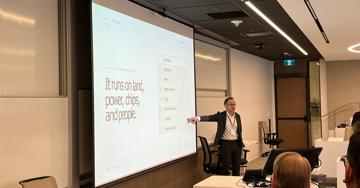
With the formal review window for the Canada-United States-Mexico Agreement (CUSMA) set to open on July 1, two senior figures in Canada's automotive sector used a recent Ivey Business School policy workshop to deliver a similar message to Ottawa: the country's EV investment strategy was built on assumptions about US alignment that no longer hold, and the months ahead will determine whether Canada can adjust in time.
Speaking at the Lawrence National Centre for Policy and Management's Driving Forward: Canada's Auto Strategy and EV Transition workshop, Sarah Goldfeder, Executive Director of Government and Corporate Affairs at General Motors, and Jean-Marc Leclerc, the recently retired President and CEO of Honda Canada, offered overlapping diagnoses of how Canada arrived at its current position — and what governments at both levels should prioritize from here.
The US relationship comes first
Both executives were of the view that no Canadian auto strategy works without preferential access to the American market.
"We are not competitive for manufacturing investments unless we have access to the United States market. Full stop," Goldfeder said. She framed the CUSMA review through Prime Minister Mark Carney's Davos line: "If you're not at the table, you're on the menu. I think we have to remember that."
Leclerc, who said he was speaking "as a Canadian" rather than for Honda, reached the same conclusion from a different direction. Trade diversification through Comprehensive and Progressive Agreement for Trans-Pacific Parternership (CPTPP) and Comprehensive and Economic Trade agreement (CETA) with the European Union, he argued, cannot match the depth of the US market.
"The bottom line is that we need the United States from a scale perspective." Even prospective Chinese entrants exploring Canadian assembly, he noted, are ultimately calculating US market access.
Leclerc described the past 18 months as a convergence of shocks: a US rollback of emission standards and electrification incentives, broad new American tariffs, and uncertainty around CUSMA itself. "You might say this was the perfect storm that was created," he said.
Of the more than US$300 billion in EV and battery investments announced globally since 2020, he told the audience, "the industry absorbed at least $65 billion in losses and write-downs, with some experts predicting that that may rise to $100 billion." Of the $46 billion Canada had attracted, "many have been paused, modified, canceled, or placed in jeopardy", including Honda's own $15-billion Canadian commitment, which he was "intimately involved with bringing to Canada."
Goldfeder placed the current moment in a longer arc. The temptation, she said, "especially from the political side," is "to identify President Trump as… the bane of our existence and the reason that all of our problems are here." Her view from inside the industry was different: "What we are dealing with is just the latest step and a cadence of challenges" stretching back through China's WTO accession, the NAFTA backlash, and the persistent 2.5 per cent US most-favoured-nation tariff that, in her telling, has quietly undercut reshoring incentives for two decades.
Chinese EVs: a separate question
Both speakers addressed Canada's decision to admit roughly 49,000 Chinese EVs at a reduced 6.1 per cent tariff, but treated it as a distinct policy question from the CUSMA file.
Goldfeder's concern was structural. Chinese OEMs, she argued, benefit from state-financed refining, processing and supply-chain infrastructure that legacy automakers had to build themselves. "In this scenario, it's not a fair fight," she said.
Leclerc described the Canadian tariff arrangement as "a hedging policy, diversifying our economic relationship with the US." He acknowledged the potential upside. Chinese investment "could potentially fill the gaps of what has been paused or delayed or abandoned", alongside risks around stranded investments, cybersecurity and production allocation decisions made outside Canada. His recommendation was "a slow, steady approach," using market access as leverage to require domestic supply-chain investment and partnerships with Canadian firms.
What governments should do next
On the domestic side, both executives identified areas where governments can move without waiting on Washington.
Leclerc's emphasis was on consumer adoption. The federal pivot in February from the Electric Vehicle Availability Standard to the Electric Vehicle Affordability Plan was, in his view, overdue: technology-neutral GHG standards were "what the industry was asking for since the beginning." But meeting the revised 75 per cent EV sales target by 2035 will require treating "customer adoption as a behavioral change," restoring consumer incentives, and accepting a "flexible technology mix" that includes hybrids and plug-in hybrids during the transition. He also flagged a gap in charging policy: the "garage orphans" in condos and multi-unit dwellings for which no concrete policy solution has yet been developed.
Goldfeder's focus was upstream and physical. Canada's critical minerals position, she argued, has been more announcement than execution. The Trudeau government "listed all of the critical minerals that we have, but nobody really thought about what it was we were supposed to do with those." The result, she said, is that Canada is still "extracting resources… sending them someplace else to be refined and processed, and then bringing them back into Canada to use them in big factories" — while China built the midstream capacity that determines EV cost competitiveness. She paired that with a call for sustained federal investment in charging infrastructure and a hard look at stacked compliance regimes, where provincial ZEV mandates layered on federal GHG rules produce what she called "double jeopardy" for manufacturers.
According to the two industry veterans, there is no tidy roadmap. Both suggested the test for Ottawa over the coming months is whether it can defend the US relationship at the CUSMA table while delivering, at home, the consumer, mineral and infrastructure policies that the EV transition has yet to fully unlock.
Related Articles