From electrifying public transit systems to scaling AI-powered health-care delivery across continents, Ivey’s Scotiabank International Case Competition challenged student teams from around the world to grapple with decisions tied to two global priorities: cutting emissions and improving access to critical services.
Now in its 36th year, the competition, held March 24-28, brought together 13 international teams – alongside an Ivey team – from countries spanning five continents, including, for the first time, teams from Nigeria and Japan.
“This is one of the largest, longest-running, and most diverse business school case competitions in the world,” said Ivey Dean Julian Birkinshaw at the opening ceremony.
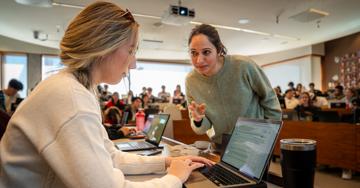
Teams were tasked with analyzing complex, real-time business challenges and defending their recommendations before panels of experienced judges.
“It’s like stepping into a boardroom – tackling one of the most important decisions an organization is facing while competing against top teams from around the world,” said Romel Mostafa, Director of the Scotiabank Digital Banking Lab and Faculty Lead of the competition. “The cases are live. The challenges are current, and no decisions have yet been made. Participants can’t rely on hindsight; they must make decisions in real time.”
Tackling complex, real-world decisions
The first case, written by Michael Raynor, MBA ’94, associate professor in the Sustainability and Strategy area groups, focused on whether the Toronto Transit Commission (TTC) should invest $150 million in hybrid or fully electric buses – a decision with system-wide implications.
The second case, written by Yasser Rahrovani, associate professor of information systems at Ivey, focused on Zipline, a U.S. startup delivering blood and emergency supplies to medical clinics in Rwanda. Teams were asked to assess the company’s global strategy and whether its expansion is driven by business or social impact considerations.
Kyle Kaufman, an HBA ’27 candidate and Co-Chair of the Scotiabank International Case Competition (SICC) executive team, said the case choices were intentional.
“We really try to bring in global ideas – whether it’s AI, trade, or emerging technologies – and push students to think about how those trends shape real-world problems,” he said.
Judges said the strongest teams stood out for both the quality of their analysis and their ability to translate ideas into action.
“There’s a depth and breadth in their thinking… The best teams back up their ideas with both qualitative and quantitative analysis and a clear path to implementation,” said Karen Cheung, MBA ’09, a judge and Vice President, Global Risk and Treasury Technology at Scotiabank. “The teams that really stand out combine strong analysis with conviction. They’re able to clearly defend their recommendations and show how they would actually implement them.”
Scotiabank’s long-standing partnership
Now in its 25th year as title sponsor, Scotiabank plays a central role in the competition. Senior leaders from the bank serve as judges and engage directly with participants.
“I’m very proud Scotiabank continues to invest in this relationship, not only to develop future leaders, but to support innovation and research through the Scotiabank Digital Banking Lab,” said Cheung.
A global exchange of ideas
For participants and organizers alike, the global exchange of ideas is a defining part of the experience.
“It’s my first time meeting so many people from all over the world,” said Andrew Feng, an HBA ’26 candidate and VP of content strategy on the SICC executive team. “It’s been really interesting learning how they approach case competitions, how they study, and even what their day-to-day lives are like.”
For Jasiel Joe, a member of the team from Nile University of Nigeria, that experience was one of the most valuable parts of the competition.
“Opportunities like this let you gauge what you’ve been taught against a global standard,” he said. “You see how you stand, and you learn from how others think.”
Behind the teams’ success
Some teams spent months preparing.
“We actually went through about nine months of preparation,” said Favour Edubio, another member of the Nigerian team. “We’re engineering students, so we had to learn business concepts from scratch.”
The team was supported by Ivey alum Tomina Fubara-Manuel, MBA ’22, who mentored the students and travelled from Montreal to cheer them on.
The participants also emphasized the value of connecting across cultures.
“You can meet people from different countries, learn about their cultures, and find things you have in common,” said Faviana Vargas of Universidad del Pacífico in Peru.
For longtime judge Darren Jack, HBA ’88, MBA ’92 – who has been involved with the competition for nearly three decades – that global evolution is one of the most striking changes.
“Twenty years ago, North American schools dominated. Now you’re seeing teams from around the world competing at an incredibly high level – even in their second language,” he said. “The ability to communicate your ideas clearly and defend them under pressure is critical.”
Beyond the case room
That ability to perform under pressure is something judges consistently look for.
“What stands out is their ability to think on their feet, collaborate quickly, and deliver under pressure,” said Dayo Odunfa, MBA ’19, a judge from Manulife.
Beyond the case deliberations, the experience is designed to foster connection. Teams took part in activities throughout the week, including a visit to Niagara Falls and team-based events like the Spirit Cup.
For many participants, it was their first time visiting Canada, making the trip to Niagara Falls especially memorable.
“We wanted to bring that work hard, play hard mindset to the competition,” said Elizabeth Swiston, an HBA ’26 candidate and vice-president of events on the SICC executive team. “It’s about making sure people feel welcomed and get to experience Canada while they’re here.”
That balance between competition and experience is intentional.
“They’re working on real-world challenges during the competition, and at the same time getting to explore Canada together,” said Feng.
Behind the scenes, student organizers spent months planning the event – coordinating logistics and supporting international teams.
Building future leaders
For many judges, the competition offers a glimpse into the next generation of global leaders.
“When you hear these students present, you realize they have what it takes to lead,” said Odunfa. “They’re adapting to a business environment that’s changing faster than ever.”
For students, the impact extends beyond the competition itself.
“It feels less like just a professional case competition, and more like we’re all friends here,” said Feng. “You’re building connections with people from all over the world.”
Competition results
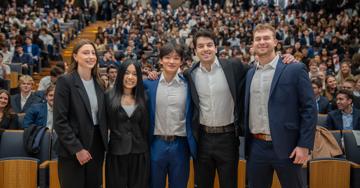
- First place – Beedie School of Business, Simon Fraser University (Canada) – Troy Cheah, Julie Cheung, Tania Pocrnjic, and Sage Singh;
- Second place – Ivey Business School (Canada) – Isaac Irwin, London Luyks, Tristan Nemcek, and Shane Weinberger; and,
- Third place – Florida State University (U.S.) – Lucas Bonassi, Omer Chai, Yash Mirpuri, and Thomas Ngo.
Maastricht University from the Netherlands received the Spirit Award, recognizing exceptional energy and engagement throughout the week.
Participating teams
- Universidad Panamericana Ciudad UP (Mexico)
- Asper School of Business, University of Manitoba (Canada)
- HKU Business School, University of Hong Kong (Hong Kong)
- Ritsumeikan Asia Pacific University (Japan)
- Chulalongkorn Business School (Thailand)
- SFU Beedie School of Business (Canada)
- University of Münster (Germany)
- Nile University of Nigeria (Nigeria)
- Universidad del Pacífico (Peru)
- University of Otago (New Zealand)
- IE University (Spain)
- Maastricht University (Netherlands)
- Florida State University (U.S.)
- Ivey Business School (Canada)
Thank you to the judges
Case 1 :
- Meghan Connors, EMBA ’17 (PipeSak Incorporated)
- Rick Gleed, MBA ’16 (GLEED Inc Real Estate Brokerage)
- Reg Jackson, HBA ’96 (National Bank Financial)
- Adam Jean, HBA ’00 (Harrison Pensa)
- Marc Lacoursiere, EMBA ’05 (The Achievement Centre International Inc.)
- Bruce Lamb, HBA ’85 (Avalanche Search Marketing Inc.)
- Don Pollock, HBA ’73 (Canadian Tax Planners Limited)
- Greg Schinkel, HBA ’91 (Unique Training & Development Inc.)
- Alex Yazdani, MBA ’07 (Yazdani Aesthetics)
Case 2:
- Karen Cheung, MBA '09 (Scotiabank)
- Archit Chitnis, Scotiabank
- Darren Jack, HBA ’88, MBA ’92 (Retired – EY Cayman)
- Fabiana Montoya, Scotiabank
- Sergii Nevmerzhytskyi, Ivey Posdoctoral Fellow
- Dayo Odunfa, MBA ’19 (Manulife)
- Carlos Orencia Horta, Scotiabank
- Craig Pattinson, MBA ’04 (BCE/Bell Canada)
- Stephanie Zee, MBA ’06 (Payments Canada)
Related Articles