Artificial intelligence is expected to reshape work across industries, but for those early in their careers, the bigger question may be less about whether AI will matter and more about what skills will matter alongside it.
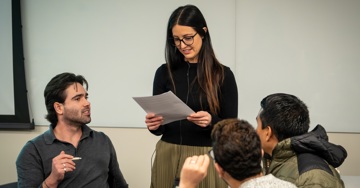
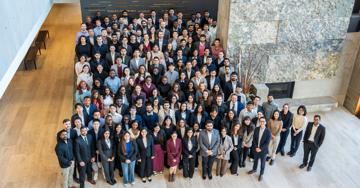
That was the focus of a panel discussion that helped kick off this year’s MBA Get Connected, organized by Ivey’s Career Management team. More than 250 Ivey alumni attended the event to meet current MBA students, discuss career paths, and build connections. Against that backdrop, moderator Mazi Raz, Assistant Professor of Strategy at Ivey, led a conversation with Salim Teja, HBA ’96, partner at Radical Ventures; Erik Garcia, senior project manager at The Vector Institute; and Neha Khera, MBA ’11, managing partner at IRV, on what an AI-enabled workplace will demand from the next generation of professionals.
Becoming comfortable with AI
The panelists were clear that AI is no longer a niche topic. “Without a doubt, you are going to be a user of AI whatever job that you pursue next,” said Khera. “So, get comfortable with it, and don’t be afraid to leverage it.”
At the same time, the discussion stayed grounded in the technology’s limits. AI may be advancing quickly, but it does not replace judgment. As Garcia put it, the challenge is not simply adopting new tools, but navigating a more uncertain environment: “I’m coming from a structured and predictable world into something that is completely ambiguous.”
For students preparing to enter that world, the panel emphasized AI fluency. Teja said employers increasingly want people who can do more than talk about AI in theory. They want people who can use it, understand where it creates value, and see how it changes work across functions. He noted that some employers are already changing how they assess candidates, asking them to solve problems with AI tools in real-time rather than simply discuss them during a job interview.
Critical thinking still matters
But fluency, the panel argued, is only the starting point. Raz said critical thinking remains essential, describing it as “the readiness and the willingness to encounter different perspectives, looking for the assumptions that were taken for granted.”
That point came up repeatedly as panelists discussed the risks of over-relying on AI. Khera cautioned young professionals not to let convenience replace judgment. “Not using AI as a crutch, because it’s really easy to do that,” she said. “Use it as a guide, but then put your critical thinking hat on.”
Teja made a similar point, saying AI can help provide structure and accelerate work, but “ultimately you’re going to have to apply critical thinking” and judgment in how those tools are used inside organizations.
Human skills in an AI workplace
The discussion also widened beyond technical ability. Teja said business leaders are still looking for skills that remain deeply human: communication, team building, and the ability to work well with others. Even as AI changes workflows, those capabilities are becoming more important, not less. “It’s still a person-to-person culture, and communication and team building is really, really important,” he said.
That emphasis mattered especially in the context of Get Connected, where students were having meaningful career conversations with alumni. The panel suggested that the future of work will not be defined by technical knowledge alone, but by the ability to translate ideas, solve problems with others, and help organizations adapt.
Teja argued that much of the challenge ahead is not purely technological. “It is a human challenge, not just a technology challenge,” he said, pointing to the broader organizational changes companies will have to make as AI becomes more embedded in areas such as finance, legal, marketing, and software development.
An opportunity for early-career professionals
For younger professionals, that creates an opening. Both Teja and Khera argued that new graduates should recognize the advantage they may already have. Many senior leaders did not grow up with the same level of comfort using digital tools, and AI is no exception. That means early-career employees can bring real value by helping organizations build confidence and capability.
Teja said that while public discussion often focuses on job displacement, there is another side to the story: “this is an amazing time to be going into” the workforce. Because AI tools are still new to everyone, he said, young professionals have a chance to stand out if they position themselves well and build expertise in the right areas.
Khera made a similar point more directly. “A lot of the leaders of these organizations aren’t as fluent with technology the way you are,” she said. “So, if you can position yourselves as being the thought leaders of AI, they’re going to come to you.”
While artificial intelligence has the potential to create workflow efficiency, Khera also identified a range of new problems AI is creating, from energy and governance to safety and security, suggesting those emerging areas may create significant opportunities over the next decade.
Relationships still set people apart
Finally, in a workplace being reshaped by AI, relationships still matter. Khera said what helps people stand out is “the authenticity and the human connection,” and encouraged students to take networking seriously early in their careers. “No amount of AI can kind of take that away,” she said. “It’s a relationship game at the end of the day.”