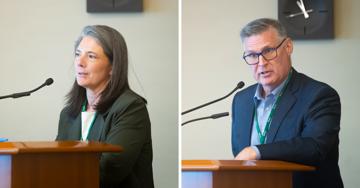
A room of more than 250 students, faculty and staff at Ivey got a rare direct look at Canada’s AI policy future when Evan Solomon, the federal minister leading the country’s artificial intelligence strategy, visited the School for a keynote, fireside chat and student question period.
The Minister of Artificial Intelligence and Digital Innovation delivered that message at an event organized by Ivey’s Lawrence National Centre for Policy and Management in collaboration with the MBA AI in Business Club. After a short lecture, Solomon drew students into a discussion that ranged from privacy and public trust to startup capital, AI education, digital sovereignty, and energy infrastructure.
Trust comes first
From the outset, Solomon framed Canada’s approach around trust. “We start with trust because technology moves at the speed of innovation, and people move at the speed of trust,” he said, arguing that AI adoption will only scale if Canadians believe the technology is being developed and used responsibly.
That logic sits at the centre of the federal government’s “AI for All” strategy, announced in June, which aims to build trust, create opportunities and reinforce Canadian sovereignty. Solomon said the strategy is designed to make AI safer and more useful while protecting the public from harms ranging from deepfakes to privacy abuse. “We have a big social license problem when it comes to AI,” he said during the lecture, noting concerns that AI can take jobs, undermine privacy or strain infrastructure.
He pointed to proposed and existing policy measures that are meant to address those fears, including rules around non-consensual AI-generated imagery, political deepfakes, protections for children online and new privacy safeguards. “It gives you the right to deletion,” he said of the proposed privacy law, describing it as part of a broader effort to make automated systems more transparent and accountable.
Building opportunity
The second pillar in the strategy is opportunity. Solomon said the point of AI policy is not simply to protect Canadians from risk, but to ensure they can participate in the economic upside. “We need the most literate population in the world,” he said, noting free AI literacy courses and other measures aimed at students, workers and small businesses.
That message resonated with MBA student, Iqbal Badruddin, President of the AI in Business MBA club during the fire-side chat, who pressed him on how the federal plan would affect classrooms and post-secondary learning. Solomon said every post-secondary student will be offered access through their institution to a free AI agent in the coming year.
“Why are we doing it? What’s the problem we’re trying to solve? Equity,” he said. “Don’t you think every Canadian student who’s postsecondary should have the same access to a tool that you have?” He added: “Education should be about you, not about the tool.”
The minister also used the stage to argue that AI adoption has to be accessible across the country, not just in established institutions or large firms. “We need to make sure there’s jobs for young people,” he said, pointing to a plan to create 90,000 AI-related jobs and work placements, along with a national literacy push that he said should make AI less intimidating and more practical.
Digital sovereignty and optionality
A major thread of the discussion was on digital sovereignty prompted by Mayura Pamidimukkala, VP of MBA Association. She asked how much of the AI stack Canada can truly control. Solomon rejected the idea that sovereignty means trying to do everything alone. “Sovereignty is choice, and sovereignty is optionality,” he said. “You can’t build every part of the stack.”
Instead, he said Canada must anchor key capabilities at home, partner where it makes sense and buy where it must. “If we can build it here, we’ll build it. If we can partner to do it, as we’ve done, we’ll partner with like-minded countries. If we can’t build or partner, we’ll buy,” he said. He added that the goal is to retain the country’s most valuable assets, especially intellectual property, and avoid becoming overly dependent on a single source.
Capital for growth
That same logic underpinned Solomon’s response to questions about access to capital and business growth. He argued that AI policy has to make Canada a better place to start and scale a company. “The Productivity Mega Deduction, so you can write off investment in capital,” he said, describing the new tax measure as a way to lower the cost of buying equipment, computers and other productive assets. He also pointed to the Canada Growth Incentive, a technology growth fund and a compute access fund as part of a wider effort to help founders raise money and invest at home.
“We believe that we should be owners,” Solomon said, presenting the policy mix as a way to keep more value in Canada and strengthen the domestic innovation ecosystem. He argued that if the country wants to keep AI companies and talent here, it has to give them both customers and the conditions to grow.
Powering the AI buildout
Infrastructure was another central concern, especially the electricity needed to power the data centres that AI depends on. Solomon said the issue cannot be separated from the broader AI strategy. “It’s not about building or not building. It’s build right or build wrong,” he said, emphasizing that provinces control power allocation but communities still need to see clear benefits.
He outlined five principles for responsible data centre development: ratepayers should not pay more, water use must be sustainable, efficiency should be maximized, communities should benefit and the rules should be transparent. “First thing is you cannot have your data center increase ratepayers,” he said, adding that projects need public support if they are to move forward at scale.
The minister’s answer also reflected the government’s view that AI infrastructure has to be paired with public legitimacy. “You’ve got to invest in the community,” he said, describing the social license needed for new data centre growth.
The core message for the future
Throughout the event, Solomon returned to one core idea: Canada has a narrow window to shape AI around Canadian values, Canadian institutions and Canadian economic interests. “We start with trust,” he said, “and then we’re going to make sure we’ve got the talent, the capital, the compute, the customers.”
Ultimately, the AI debate is not just about technology. It is about who gets access, who gets to build, and how Canada can turn its policy ambition into a competitive advantage both responsibly and inclusively.
Shaping that future requires dialogue with the next generation, who will both lead AI’s transformation and live with the consequences of today’s decisions.
“Direct engagement between policymakers and students helps bridge the gap between policy and practice, giving the next generation a stake in shaping Canada’s AI future while ensuring decision-makers hear firsthand the perspectives, questions and ambitions of the talent who will eventually drive it forward,” said Professor Romel Mostafa, Director of Ivey’s Lawrence National Centre.
Related Articles