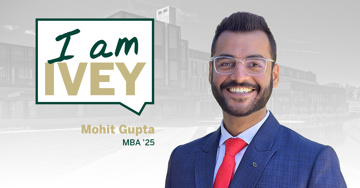
Their destinations may differ, but they all began at the same place. A look at alumni stories of success that started at Ivey.
Tell us a little bit about yourself
I grew up in Dhaka, Bangladesh, and later moved to Bangkok, where I completed my Bachelor of Business Administration in Industrial Management at Assumption University of Thailand. I was drawn to manufacturing early, fascinated by how people, processes, and decisions come together to create a finished product.
After university, I returned to Bangladesh and built my career in apparel manufacturing, progressing from the production floor into senior marketing and operations leadership. Along the way, I worked with customers, suppliers, manufacturing partners, and teams across Asia, Europe, and North America.
My wife and I moved to Canada in 2022, and we now live in Toronto with our three-year-old daughter. Since arriving, my experience has expanded across logistics, supply chain, and business operations, giving me a different perspective on how organizations grow, serve customers, and build effective systems. More recently, I have begun reconnecting with apparel, bringing together my manufacturing background with what I’ve learned through my experience in Canada.
What led you to your career and how has it evolved over time?
Manufacturing was part of the world around me growing up. Several members of my extended family worked in the sector, and one of my uncles was a textile engineer. What stayed with me was not simply his profession, but the respect he earned because people saw the value he created.
I chose Industrial Management because I wanted to understand manufacturing while keeping myself open to different industries.
Then I discovered apparel.
I joined Total Fashion as a Quality Control Specialist and began learning how every part of the product came together: product safety, garment construction, knitting, dyeing, cutting, sewing, quality, capacity, and delivery.
Over more than eight years, I progressed to Director of Marketing and Operations. Early in my career, I was learning individual processes. Later, I was responsible for connecting them through people, customers, capacity, quality, financial performance, and growth.
During that period, the operation grew from eight sewing lines to 40. I developed a network of 22 external manufacturing partners, while average monthly shipments grew from US$350,000–US$400,000 to around US$2 million.
Moving to Canada opened a different chapter. My first opportunity here was in logistics and supply chain, which broadened my understanding of the product journey through inventory, warehousing, distribution, and fulfilment.
Interestingly, it was being away from apparel that made me realize how deeply connected I was to it. I missed the instinct that develops after years inside an industry, when experience helps you anticipate problems, understand how decisions in one area affect another, and know where to look when something goes wrong.
That realization eventually brought me back toward apparel, now with a broader understanding of sourcing, commercialization, product development, supply chain and operations.
Who inspired you?
Different people have inspired me at various stages of my life.
My uncle was one of the earliest. He showed me that professional success and humility do not have to compete with one another. You can create meaningful value, earn respect, and still remain kind and grounded.
Later, one of my managers and mentors shaped the way I think about leadership. He taught me that the greater your authority, the greater your responsibility toward others. As you move up, your role is not simply to make decisions. Sometimes leadership means initiating reconciliation, absorbing frustration, or looking beyond who was technically right because someone has to see the bigger picture.
My wife has influenced me in a different way. Watching her rebuild her career after we moved to Canada taught me that progression is not always linear. Sometimes moving forward requires the confidence to step back, understand a new environment, and create the runway for a bigger leap.
Those lessons continue to shape the kind of leader and person I want to be.
How did Ivey play a role?
Ivey expanded the way I think.
My network grew tremendously, and so did my confidence, but what stayed with me most was the opportunity to see how leaders from very different industries, organizations, cultures, and backgrounds actually think.
You see accomplished people wrestle with uncertainty. You hear their assumptions, questions, vulnerabilities, and disagreements. Sometimes you watch someone strongly defend a position and then change their mind because another perspective revealed something they had not considered.
Earlier in my career, I probably associated leadership more closely with certainty. Ivey gave me a much greater appreciation for curiosity, judgment, and the willingness to reconsider your own assumptions.
It also gave me space to reflect on my own career. Somewhere during the EMBA, I became much clearer about the industry I wanted to reconnect with and the kind of work I wanted the next chapter of my career to contain.
Why did you choose the EMBA program specifically?
After moving to Canada, I knew I wanted a Canadian business education that would complement the experience I had already built internationally.
I considered several schools, but Ivey stood out because of the case method. I was not looking only for theory. I wanted to work through real business situations, make decisions with imperfect information, defend those decisions, and then hear someone sitting beside me interpret exactly the same facts differently. That felt much closer to the reality of leadership.
Ivey’s reputation was important, but so was its alumni community. Before joining, I had repeatedly heard that Ivey alumni genuinely supported one another across industries and geographies. I wanted the education. I also wanted to become part of that community.
What personal or professional accomplishment are you most proud of?
Professionally, I am proud of what we built at Total Fashion. When I joined, the operation had eight sewing lines. By the time I left, it had 40, supported by a network of 22 external manufacturing partners. Average monthly shipments had grown from roughly US$350,000–US$400,000 to around US$2 million.
The numbers show scale, but what matters more to me is what had to exist behind them: capable teams, customer trust, operational discipline, strong relationships, and the ability to solve difficult problems together.
Personally, my definition of accomplishment is less visible. I began taking significant responsibility for my family at a relatively young age, and over the years I have also been fortunate to support children from underprivileged backgrounds with education and career guidance.
If I had to choose what I am most proud of, though, it would be the trust I have earned from people around me. Titles change. Numbers eventually become old numbers. Being someone people believe will show up when things become difficult means more to me.
What do you like to do when you are not working?
These days, some of my favourite time belongs to my three-year-old daughter. I enjoy driving her around Toronto, taking her somewhere new, or finding another place for ice cream. I enjoy hearing the story afterward even more. Her version is usually far more dramatic than what actually happened.
I also spend a fair amount of my personal time learning. I regularly take courses related to apparel, fashion, and product development because I genuinely enjoy understanding the product side of the industry more deeply.
If something interests me, I tend to keep pulling at the thread.
What might someone be surprised to know about you?
I have travelled to 27 countries, and I have a personal goal of reaching 40 by the time I turn 40. Travel has always appealed to me because I enjoy seeing how people live, work, communicate, and think in different parts of the world.
I am fluent in English and Bengali, speak Hindi fluently, and am conversational in Thai. Years of living, travelling, and working across cultures have also made me quick at picking up accents and adapting to different communication styles.
And despite all that movement, I can be perfectly happy spending an entirely free day watching four or five movies back-to-back.
I am not sure that last one qualifies as a skill, but I have certainly put in the hours.
What is your favourite memory from your time at Ivey?
My first Residence Week.
I arrived at Spencer knowing very few people and wondering whether I truly belonged in the room. Over the course of that week, something shifted. We studied together, ate together, debated cases, stayed up late, and started getting to know the people behind the titles. The more I learned about my classmates, the less important those titles became.
By the end of the week, I was no longer looking around the room wondering how I compared with everyone else. I had started to feel part of it.
Our cohort trip to Chile is another memory I will always keep. Almost the entire cohort travelled together, and by then many of the people I had first met as classmates had become genuine friends.
What is the most important takeaway from your Ivey experience?
There is rarely only one credible way to look at a problem. The case method reinforced that constantly. Two intelligent people can examine the same information, understand the same objective, and still arrive at very different conclusions.
What became increasingly important to me was looking beyond whether a decision solves the immediate problem. A solution can work perfectly on paper and still create consequences for people, culture, customers, or the organization months or years later.
The better question is not simply, “Does this solve the problem?” It is also, “What happens because we solved it this way?”
Ivey reinforced something else as well. Even very strong leaders have blind spots. Leadership is not pretending they do not exist. It is developing enough curiosity and self-awareness to recognize them, listening when someone else sees something you do not, and having the confidence to change your position when the evidence demands it.
Are you still connected to the School in any way?
Very much so. I remain closely connected with people from my cohort and stay engaged with Ivey through alumni communications, newsletters, social media, networking opportunities, and events whenever I can attend.
One of the things I value most about Ivey is that the relationship does not end at graduation.
The School gave me a much broader network, exposure to perspectives I would not have encountered otherwise, and relationships that have continued beyond the program. Going forward, I hope to stay involved, support others in the Ivey community, and contribute wherever my experience can be useful.
Related Articles