Inside Ivey
Step into the world of Ivey Business School through the eyes of its students. Whether navigating the program, embracing leadership opportunities, or forging lifelong connections across the globe, these firsthand stories showcase the ambition and impact of Ivey students. Real voices, real experiences, and real insights into life at one of the world’s leading business schools.
For Ivey students participating in the Service Learning in Africa course, the experience extends well beyond the classroom. This summer, students travelled to Tanzania to teach business classes at St. Augustine University of Tanzania (SAUT) in Mwanza, while learning from the students, faculty and communities they encountered along the way.
Their experience also brought them into the work of the Twende Education Fund, a student-led initiative established by an earlier Ivey cohort to support students and schools in Tanzania. This year, the students helped support the fund’s scholarship program while building on that earlier work.
In this Q&A, students Avery Bailey, Jayden Xiao, Nate Verhulst, Pavlos Bousalis, Nisa Qureshi and Jiya Mooljee – all HBA ’27 candidates – reflect on teaching abroad, adapting the Case-Method Learning approach to a new environment, building relationships with SAUT students, and the lessons they will carry forward.
Q&A with Avery Bailey, Jayden Xiao, Nate Verhulst, Pavlos Bousalis, Nisa Qureshi and Jiya Mooljee
What inspired you to participate in the Service Learning in Africa course, and what were you most hoping to gain from the experience?
(Avery) Summer as a student is a unique window of time. While many students spend it gaining valuable work experience and preparing for their careers, I knew I wanted to dedicate one summer to something completely different. Rather than following my usual routine, I wanted to immerse myself in an experience that would challenge me, push me outside my comfort zone, and allow me to see the world from a new perspective.
What ultimately convinced me was speaking with HBA2 students who had participated in the Tanzania service-learning trip before me. They did not just talk about the places they visited. They spoke about the relationships they built, the challenges they overcame, and the lasting impact the experience had on them. After those conversations, I knew it was an opportunity I could not pass up.
Looking back, I applied because I wanted to do something I had never done before. I also recognized that opportunities to live and learn in another country for an extended period are rare, and I was not sure when I would have another chance. What I did not expect was just how much the experience would shape me.
The trip challenged me in ways I never anticipated. I learned that I thrive in unfamiliar situations. I learned how to build trust and meaningful relationships quickly, and how to adapt when resources are limited and plans change unexpectedly. Beyond the personal growth, the experience changed the way I see the world. I gained a deeper appreciation for different cultures, experienced incredible generosity and kindness despite language and cultural differences, and came home with a renewed gratitude for the opportunities I often take for granted. It was far more than a month abroad. It is an experience that will continue to shape how I approach both my personal life and my future career.
Can you describe a typical day in Mwanza and what your teaching experience at SAUT was like?
(Avery) A typical day in Mwanza was never really typical, which was one of my favourite parts of the experience. We would usually wake up around 8 a.m. and start the day with a traditional Tanzanian breakfast of sweet chai tea and mandazi, a lightly spiced fried dough. After breakfast, it was straight to work.
Our mornings were spent dividing tasks and preparing for the week ahead. We would prioritize who was teaching which case and what needed to be accomplished that day. Even preparing the physical materials took much more planning than I expected. We had to send our cases to be printed by around 11 a.m. if we wanted them ready for our 6 p.m. class, a big adjustment from Ivey, where you can print your case 10 minutes before class.
If you weren't preparing to teach, you were building workshops, hosting office hours, working with Twende on our scholarship fund, or helping with class logistics. Although our days were much busier than I expected, working toward a shared goal made it fun. We also made time to enjoy Mwanza by going to the gym, playing volleyball, visiting the local market, taking a day trip to Lake Victoria, or spending time with our students outside the classroom.
Around 4:30 p.m., we would get ready for class. SAUT has a professional dress code, and I loved seeing students arrive in vibrant patterned dresses, button-down shirts, ties, or polo shirts. The pride everyone took in their appearance created an atmosphere of professionalism and respect.
After class, we would head home for dinner around 8:30 p.m., where our chef, Sarah, prepared incredible meals. Dinner was always followed by a debrief where we reflected on the class and shared feedback before ending the night watching soccer, playing basketball with our students, competing over the boardgame, Catan, or simply stargazing before doing it all again the next day.
How did the SAUT students respond to the business classes you taught, and what surprised you most in the classroom?
(Avery) Going into the session, I was nervous. Many of the students we were teaching were older than us, pursuing a wide range of degrees, and our cases were based on African businesses I wasn't very familiar with. I kept wondering how the sessions would be received. Would they find them valuable? And I found myself asking, How do I do my part to make an impact?
I was pleasantly surprised by the response. The students were incredibly open-minded, eager to learn, and genuinely willing to put in the time and effort to fully understand the concepts. What surprised me most, though, was that they didn't just want to learn the cases; they wanted to get to know us. The people we met in Tanzania were some of the most welcoming people I have ever met. They invited us to events, asked how our time was going before every class, and sometimes even came to our workshops just to spend time with us. For them, it wasn't just about gaining knowledge or earning a certificate. It was also an opportunity to connect with people from another culture.
One of the most rewarding moments came on our last night. At dinner, a young man working at the hotel overheard us talking about Ivey and asked, "Are you guys from Ivey Business School?" We were all shocked that he recognized a business school from Canada. He told us he had attended the SAUT classes when an Ivey group visited a few years earlier. He shared how grateful he was for the experience and explained that he still uses the strategic thinking he learned from those cases in his everyday work. Hearing that on our final night was incredibly meaningful. It reminded me that the impact of these experiences extends far beyond the classroom, and that we are all part of something much bigger than ourselves.
In what ways has teaching in a different cultural and academic context challenged or strengthened your understanding of business education?
(Pavlos) Teaching in Tanzania challenged my assumption that the case method could be introduced and facilitated in the same way across different academic and cultural environments.
At Ivey, the case method is supported by familiar expectations around preparation, participation, and open discussion. At SAUT, while students come from a variety of academic backgrounds, discussion-based learning was a foreign concept. This became clear through some initial hesitation in our students to contribute, particularly when sharing and defending their ideas in front of their peers.
While teaching, we observed that some students viewed a public answer as a reflection of their credibility and worth, which increased the perceived cost of being wrong. This made us realize that we could not immediately replicate all of the classroom dynamics that make an Ivey section successful; rather, we had to introduce open discussion gradually. We leveraged smaller groups, adjusted the pace of the sessions, and gave students more time to develop and test their reasoning to lower the cost of contributing to the full class. These tactics were successful, and as students became more comfortable, participation grew, and the discussions became increasingly open.
This experience strengthened my understanding that the case method remains effective across academic and cultural environments, but just as business frameworks must be adapted to fit a company’s market, constraints, and objectives, the case method must be modified to reflect how a group of students communicate, participate, and learn.
Can you share a moment from your time in Tanzania that was especially meaningful or memorable?
(Pavlos) When I think back on my time in Tanzania, it is difficult to choose a single moment that was especially meaningful or memorable. Every day brought an experience that felt as though it would stay with us for a lifetime.
Some of the most significant moments were ones I never imagined I would experience: pitching our course classroom by classroom to students hoping they would join, raising funds for local orphanages while gathering food and supplies to meet immediate needs, and supporting the Twende Education Fund to pay for four students under extreme financial need to complete the remainder of their university education. However, many of my favourite memories came from the moments we never planned. We played late-night basketball with students we ran into, visited local markets, and immersed ourselves in Tanzanian culture. However, if I had to choose one moment, it would be teaching my first case. It was a Decision-Making Analysis case in which students used decision trees and expected-value analysis to determine whether a farmer should pay for irrigation or remain exposed to the risk of poor weather.
Partway through the session, the power went out, taking our projector and slides with it. At Ivey, I had always assumed that the classroom technology would work. Suddenly, I was standing in front of 100 students in the dark without any of the materials I had prepared. So we had to improvise; with a large sheet of paper and our phones as flashlights, the class went on. I had to draw on my understanding of the case, explain the analysis clearly, and respond to students’ questions in real time. It tested my composure, adaptability, and command of the material in a way that a typical classroom presentation never had.
What stood out was how naturally the students accepted the disruption; they remained focused and ready to continue. Their response made me reflect on how much I take for granted in Canada, where reliable classrooms, electricity, and technology are simply expected, but in Tanzania, interruptions were normal.
Despite the outage, the session became one of our strongest discussions. Students worked through the case in smaller groups, and one student, Fulgence, used his farming experience to explain his opinions to his peers before sharing his reasoning with the full class. The moment showed me that success does not depend on perfect conditions. It depends on knowing the material, adapting under pressure, having confidence, and remaining flexible when the original plan is no longer possible.
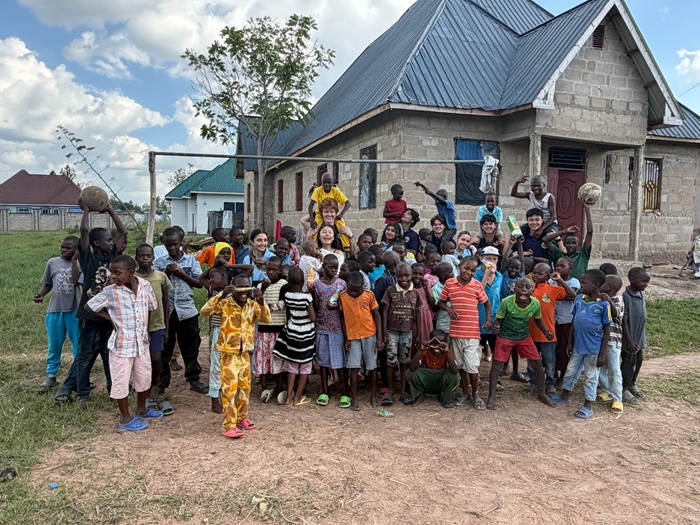
(Photo above) The Service Learning in Africa cohort with children in Tanzania
You and your peers have launched a fundraising initiative with the Twende Education Fund – what inspired this project, and what impact do you hope it will have?
(Nate) We were asked constantly during our stay at SAUT, “How can I come to Canada?” It was hard to admit we couldn't make that happen. Visa restrictions have closed the exchange path that used to bring students back with us.
Learning about the Twende Education Fund was the most inspiring part of the trip, and it's what convinced me to go in the first place. Twende was started by a previous group of Ivey students who spent years building a real relationship with SAUT faculty, laying the groundwork for a scholarship program that could actually run on the ground rather than exist only on paper. We got to be the group that helped bring that groundwork to life, working with faculty on student selection and tuition disbursement so this year's scholarships reached real students. None of that happens without the foundation Twende had already built.
Our focus now is on making sure this doesn't stop with us. A one-time visit rarely leaves a lasting mark, so we've worked to set the program up to hopefully run every year. If it works, our trip becomes one data point in something ongoing, built on top of everything Twende started.
What's made it even better is watching the Twende Education Fund grow past SAUT entirely. Our friends who did their service learning at Jomo Kenyatta University of Agriculture and Technology in Kenya ran their own fundraiser in partnership with Twende, and used it to help children with disabilities get access to a basic education. Seeing Twende take root in a second country, doing work that specific, tells us this isn't just a nice thing a few Ivey students did one summer. It's becoming something durable, and we're proud to have played a part in that.
Learn more about the start of the Twende Education Fund
How did working closely with local community members and students shape your perspective on leadership and social responsibility?
(Nisa) Working closely with local community members and students was one of the most meaningful aspects of my experience in Tanzania, and it significantly reshaped my understanding of leadership and social responsibility. Before the trip, I viewed leadership primarily as the ability to take initiative, generate momentum, and guide others toward meaningful progress. I believed strong leaders were dependable, adaptable, and capable of bringing diverse groups of people together. While I still value those qualities, my time at SAUT taught me many other leadership traits along the way.
One interaction that especially shaped this perspective occurred during a workshop we hosted on new venture creation using Ivey’s nine-step framework. As part of the session, we broke out into meetings with individual students or small groups to discuss their business ideas, identify potential gaps, and explore opportunities to make their concepts more feasible and sustainable. I spoke at length with one student who was also a club president. Despite her demanding schedule, she attended every mandatory Ivey case session and consistently participated in our optional workshops on entrepreneurship, professional skills, resumés, and interviews. She arrived prepared with an ambitious yet realistic business idea and demonstrated a level of commitment, curiosity, and professionalism that deeply impressed me.
Our conversation felt less like a traditional mentoring session and more like a genuine exchange of knowledge. We challenged one another’s thinking, explored possible risks, and considered how her business plan could grow within the Tanzanian context. This required me to be thoughtful about the advice I offered. Much of my business education has been shaped by a North American perspective, and I recognized that I could not assume every framework or recommendation would translate directly into another cultural and economic environment. I had to listen carefully and draw on what I had learned from students, faculty, my experience living on campus, and our course’s business cases to ensure that my suggestions reflected the realities in which her business would operate.
This experience changed the way I think about social responsibility because it showed me how important it is to first understand what people actually want and need before deciding how to contribute. Instead of assuming which topics would be most useful, we asked the students what they were interested in learning and built our workshops around those requests. This made the sessions feel more meaningful because we knew the students chose to be there and were gaining information they could realistically apply. It also reminded me that leadership is not always about being the person with the answer. Sometimes, it means listening closely, adjusting your approach, and making sure the work you are doing is guiding people in the right direction so it can be genuinely useful and create a lasting impact.
In future leadership roles, I will carry forward the importance of giving people my full attention. Meaningful guidance cannot be rushed. Taking the time to listen, ask thoughtful questions, and work through the endless possibilities alongside someone can help create the conditions for them to succeed. I entered Service Learning in Africa believing leadership was about directing progress; I left truly understanding that it is more about listening, learning, and empowering others to grow into a position to lead as well.
What was the most unexpected lesson you learned from this experience, either inside or outside the classroom?
(Jayden) The most unexpected lesson came from a phrase we heard almost every day in Tanzania: "pole pole," which means "slowly, slowly." Home had trained me to think of time as something you manage, and Ivey sharpened that instinct into a habit. Ivey teaches you to move quickly and make decisions with what you have, so I came in used to days that were measured by how much I got through them. When tasks in Tanzania took hours instead of minutes and schedules moved without warning, I assumed something was going wrong.
What I eventually realized is that "pole pole" isn't disorganization. It's a different set of priorities. People weren't rushing because they were focused on the conversation in front of them rather than the next thing on a list. Slowing down let me build much deeper relationships in three weeks than I would have otherwise, and it made the whole experience feel fuller. I went to SAUT expecting to teach business frameworks. I did not expect to come home rethinking how I spend my own time, but that is the lesson that stuck with me most.
How do you think this experience will influence your approach to your studies, career or leadership in the long-term?
(Jiya) Throughout my two years at Ivey, I became accustomed to the case-based learning method, where students are provided with the information they need and encouraged to contribute to the discussion. Teaching this methodology in Tanzania was a completely different experience. Limited resources, different learning environments, and teaching in English to students for whom it was not a first language challenged me to adapt my communication, think creatively, and meet students where they were. It showed me that effective leadership is not about having the perfect plan, but about being adaptable and creating an environment where others can succeed. It also reminded me that some of the greatest opportunities to learn come from stepping outside your comfort zone and embracing unfamiliar situations with an open mind.
This experience reinforced the impact that taking initiative can have. Rather than waiting for the right opportunity, I learned that meaningful change often comes from stepping forward, building relationships, and finding ways to contribute wherever you can. Seeing the confidence and engagement of the students throughout the week showed me how much of a difference one person's initiative can make. As I begin my career in consulting at KPMG, I'll carry this mindset with me, approaching new challenges with curiosity, adaptability, and a willingness to take initiative, knowing that even small actions can have a meaningful and lasting impact on the people and organizations around me.