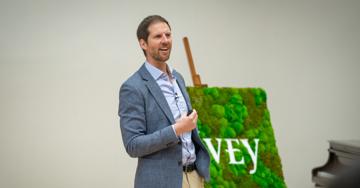
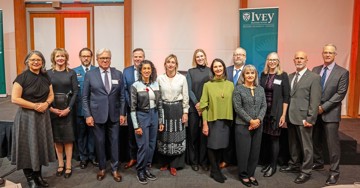
Twenty years after delivering the inaugural lecture that now bears his name, Thomas d’Aquino, C.M., returned to Ivey to address HBA1 students – a cohort likely not yet born when the series began – at the 20th Thomas d’Aquino Lecture on Leadership.
“I tried to distill in just a few words the essence of leadership… I talked about ambition and integrity… knowledge, vision, humility,” he said, reflecting on that first lecture two decades ago.
Hosted by Ivey’s Ian O. Ihnatowycz Institute for Leadership, d’Aquino’s address, Business Leadership in a Time of Crisis, was followed by a fireside chat with Ivey Dean Julian Birkinshaw.The London lecture followed a milestone event in Ottawa, where d’Aquino delivered the 20th anniversary lecture to a record audience, reflecting on five decades of leadership through the Business Council of Canada.
d’Aquino revisited those early ideas, noting the attributes remain just as important today, before turning to character – the focus of the Ian O. Ihnatowycz Institute and something he now sees as central to leadership.
“Leadership begins where character is tested and not where authority is granted. Titles may confer power, but only character really confers legitimacy,” he said. “In calm waters, competence may suffice. In turbulent times, it’s character that determines whether a leader bends, breaks, or prevails.”
d’Aquino described today’s environment as unusually unstable, shaped by geopolitical tension, economic uncertainty, and weakening global institutions.
“We are living in a time of crisis. Business leadership in Canada, as well as throughout the democratic world today, is confronted with a dizzying array of challenges arising from the disruptive geopolitical fracture that is wreaking across the globe,” he said.
A pivotal moment for Canada
He highlighted the erosion of the rule of law, fractured international trade systems, and rising protectionism as key concerns. He also cited conflicts in Ukraine and Iran, along with growing tensions between the U.S. and China, as part of a broader shift away from the postwar global order.
“It’s everybody for themselves. It’s the law of the jungle,” he said. “How do you run a business if you do not have stability? How do you run a business if the rules are changing every day?”
At the same time, d’Aquino described this period as a turning point for Canada, with an opportunity to play a larger international role. He referenced recent remarks by Prime Minister Mark Carney, who described this period as a “hinge moment” in history.
“Canada is a bridge. We are a bridge between Europe and Asia… [and] coordinate among the democratic countries,” he said.
He also stressed the importance of unity at home, citing internal trade barriers and regional tensions, including separatist pressures in Quebec and Alberta.
“Unless you hang together, you’re all going to hang separately,” he said.
The role of business leaders
A central theme of the lecture was the responsibility of business leaders to speak up when economic stability is at risk.
He warned about the return of tariffs, recalling their role in triggering past economic crises.
“The last great encounter that we had with tariffs was back in the 1930s… and the result of that was a huge economic depression,” he said.
d’Aquino said too many business leaders have remained silent in the face of policies that undermine trade and stability, describing it as “the silence of the lambs.”
“Part of that leadership is speaking out, especially if you know that you’re on the right side. To do that requires character,” he said.
He illustrated this with an early experience as CEO of the Business Council of Canada, when he publicly opposed a federal budget measure that would have negatively affected low-income Canadians. The stance drew significant backlash, including calls for his dismissal, but he held firm – a decision that ultimately led to the government withdrawing the measure. The experience reinforced the importance of acting on principle.
Building resilience
While much of the discussion focused on global pressures, d’Aquino also stressed the need to strengthen Canada’s domestic economy – particularly in productivity, internal trade, and resource development.
Responding to student questions on affordability and the cost of living, he said those concerns are real but tied to broader economic performance.
“Unless we have growth, the affordability crisis is not going to be resolved,” he said.
He pointed to opportunities in natural resources, artificial intelligence, and advanced manufacturing, as well as the need to remove barriers that slow development and investment. He also noted Canada’s strong fundamentals – its resources, financial system, and democratic institutions – as reasons for continued confidence in the country’s long-term prospects.
Advice for future business leaders
Speaking directly to students, d’Aquino framed the current moment as both challenging and full of possibility.
“I’m talking to the future leaders of this country. This is also a huge moment for you,” he said. “You are at a moment in time where you’re entering this world of turbulence… It’s not an easy time. It’s also a time of exponential change.”
While acknowledging that many graduates may look abroad, he encouraged the students to consider the opportunities in Canada and the role they can play in shaping its future.
“All I would ask you to do is take a really good, hard look at what is on offer here,” he said.
After a decade of concern about Canada’s direction, he said he is increasingly optimistic – particularly because of the next generation preparing to take on leadership roles.
“For the first time in a decade, I’m now feeling much more bullish about the possibilities of this country,” he said.
Related Articles