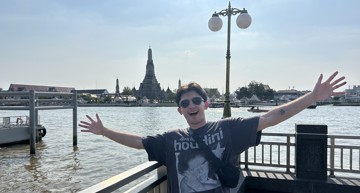
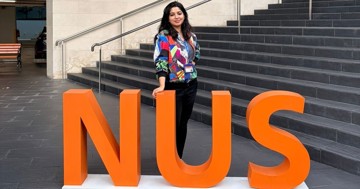
What began as an opportunity for MSc ’27 candidate Tanishtha Thakur to explore her curiosity about restaurant technology became a much broader lesson in business, leadership, and herself. During her two-month Ivey Global Lab placement with HatoHub in Thailand, Thakur worked with an Ivey student team, which also included Omar Elhaw, Noor Soliman, and Jingyi Zhao, on an AI-focused project while immersing herself in a new workplace and culture.
There’s a saying that the experiences we choose to explore teach us far more about ourselves than the thing we set out to discover, and that sentiment captures how I feel about my Ivey Global Lab experience in Thailand. I went in hoping to better understand a new industry. I came back thinking differently about work, people, leadership, and myself.
My placement with HatoHub allowed me to step into the world of restaurant technology – an industry I had always been curious about but never explored firsthand. The Global Lab gave me the chance to test that curiosity by working with three other Ivey students on research, product ideation, and execution strategies for HatoHub.
Curiosity brought me to the placement
I have always been fascinated by the intersection of technology, business, and customer experience. Restaurant technology was particularly interesting to me because restaurants are operationally complex businesses. Customers, servers, managers, kitchens, payments, menus, loyalty programs, and customer data are all interacting simultaneously.
My first impression was that I had entered an environment where there was a genuine willingness to experiment. Rather than simply observing how the business operated, we were encouraged to understand its challenges and think about what could be built to address them.
From a roadmap to real problems
One of the most exciting parts of the experience was working with my Ivey team on an AI-focused roadmap for HatoHub. We researched opportunities and developed concepts for future product development, including a Consulting AI and Hato AI.
Hato AI, which I led, was a new solution our team conceptualized for HatoHub. Initially called Customer Brain AI, it was designed as an AI-enabled database and chatbot that could help restaurants better understand their customers and operations in real time.
Instead of simply presenting data, the system could provide actionable insights about customer sentiment, trending menu items, operations, customer behaviour, and other signals that could help a restaurant make better decisions.
We also thought carefully about the different people who would interact with these tools. A manager does not need the same information as a server. A server might need customer preferences and recommendations at the table, while a manager might need a broader view of operations, trends, and risks.
That distinction became an important lesson for me: good technology is not simply about how much information you can provide. It is about providing the right information to the right person at the right moment.
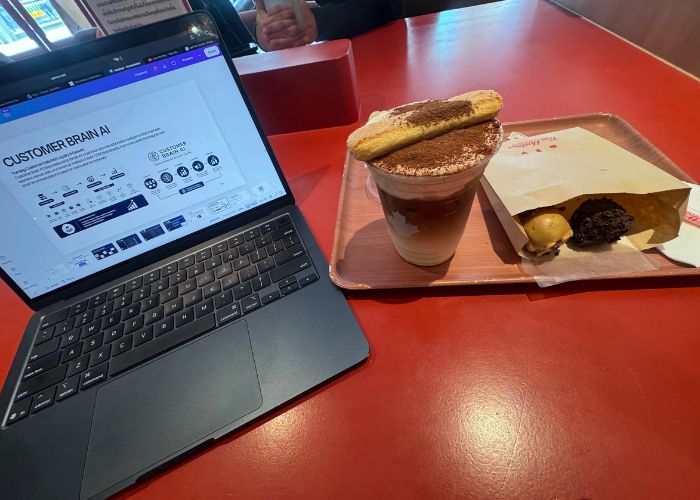
(Photo above) Customer Brain AI in the works
When inclusion becomes motivation
Some of my strongest memories of HatoHub have nothing to do with the technology we were building, but with how the people around us made us feel.
Two employees, Jake and Nana, made a conscious effort to ensure we were fully involved in the organization. There were meetings and conversations we could easily have been left out of. Instead, they invited us in.
We were included in morning updates, meetings, and conversations across the business. Even our smallest suggestions were heard and appreciated. That was motivating. When you know even a small contribution is genuinely valued, you naturally want to contribute more.
It showed me that inclusion is not just about making people feel welcome; it can also change how much they are willing to contribute.
A two-way learning experience
The same feeling extended to our interactions with Darin Suthapong, HatoHub’s CEO.
What stood out to me was how open he was to our ideas, even when they were unconventional or outside what might traditionally be expected from students on a short-term placement.
Our conversations never felt one-way. We were learning from Darin, but he also made us feel he was genuinely interested in learning from us. He gave our opinions weight. We did not feel like students completing an assignment; we felt like contributors whose ideas could potentially influence something that would actually be used.
For someone aspiring to become an entrepreneur, that was incredibly valuable. Meeting a leader who combines experience with curiosity and openness showed me the kind of environment I would want to create someday. It reinforced the idea that leadership does not have to mean having all the answers. Sometimes, it means being confident enough to listen to others.
The culture beyond the workplace
Our cultural immersion extended far beyond the office. The HatoHub team took us out for lunch, introduced us to local cuisine, and helped us understand Thailand through everyday experiences rather than simply as visitors.
Even language became a deliberate act of inclusion. Meetings were conducted in English so that we could follow the discussions and understand what was happening across the organization.
These details may seem small, but collectively they made a huge difference. We were not simply working in Thailand; we were being given an opportunity to participate in the culture around us. The people at HatoHub did not expect us to adapt to everything on our own. They met us halfway.
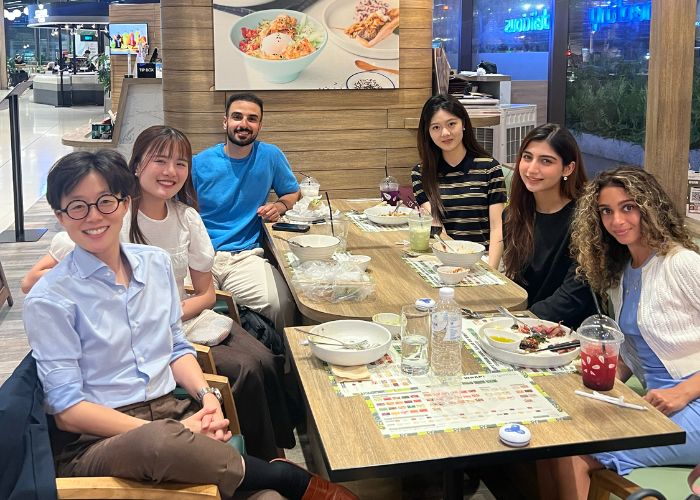
(Photo above) Having lunch with the HatoHub team
Learning to work differently
One of the most memorable parts of the Global Lab was experiencing a different workplace culture in Thailand.
At HatoHub, we worked across levels and functions – from the CEO and supervisors to the IT team and CTO. Everyone brought a different perspective, and the best ideas often emerged when those perspectives came together.
There was also a sense of fun in the workplace that I found refreshing. HatoHub made a conscious effort to create an environment where people wanted to come into the office, contribute to the product, and enjoy working with one another.
The challenge was not always the work
Ironically, some of the biggest challenges we faced had less to do with the technology itself and more to do with working as a team.
Everyone approached the experience differently, and we each had different expectations and working styles. That forced me to adapt. I had to learn when to push, when to step back, when to motivate someone, and when to give people the space to work in their own way.
Most importantly, I learned that bringing a team together does not mean making everyone work in the same way. It means understanding what each person brings to the table and finding a way to make those differences work toward a common objective.
Looking back, that was one of the most valuable lessons of the entire experience.
A mentorship that stays with you
Darin’s mentorship was another defining part of the experience. In a short period of time, he understood our strengths, personalities, and working styles and challenged us accordingly. His mentorship went beyond the project itself, encouraging us to think about how we showed up professionally and interacted with one another. His guidance is something I will carry with me long after the Global Lab.
A new perspective on business and leadership
The Global Lab changed the way I understand business. Before this experience, it was easy to look at business through a relatively conventional lens – growth, revenue, strategy, and results. But spending two months working in a different industry and cultural environment made me realize that business can be about more than financial outcomes.
For me, business is increasingly about service. An idea may originate in my mind and be shaped by my ambitions, but its true value comes from what it gives to other people. Whether that is a product, a service, an experience, or a solution to a problem, I now see business as an opportunity to create something meaningful for the people and communities I serve. That has made my ambitions feel much more personal. I want to build things that create change - not just externally, but within me as well.
My understanding of leadership has evolved similarly. I have always considered myself a leader, and I have always tried to bring people along with me rather than moving forward alone. But the Global Lab taught me the importance of creating space – knowing when to step forward, when to step back, how much support to provide, and when to let someone else take ownership.
I also learned a great deal about myself, particularly about people management and the importance of maintaining a healthy separation between my personal and professional life. Most importantly, the experience reinforced something I have always believed: kindness, understanding, and a genuine desire to help others matter. HatoHub was a powerful reminder of that.
What I would tell future Global Lab participants
My biggest piece of advice to future Ivey Global Lab participants would be simple: choose an industry you have always been curious about but never had the opportunity to explore. The Global Lab is an opportunity not only to learn about a business or a country, but also to learn about yourself.
Do not be afraid to choose something outside your comfort zone. The unfamiliar situations, the different people, the unexpected challenges, and even the moments when things do not go according to plan are often the experiences that shape you the most.
My two months in Thailand were among the most formative months of my life. Every part of the experience contributed something – the country, the people, the workplace, the cultural immersion, the challenges we faced as a team, and even the everyday experience of building a routine somewhere completely new. I changed, piece by piece.
I went to Thailand hoping to explore a new industry and test myself professionally. I came back with a deeper understanding of business, leadership, teamwork, and myself.
Most of all, I came back with a connection to a country that will always hold a special place in my heart. I will always be grateful to Ivey’s Global Lab for giving me the opportunity to experience Thailand – not simply as a place to work, but as a place to learn, grow, connect, and discover. I know I will always love Bangkok and Thailand because of it.