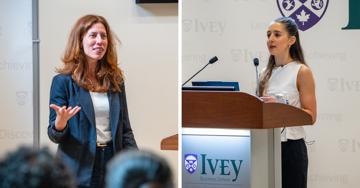
For years, Chris Cull was trying to escape his life. At his lowest, he weighed 139 pounds, stole food to survive, and had been, in his own words, “labelled a junkie” and written off by nearly everyone who once cared about him.
Today, Cull is a motivational speaker, filmmaker, health-care worker, and policy consultant who has advised organizations including Ontario Health and the World Health Organization, as well as the Canadian Minister of Health and the United Nations.
He shared his story with HBA1 students during HBA Leadership Day, an annual event hosted by the Ian O. Ihnatowycz Institute for Leadership that asks students to think about leadership through the lens of character, resilience, and judgment.
“Today is about who you will be as a leader – your character, not just your competencies,” said Dusya Vera, PhD ’02, Executive Director of the Ian O. Ihnatowycz Institute for Leadership, in her opening remarks.
Vera told the students that while technical skill may open doors, it won’t tell them how to respond when conditions change quickly.
From adversity to resilience
Cull’s story brought that message into focus. When he was 18, his father, a paramedic, was diagnosed with Huntington's disease. As the illness progressed, his father spiralled into heavy drinking and repeated suicide attempts, and Cull became his caregiver while trying to finish college. He described those years as “living on a knife's edge of stress.” When he was 21, his father died by suicide.
Having already turned to opioids to cope with the stress of caregiving, he said his drug use escalated after his father's death. That addiction lasted nearly a decade and cost him his fiancée, the mortgage-free home his father had left to him, and more than 50 pounds.
Cull told the students the turning point came while he was working as a cashier at Walmart. After a difficult interaction with a customer, Cull quit and began thinking about what he would do if he could do anything at all. His list included everything from skydiving to riding his bike across Canada.
“It all became about creating a life I didn't want to escape from,” he said.
One influence was psychiatrist Viktor Frankl’s Man’s Search for Meaning, a memoir and psychological reflection on Frankl’s experiences in Nazi concentration camps, which Cull said changed the way he understood his experiences.
“I realized if he can go through all that and turn it around, what's to say I can't?” he said.
In 2014, after working his way off methadone, Cull cycled from Victoria, B.C., to St. John’s, N.L., documenting the experiences of people affected by addiction and the opioid crisis. He turned the experience into the film Inspire and later rode across Canada a second time.
Cull said the journey changed the way he thought about resilience. For him, resilience grew out of facing hard things directly and learning from them.
“It wasn’t my circumstances that changed; it was my perception of my circumstances,” he said.
He also said he has come to understand his own mental-health challenges differently, and to see parts of that experience as helping him to navigate difficult situations.
Cull described leadership as taking responsibility for how you act, how you think, and how you affect the people around you.
“Building relationships can open doors that skills alone can’t,” he said.
Learning from leaders
Cull’s story was followed by a leadership panel featuring Jeannine Pereira, HBA ’95, Director, Talent Development at EY Canada; Luke Schauerte, CEO of Woodfibre LNG; Franca Gucciardi, COO at CIFAR; and Kathy Woods, Partner, Future Ready Organization, Deloitte Canada (retired).
“Drawing on her own time at Ivey, Pereira encouraged the students to speak up before they feel fully ready and to treat mistakes as part of learning.
“Courage actually is moving forward in the face of fear,” she said.
Schauerte shared a lesson he learned after being demoted early in his career because he lacked experience. With a young family and uncertainty about his next move, he considered leaving for a job in Australia. But he remembered his father’s advice: “Just stay the course. Take a minute. Life’s a little bit longer than you think. Not everything has to happen today. It’ll work out.” Three months later, several people who had been promoted ahead of him left the organization, and Schauerte took on their roles.
He told the students to stay the course and keep taking the next step, even when progress feels slow.
Gucciardi said one of her biggest lessons was realizing that leaders do not need to have all the answers. She described growing up in Jane and Finch as a first-generation university student and feeling that she had to work harder, do things herself, and know the right answer. Over time, she said she learned that a leader’s role is often to ask questions, create the conditions for others to contribute, and bring people together.
Woods discussed the importance of being yourself. Early in her career, she said she tried to conform to corporate expectations and held herself back. She eventually learned that being authentic, respectful, and caring made a difference in how she led.
“You can be you,” she said. “You’re here because we need an eclectic, diverse group of people to bring different skills to the table.”
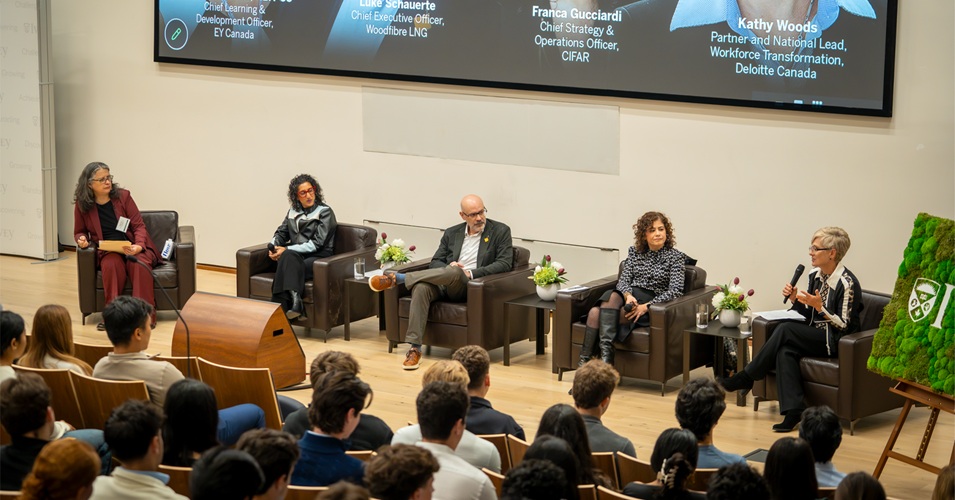
(Photo above) The panel, l-r: Dusya Vera, Jeannine Pereira, Luke Schauerte, Franca Gucciardi, Kathy Woods.
Character in practice
The discussion also touched on self-doubt, setbacks, resilience, and the many ways people define success over the course of a career.
After the keynote and panel, the students returned to their sections for mini-case discussions on crucibles of leadership – high-pressure moments that test judgment and character. The day also included a Leadership Café, where students could have informal conversations with some of the leaders who had participated in the day.
After losing much of his 20s to addiction, Cull said he has found purpose in using his experiences to help others.
“I lost the entirety of my 20s to opioid addiction,” he said. “But if you’re going to take anything away from my story, I hope it’s that you can come back from whatever chaotic situation you’re in and turn into something beautiful.”
Related Articles