For Matt Sooy, Ivey’s HBA Faculty Director, the lesson began in a cold swimming pool.
As a former competitive swimmer, Sooy said he learned early that progress rarely begins in comfort.
“Warm water is great for relaxing. It’s comfortable, but it’s terrible for challenging yourself, for improving, for striving,” he told Ivey’s incoming HBA1 students. “If you want your best, you want cold water.”
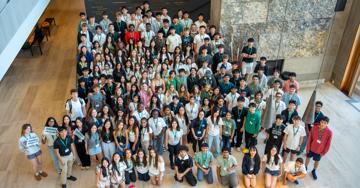
Sooy brought that lesson to the Opening Gala at RBC Place London, where 780 incoming HBA1 students gathered to begin O-Week 2026. The theme of this year’s event was A Leap of Faith.
“The water is cold. It stuns you. It takes your breath,” said Sooy. “And in a month or two, you won’t even notice the leaps you’re making every day. You’ll be so focused on the swimming – and I hope swimming further and faster than you ever thought you could.”
Taking the first leap
The morning began with remarks from HBA ’27 candidates Ryan Doerr and London Luyks, who organized and emceed the event, followed by other O-Week leaders and HBA Association representatives.
“Over 7,000 people apply to Ivey every single year, and the 780 of you are the ones that got in,” said Devin Chauhan, an HBA ’27 candidate and HBA Association President. “You didn’t get in by accident. You’re sitting here because you showed Ivey who you are, and they saw something worth admitting.”
Scott Loveland, MBA ’17, associate director of the HBA program, told the students the case method will ask them to make decisions without complete information.
“That discomfort isn’t a sign that you’re actually falling behind. It’s the sign that you’re learning,” he said. “That starts today with the person next to you and the courage to lean in and, dare I say, take a leap of faith.”
Esra Osman, an HBA ’27 candidate and HBA Association vice-president, student events, reminded the students they had already taken risks to get to Ivey.
“Somewhere along the way, you took a chance,” she said. “At some point, you had to leap without knowing exactly where you’d land. It’s a leap of faith, and the good news is you’ve already proven you know how to take one.”
Osman, who helped organize O-Week alongside Head OWL (O-Week Leader) Luke Ducheck, said she nearly talked herself out of leadership opportunities during first year and urged the students not to wait for certainty before stepping forward.
“Sometimes being ready means not having the right answer, but recognizing that doing nothing costs more than doing something,” she said. “So raise your hand, introduce yourself, apply for the role, share your ideas and, most importantly, ask for help.”
Ducheck built on that idea with a parable about a Mexican fisher who was content with a simple life, in contrast to a Harvard-trained banker who was chasing more – only to end up chasing his way back to the simple life he started with.
His challenge to the incoming class: don't let ambition erase what already matters.
"Use ambition as a tool, but do not lose sight of what has been with you the whole time," he said.
Building trust
Martha Maznevski, PhD ’94, Associate Dean, Programs, told the students that courage alone is not enough – trust matters, too.
“I love the theme of this week – the leap of faith,” she said. “It fits with a lot of what I teach as an organizational behaviour professor about the importance of courage over confidence and the importance of trust. To take a leap of faith, we need to have courage, yes, but also trust.”
Maznevski said trust has two parts: “head trust,” or believing someone will do what they say, and “heart trust,” or believing someone has your back.
She said both are built through shared experience – the kind students will have in classrooms, case discussions, and group work throughout the HBA program.
“You’ll do 300 cases together with the people in this room,” she said. “You’ll walk into a room knowing something and walk out completely changing your mind, and you’ll do that because you and the people with you are building knowledge together, learning that it’s OK to be wrong together, and building up that trust.”
Over time, she said, the people sitting beside them may become the people they call years from now.
“The Ivey program is structured for you to build trust,” Maznevski said. “That’s the magic of the leap of faith.”
A non-linear career path
Morley Ivers, HBA ’01, co-founder and CEO of Cookin, delivered the keynote address and told the students that careers rarely move in a straight line.
Twenty-eight years ago, Ivers was wait-listed for the HBA program. After advocating for himself, he earned a spot in the class. Later, between HBA1 and HBA2, he left to pursue a business opportunity before returning to graduate on the Dean’s Honour List with the Class of 2001.
“My path was not straight. It never has been,” he said.
After Ivey, he built and sold businesses in sectors including loyalty points, recycling technology, health insurance, ticketing, and smart-home devices. One company, Nucleus, ended in a legal settlement with Amazon after it released a competing product.
“I got my behind kicked,” Ivers said. “It still hurts to sit today.”
Drawing on that career, he shared four lessons with the students.
The first was to lean into a superpower, even before it is fully defined. The second was that experience compounds, including the experience that comes from setbacks.
“You might not know what your superpower is today, and that is perfectly fine,” he said. “I’m still learning some of mine along the way.”
The third was not to confuse progress with payoff. He told the students they’ll see their classmates reach milestones on different timelines, but they should remember that careers are long.
“Progress is different from payoff,” he said. “Progress is judgment, the network, your capabilities, your resiliency, and your credibility.”
He said payoff is visible, but progress is not. He urged the students to stay in the game long enough for progress to become payoff.
The fourth lesson was that a mission can stay the same even if the work changes. Looking back, he said, ventures that once seemed unrelated now make sense as steps toward Cookin, a platform that helps chefs build food businesses.
“I could never have designed this looking forward,” he said. “It only makes sense now looking backwards.”
After hearing the earlier speakers, Ivers added one more lesson: pay attention to the people beside you. He said many of his co-founders, investors, board members, colleagues, mentors, and customers were people he had met much earlier in life, including HBA classmates who later invested in Cookin.
A pledge and a reveal
After the speeches, the incoming class took part in two traditions that mark the start of the HBA experience. Led by Elizabeth Swiston, HBA ’26, the students recited the Ivey Pledge before learning their sections – 10 groups of 78 students who will work together throughout HBA1. It was the first introduction to the smaller groups that will shape much of their first year.
“Pay attention to the people beside you,” Ivers told the students. “They’re really going to matter.”
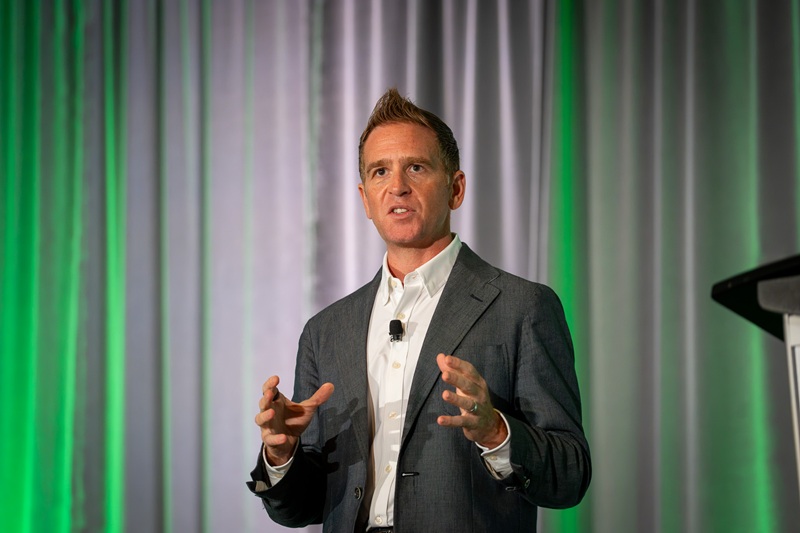
(Photo above) Morley Ivers, HBA ’01
Related Articles