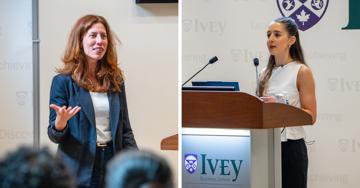
Think of Prince, then a very good Prince cover band. That was journalist Jacob Ward’s analogy for artificial intelligence at Ivey’s 2026 Character Leadership Conference.
“AI is a cover band. It may play some songs that you didn’t know Prince had written, but that doesn’t mean it wrote anything ... It’s a greatest-hits machine,” he said.
Ward, a former correspondent for CNN, NBC News, and PBS and author of The Loop, delivered the closing keynote at Ivey’s 10th annual conference, themed Beyond the Prompt: Character Leadership in Times of AI-Driven Change. One question ran through the day’s discussions: as AI takes on more tasks, who decides when to use it, checks its recommendations, and takes responsibility for the outcome?
“It is hard to know whom to believe,” said Dusya Vera, PhD ’02, executive director of the Ian O. Ihnatowycz Institute for Leadership, in her opening remarks. “Some voices say these tools will dull our thinking. Others promise they will make us sharper and freer than ever.”
Vera said AI can optimize and amplify whatever people ask of it, but it cannot decide what is worth asking for. She asked the attendees to bring judgment, courage, and integrity to the decisions they delegate to AI.
"Character matters more now, not less. When intelligence is everywhere, what becomes precious is the judgment to decide what it is for, the courage to say no when it is easier to let the machine decide, and the integrity to answer for a decision afterward. None of that can be downloaded," she said. "Don’t treat this as a day to hear about AI. Treat it as a day to think about who you want to be as a leader while using it."
Faktor: character is the advantage that can’t be copied
The conference opened with Candice Faktor, HBA ’00, co-founder and CEO of Disco and one of Ivey’s AI Fellows. Faktor said character and judgment will set people and organizations apart as AI becomes widely available. She cited an OpenAI study in which judges chose AI’s work on a complex task 83 per cent of the time, up from 12 per cent in 2024.
“If everybody has the same AI, that can’t be what gets you alpha. What gets you alpha is you. It’s your character,” she said. “The wisdom to figure out … where we should point it … is an incredibly important step before you actually use the AI. It’s also the taste to refine it.”
Faktor called it a “character sandwich”: wisdom comes before asking AI to solve a problem; judgment and accountability come into play when assessing its response. She said organizations should use AI to support human collaboration and meaningful work, not just to cut costs.
"You can't outsource your craft and character muscles to AI. You have to use your craft. You have to use your character. Flourishing is character in action," she said. "If you choose that you want to be somebody who is leading with character and creating a flourishing environment, that's where the growth and freedom comes from ... Character is truly the force of your point between whether you're languishing and drowning, or whether you're riding this wave and flourishing."
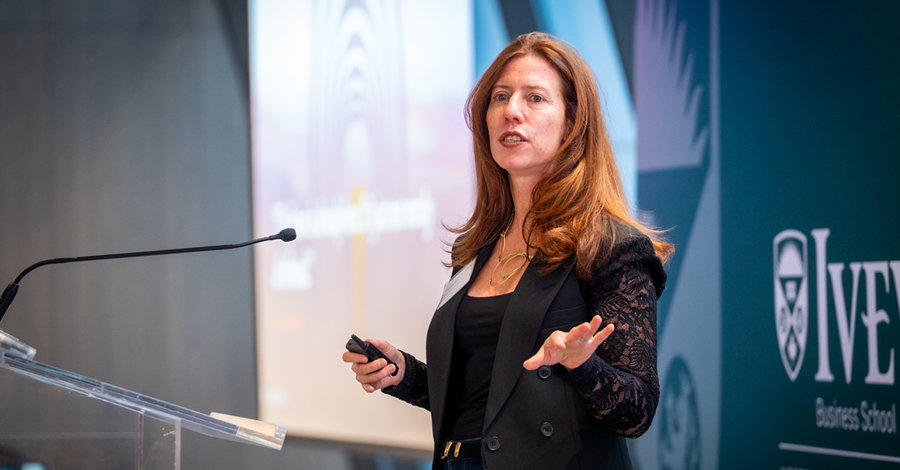
(Photo above) Candice Faktor delivering the opening keynote
The implications for work, creativity, and leadership
The conference program then shifted from big ideas to practice. Associate Professor Lucas Monzani shared an update about "The Character Engine", a project with an inter-disciplinary team including Dusya Vera, Mary Crossan, Corey Crossan Stevens, Bob Mercer, Ana Ruiz Pardo, and Sudipta Singha Roy. This AI tool measures character through narrative and is a state-of-the-art project in character measurement. Its application for research and teaching has important implications for the future of character development.
Turning to the workplace implications of AI technology, Ivey Professor Emeritus Mary Crossan, MBA ’85, PhD ’91, BMO’s Bojan Pavlovic and Google’s Mark Ryan discussed how AI could affect entry-level roles with panel moderator Laurence Mussio, Chair of The Long Run Institute. A central question they explored was, If AI takes the junior work, where are the next leaders formed? These are the roles where people build expertise, start to hone their judgment, and develop as leaders. Mussio also noted the importance of that development .
"Intelligence is now the cheapest thing in the building. Judgment is the only thing left that costs what it is worth," he said.
In an afternoon discussion moderated by Seemantini Pathak, Juan Luis Suárez of Western University and David Pickersgill of Barry-Wehmiller explored creativity and human judgment.
Suárez emphasized the vital role of lived experience in the creative process. Pickersgill said AI can mimic conversation, but conversation alone does not communicate care, love, or responsibility. As a lighthearted example, he noted that although his dog cannot speak, he still experiences its love and affection.
“I can snuggle with my dog if I want to … These are things that only living creatures can have and connect with, and these are the most important things,” he said.
Corey Crossan, executive director of Virtuosity, presented an afternoon session on behavioural forecasting. Her session looked at how a leader’s character affects the way they use AI. In a hands-on exercise, participants considered how their intentions and character could shape their use of AI and its effects on others.
Ward: the case against outsourcing judgment
Ward said AI can put people’s judgment on autopilot. He described driving on the opposite side of the road in England while making a documentary. The unfamiliar conditions kept him alert. He contrasted that with a familiar drive, which he said people may complete with little memory of the trip.
“Your brain is a shortcut machine. It’s built to take shortcuts wherever it can,” he said.
Ward cited research suggesting AI can narrow ideas, reduce collaboration among scientists, and make people more confident in wrong answers. In one study, endoscopists in Poland who received bad AI guidance were still likely to follow it and performed worse.
“It fools you into thinking: this system has told me I’m right, and so I must be right,” he said.
Ward recommended using AI only after people have built expertise. He urged organizations to preserve entry-level opportunities, protect time saved through automation for mentorship and training, and keep people practising skills they may need if a system fails. He argued that decisions with serious consequences need some friction, giving people time to think, question, and take responsibility.
He also pointed to some of the valuable work being done with AI, such as the Vesuvius Challenge, which uses AI to read 2,000-year-old scrolls buried in Herculaneum by the eruption of Mount Vesuvius.
“I have a ton of use cases for AI ... that are incredibly redeeming for humanity that nobody’s going to make a profit on,” he said.
Bill Furlong receives the Mary Crossan Leader Character Award
The day included the presentation of the Institute’s annual practitioner award, now named the Mary Crossan Leader Character Award in honour of Crossan’s 41-year career at Ivey and seminal work on character leadership.
Its first recipient under the new name was Bill Furlong, MBA ’87, a former vice-chair at TD Securities and executive-in-residence at the Ian O. Ihnatowycz Institute for Leadership.
In his acceptance remarks, Furlong said character development never stops.
“Whatever strength of character you have, you’re probably going to need more. I need more,” he said.
He encouraged the leaders to keep building character and to look beyond caution.
“I’m not sure how you have landed up here today. But however that happened, you find yourself at one of the most important, impactful, and consequential moments in history,” he said. “Given our privileged position, we have the opportunity, indeed responsibility, to make a profound and positive contribution to not only our lives, but the lives of everybody who we know, and for generations to come.”
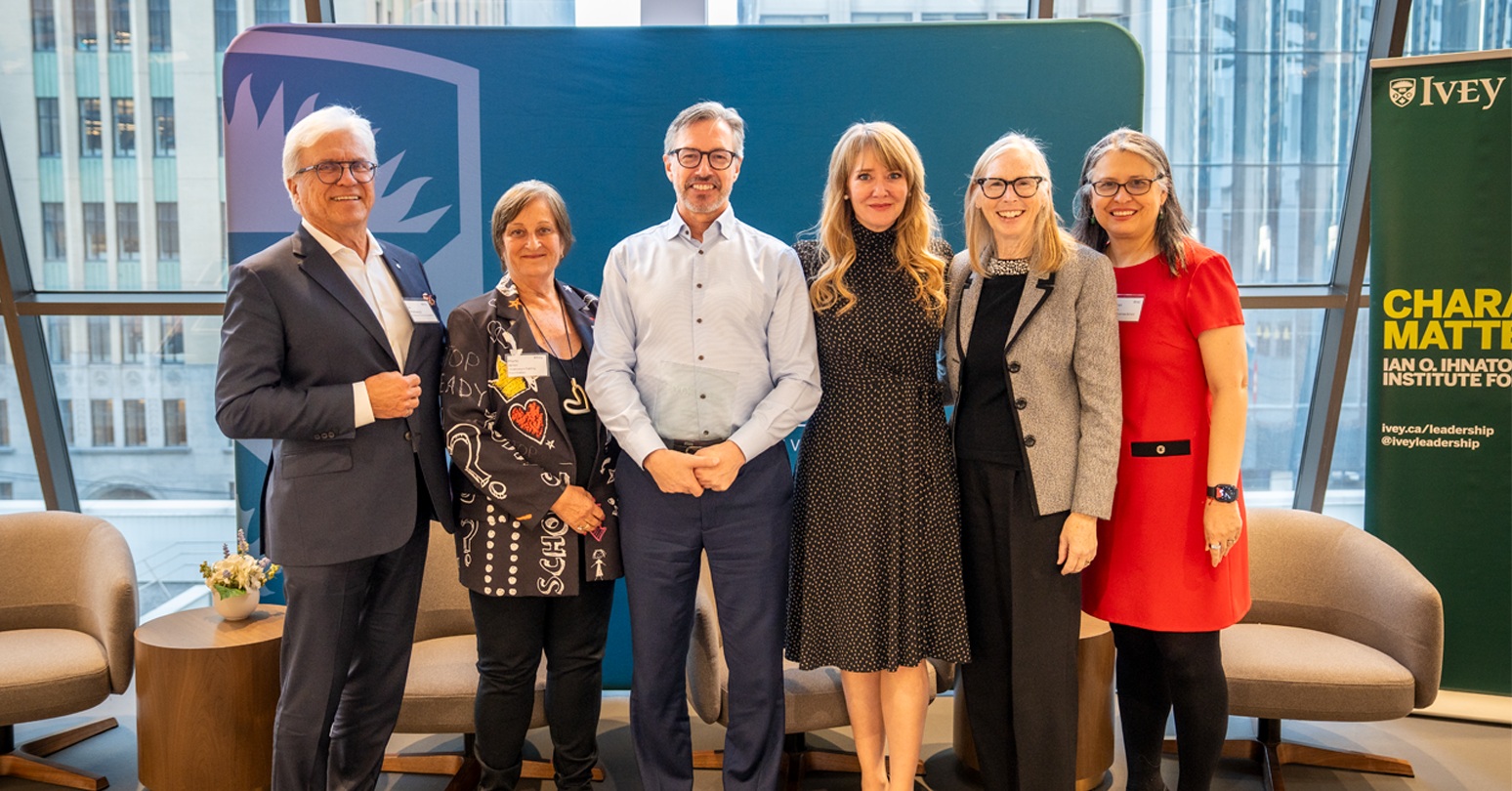
(Photo above) l-r: Ian Ihnatowycz, MBA ’82, LLD ’13, and his wife, Marta Witer; Bill Furlong; Kimberley Young Milani; Mary Crossan; and Dusya Vera
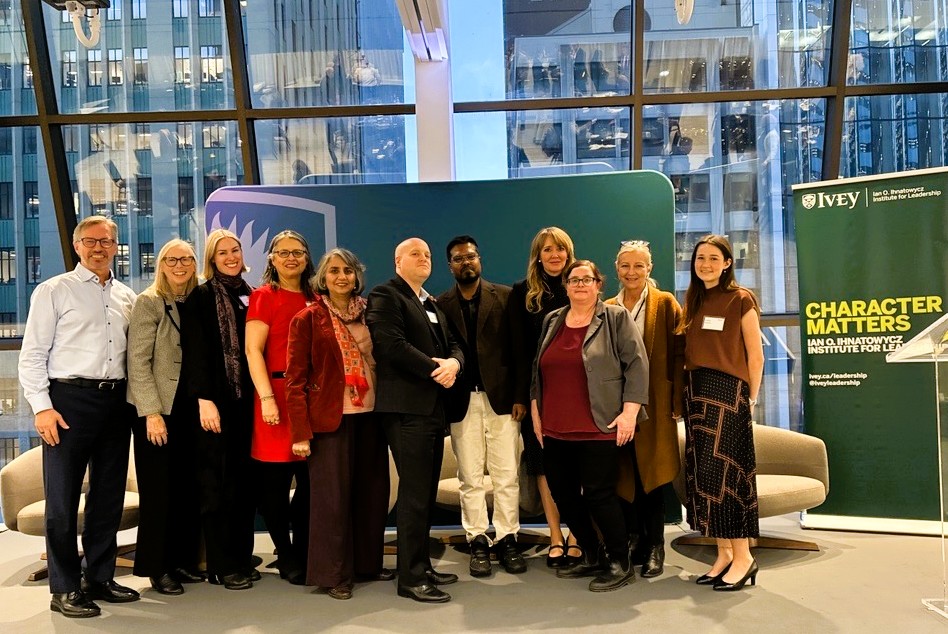
(Photo above) l-r: Bill Furlong, Mary Crossan, Corey Crossan, Dusya Vera, Seemantini Pathak, Lucas Monzani, Sudipta Singha Roy, Kimberley Young Milani, Laurie Quinlan, Marlene Janzen Le Ber, and Kirsten Swatuk
Related Articles