Giving to Ivey
Building What's Next
Siblings Rosamond Ivey, HBA ’82, LLD ’18, and Richard W. Ivey, HBA ’72, LLD ’13, are continuing their family's nearly 80-year partnership with the School by funding what business education needs next.
By Sara Kelly
The Ivey family’s involvement with Ivey Business School and Western University spans nearly 80 years and three generations. The latest chapter builds on that legacy while focusing on the future, through recent faculty chair gifts from siblings Rosamond Ivey, HBA ’82, LLD ’18, and Richard W. Ivey, HBA ’72, LLD ’13.
Rosamond sees these gifts as closely aligned with the School’s strategy: “[They] fit within Ivey's Bold Ambition, which is to build on the School's legacy of leadership in business education in Canada, with an eye focused on what's coming.” Rosamond's and Richard's generous gifts, combined with Dean's Chair Matches of $5 million, represent a total investment of $12.5 million to advance faculty excellence, research, teaching, and thought leadership.
"We look at our relationship as a partnership between the School, the University, and the family, financially, strategically, and even operationally," adds Richard. "The real driver for us has always been supporting excellence.”
A Launchpad for Character
Rosamond’s most recent investment will establish a Chair in Leader Character within the Ian O. Ihnatowycz Institute for Leadership. The new chair will play a central role in the Institute’s vision to become a global incubator for leader character research and education.
The seed for the gift was planted when Rosamond read about businessman and philanthropist Stephen Jarislowsky's initiative to fund chairs in Trust and Political Leadership at five Canadian universities. Around the same time, she read an article in Intouch about Ivey's Ian O. Ihnatowycz Institute for Leadership, established in the aftermath of the 2008 financial crisis by Ian Ihnatowycz, MBA ’82, LLD ’13.
“That was really the spark of my interest,” she recalls. Drawn to the Institute’s focus on elevating leader character along with competency and commitment, she realized that “what Ivey is creating through the Institute is something that’s new.”
“There isn’t any corner of our society … that wouldn't be enhanced by people having a greater vision of the common good,” Rosamond believes. She recognizes the need for leaders whose humanity is “based on a broader vision than just the success of the business that they run.”
Teaching character, Rosamond understands, is not obvious. “People think, ‘What do you mean teaching character? It’s too subjective,’” she says. “But the Institute has proven through its evidence-based research and programming that there is a real opportunity. The more I learned about what the research shows, the more enthusiastic I became about the Institute disseminating its expertise and the impact possibilities.”
Rosamond hopes her investment will act as a launchpad.
A chair is fundamental to the entire vision of the Institute and what it wants to do: building strategic partnerships with global programs in higher education that include a leader character component. It will provide Ivey with an opportunity to carve out an important position based on its history of research in this area.”
An AI Ecosystem
Richard’s latest gift will establish the Richard W. Ivey Family Chair for AI in Business, along with a Research and Outreach Fund, Teaching Scholar, Postdoctoral Fellows, and AI Enhanced Learning Innovation Fund. Together, they will help advance the School’s ambitions to create knowledge that matters on one of the most critical issues facing business and society today and also contribute to the School’s desire to reimagine experiential learning.
It was important to him to create an ecosystem around the chair, “to ensure an institutionally integrated approach to AI,” he explains. “Not only dedicated research and faculty positions for research in AI in business but developing AI-focused curriculum, enhancing AI-supported teaching, and ensuring AI-focused knowledge mobilization.”
Together, he hopes these pieces will help Ivey “emerge as a global thought leader in AI in business,” and “deliver a more effective and engaged experience for students and faculty.”
For Richard, AI's transformative potential drove the gift's focus. “AI is going to impact the entire world, for better or worse,” he says. “And a big chunk of that will be business. In fact, the biggest impact may be in business."
“We've never lived in a time of greater change,” he reflects. “Whether it's climate deterioration, wars, increasingly dramatic wealth inequality — and of course, AI — it's hard to keep up. These changes will impact business education in spades. Ivey needs to anticipate and adapt, and then do it again and again as these changes accelerate.”
"Business education needs to reflect that by preparing students for this new world,” he says. “Everything from how to use AI tools to create a competitive advantage, and how to implement AI tools responsibly and ethically."
He also understands that AI is a challenge to education itself. “Ivey's experiential learning is a little bit immune to a lot of the issues with AI in education,” he asserts. He sees the case method as reinforcing the areas that AI can’t reach.
Ivey’s education doesn't just focus on content. We focus on capabilities, from judgment to persuasion to resilience. That's what we teach our students. We create confident, capable people.”
Throughlines
Though independently made, when considered together, both siblings’ gifts respond to the same underlying question: what kind of leaders will the world need from Ivey, and what will they need to understand? That’s a question the Ivey family has been helping the School answer for three generations. And with these latest gifts, it’s a question Rosamond and Richard are helping answer for generations to come.
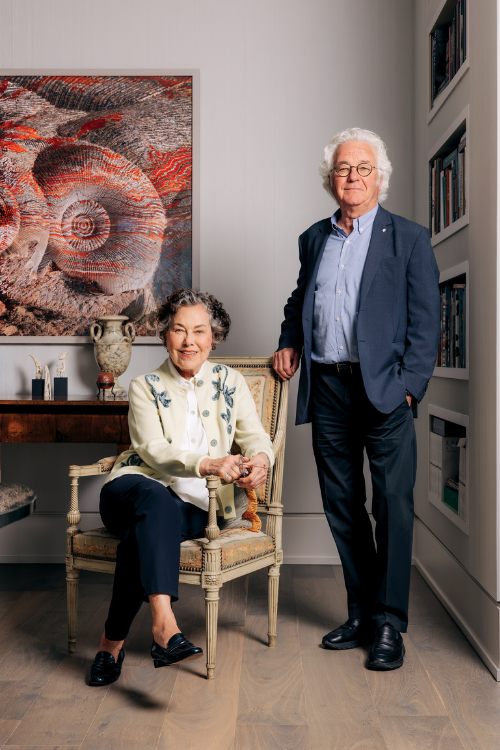
Photography by Shlomi Amiga