
For more than half a century, Canada and the United States have described their relationship through shared geography, history, and deep economic integration. In addressing the Canadian Parliament in 1961, President John F. Kennedy said,
“Geography has made us neighbours. History has made us friends. Economics has made us partners. And necessity has made us allies”
Some twenty-six years later, in announcing the U.S. government’s intention to enter into a free trade agreement with Canada, President Ronald Reagan noted, “The people of the United States and Canada have had a long and harmonious friendship that is the envy of the world. Now, in addition to sharing the world’s longest undefended border, we will share membership in the world’s largest free trade area.” And on October 1, 2018, President Donald Trump speaking at the Rose Garden, emphasized that the United States, Canada, Mexico Free Trade Agreement (USMCA) was “a truly extraordinary agreement” that it “formed a great partnership”.
Given this rich history of partnership, the series of tariff measures introduced beginning in early 2025 marked a significant shift in the trajectory of Canada–U.S. economic relations. Since January 2025, the U.S. administration has issued more than twenty trade-related executive orders invoking authorities under the International Emergency Economic Powers Act (IEEPA), Section 232 of the Trade Expansion Act of 1962, and Section 301 of the Trade Act of 1974, fundamentally reshaping the global trading environment. These measures have included broad-based tariffs on non-CUSMA goods, sectoral tariffs on steel, aluminum, automobiles, copper, lumber, and other strategic industries, as well as reciprocal tariff frameworks affecting multiple trading partners.
The U.S. administration has articulated multiple rationales for these tariff actions, including border security concerns, illicit drug flows, trade deficit reduction, national security considerations, industrial policy objectives, and concerns about reciprocity in trade relationships. At various points, additional tariff actions have been announced, modified, delayed, or suspended, reinforcing an environment of sustained trade volatility.
For Canada, initial tariffs imposed in March 2025 applied to most goods imports not qualifying under CUSMA, alongside additional sector-specific tariffs. In several instances, tariff measures have had cumulative or “stacking” effects depending on product classification and applicable exemptions, increasing effective trade costs across deeply integrated North American supply chains. Legal challenges within the U.S. and consultations at the WTO have further contributed to policy uncertainty.
In response, Canada initially introduced retaliatory tariffs, sectoral countermeasures, and formal trade consultations. However, by 2026, under Prime Minister Mark Carney, Canada’s approach has increasingly emphasized a broader nation-building and economic resilience strategy. The 2026 federal budget outlines measures aimed at strengthening domestic industrial capacity, accelerating infrastructure and energy development, supporting strategic sectors such as steel, aluminum, automotive manufacturing, and critical minerals, and diversifying trade relationships beyond the U.S. Provincial governments have likewise implemented targeted support programs and procurement adjustments to mitigate the impact of ongoing tariff pressures.
With the USMCA/CUSMA review approaching its 2026 sunset timeline, Canada-U.S. trade relations have entered a period of sustained adjustment. In this context, the Lawrence National Centre for Policy and Management has prepared this infographic series to inform students, faculty, leaders, and citizens about the importance of trade to the Canadian economy, the mutual benefits of Canada-U.S. trade and investment, and the implications and unintended consequences of the ad hoc and ill-informed tariffs proposed by President Trump on Canada.
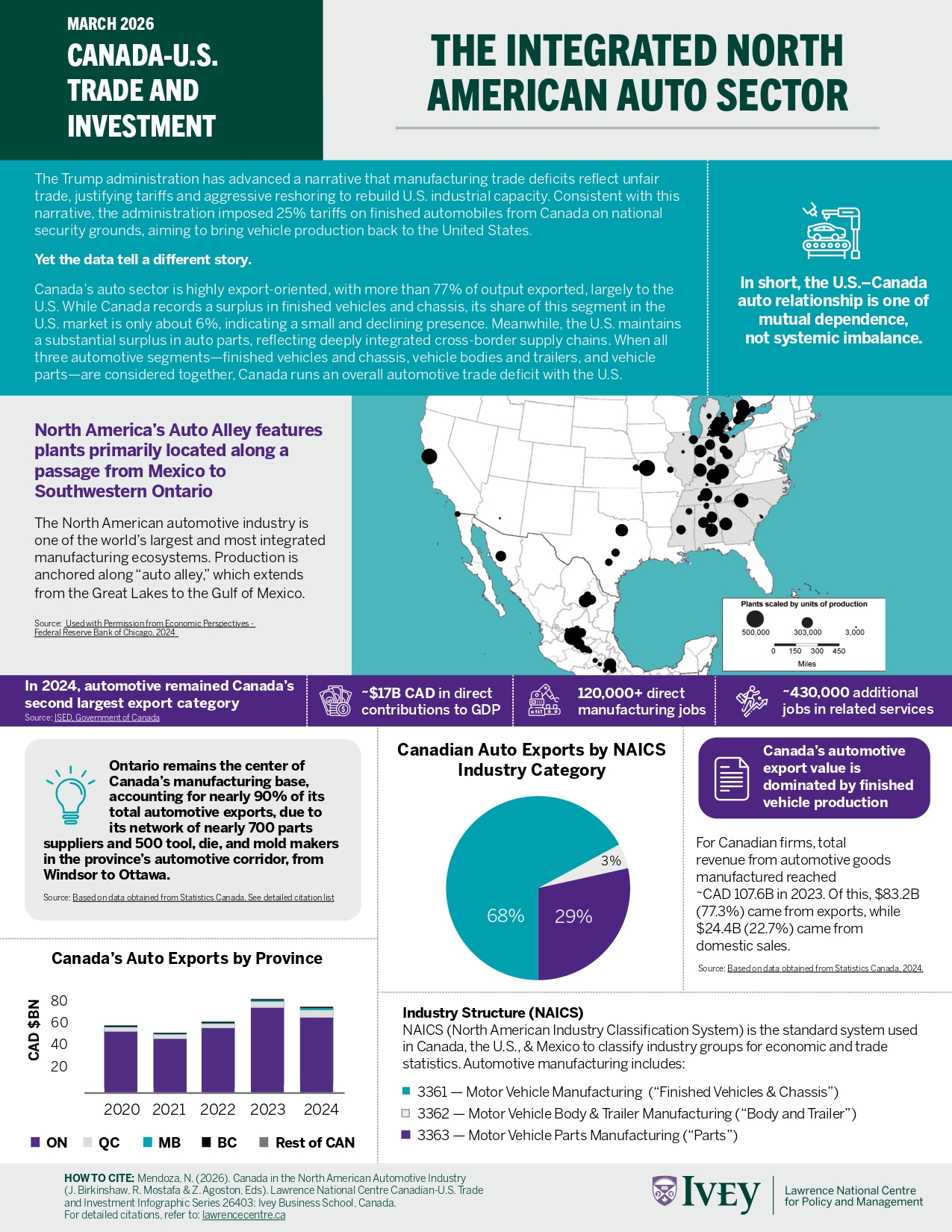
Acknowledging the contributions of Mahmood Nanji (Policy Fellow), Andrés Sánchez Niño (MSc ’25), Zsofia Agoston Villalba (Policy and Communications Specialist), Romel Mostafa (Professor and Director) and Laura Radulescu (Graphic Designer).
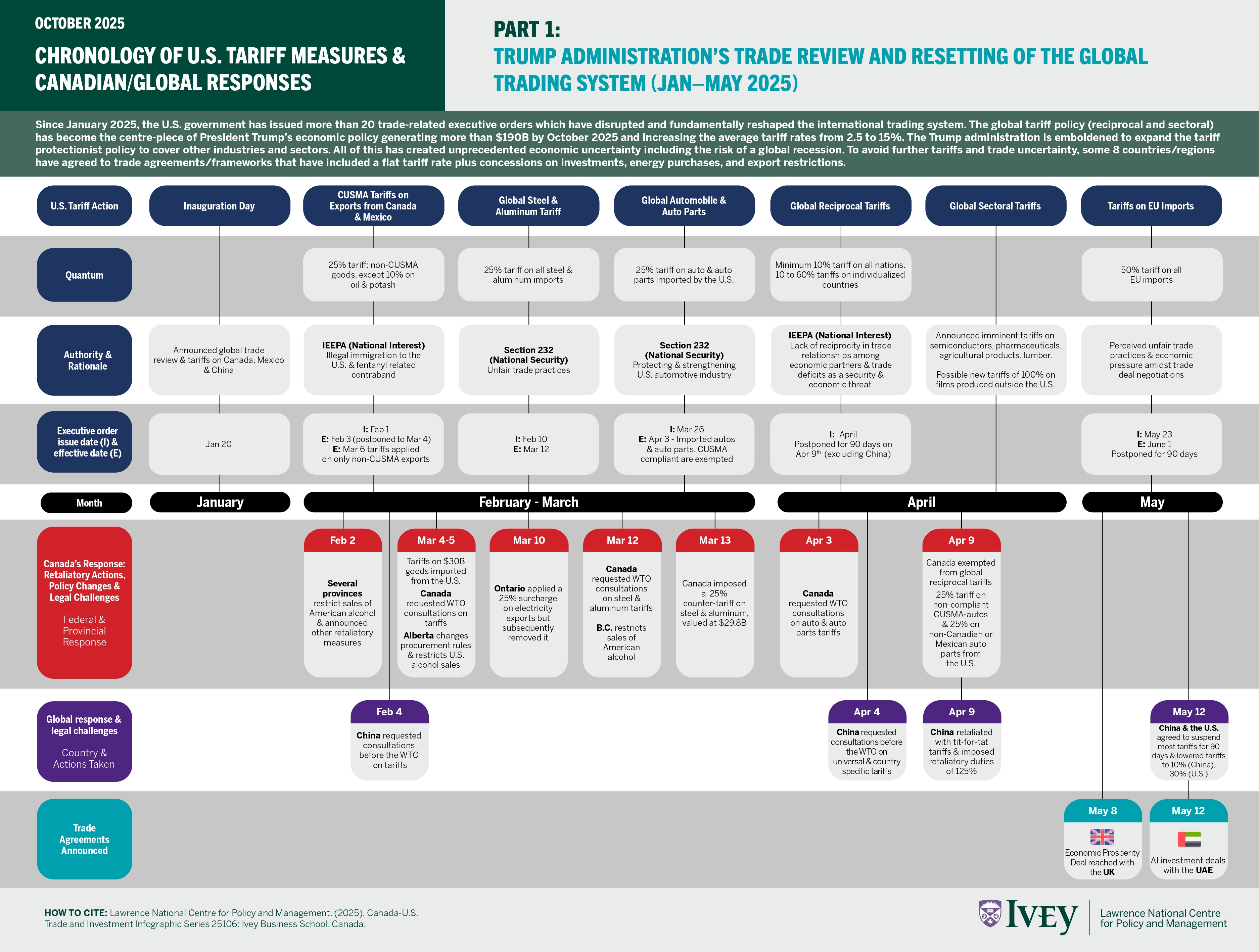
Acknowledging the contributions of Romel Mostafa (Professor and Director), Mahmood Nanji (Policy Fellow), Andrés Sánchez Niño (MSc ’25), Zsofia Agoston Villalba (Policy and Communications Specialist), and Laura Radulescu (Graphic Designer).
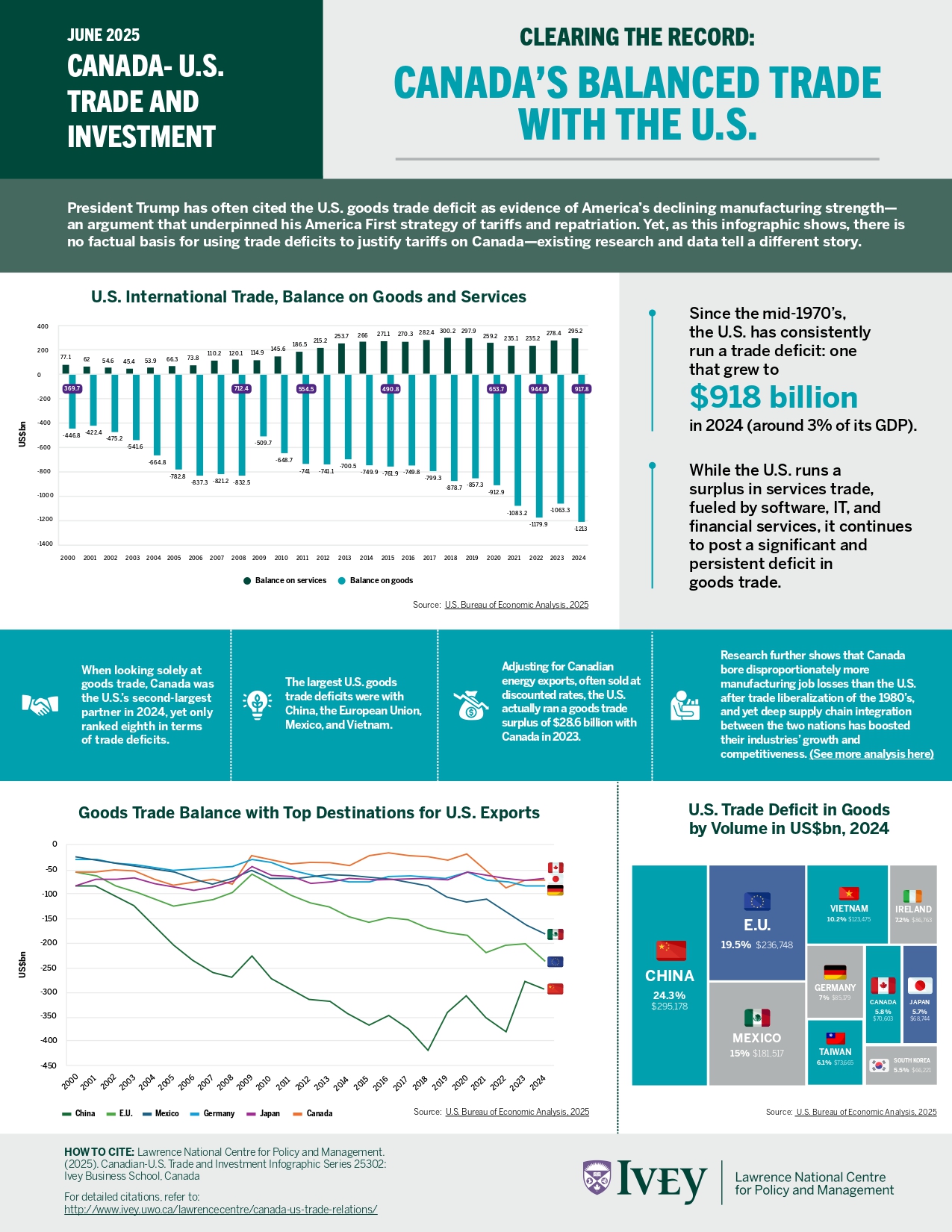
Acknowledging the contributions of Romel Mostafa (Professor and Director), Mahmood Nanji (Policy Fellow), Andrés Sánchez Niño (MSc ’25), Zsofia Agoston Villalba (Policy and Communications Specialist), and Laura Radulescu (Graphic Designer).
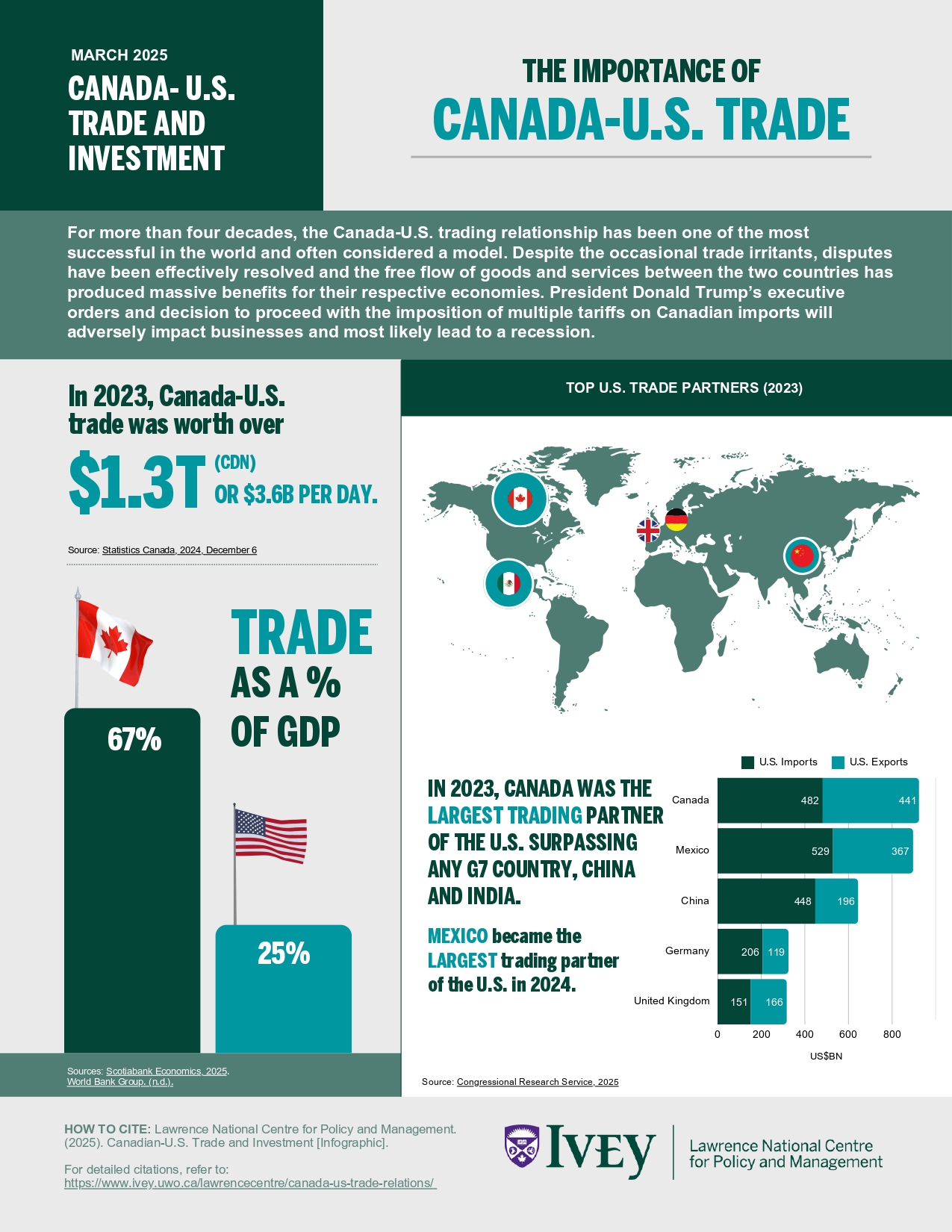
Acknowledging the contributions of Romel Mostafa (Professor and Director), Mahmood Nanji (Policy Fellow), Andrés Sánchez Niño (MSc ’25), Zsofia Agoston Villalba (Policy and Communications Specialist), and S.V.D. (Graphic Designer).
Stay tuned for upcoming infographics on Canada-U.S. Trade and Investment.
Generous support from the Power Corporation of Canada, Canada Life Research Fund, Jack Lawrence Family and the Mitchell and Kathryn Baran Family Foundation is gratefully acknowledged.