
Lawrence National Centre–affiliated faculty members were invited to contribute to Canada’s ongoing conversation about the future of electric mobility. Professors Romel Mostafa and Gal Raz, along with Centre PhD Fellow Vikash Kumar, submitted a report documenting evidence from ongoing research across global jurisdictions—including Norway, China, California, and Canada—to support the Committee’s study of the Electric Vehicle Availability Standard (EVAS).
Across these contexts, the research points to a consistent conclusion: while supply-side mandates such as EVAS may play a supporting role, they are not the primary drivers of EV adoption. Instead, markets transition rapidly only when two foundational conditions are met. The first is price parity between electric vehicles and internal combustion engine vehicles, particularly in upfront purchase costs. The second is the availability of dense, reliable, and accessible charging infrastructure in both urban environments and along major transportation corridors.
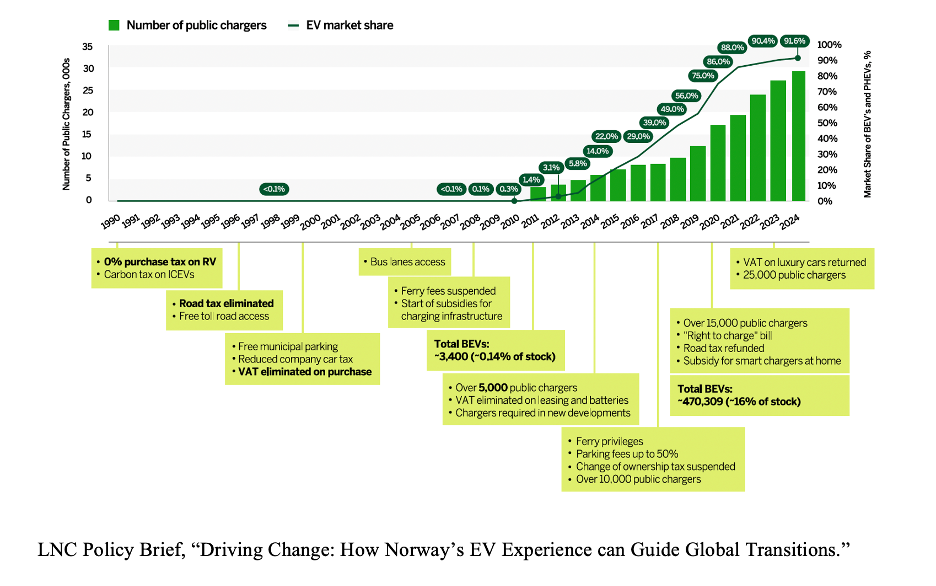
Where these conditions aligned, EV adoption accelerated organically, pushing markets into the familiar S-curve of rapid, self-reinforcing growth (See Figure 1). In countries such as Norway and China, EV uptake surged even in the absence of binding supply mandates once vehicles became affordable and charging infrastructure was widely available. By contrast, where either affordability or infrastructure lagged, adoption remained slow despite policy targets or regulatory pressure.
Canada now stands at a pivotal moment in its EV transition. The country possesses significant structural advantages, including access to critical minerals, emerging battery manufacturing capabilities, and a highly integrated automotive supply chain. These strengths position Canada to build a globally competitive EV ecosystem. However, the research underscores that industrial strategy alone will not deliver widespread adoption. Supply-side investment must be paired with demand-side policies that directly influence consumer behaviour and market confidence.
Figure 1. Timeline of policies and EV adoptions in Norway
In its submission, the research team outlines several policy levers that can help close the affordability and infrastructure gaps that continue to constrain adoption. These include co-investment in fast-charging networks through the Canada Infrastructure Bank, targeted measures to expand charging access in multi-unit residential buildings and workplaces, and carefully designed price tools that encourage competition and accelerate cost convergence. Importantly, the researchers emphasize that such price interventions should be temporary transition tools rather than permanent subsidies, phased out as battery costs fall and EV–ICE price parity emerges across vehicle segments.
Taken together, the evidence suggests that Canada’s EV targets are achievable, but only if policy remains focused on the conditions that shape consumer decisions. If affordability and infrastructure are addressed directly, there is no structural reason Canada cannot reach 90 to 95 percent EV adoption, measured as a share of new vehicle sales, well before 2035.
This research is supported by Social Sciences and Humanities Research Council (SSHRC) 2024 Insight Grant and Ivey's Critical Issues Challenge Fund.