
Trade Insights offer timely, evidence-based perspectives on developments shaping Canada–U.S. trade and economic relations.
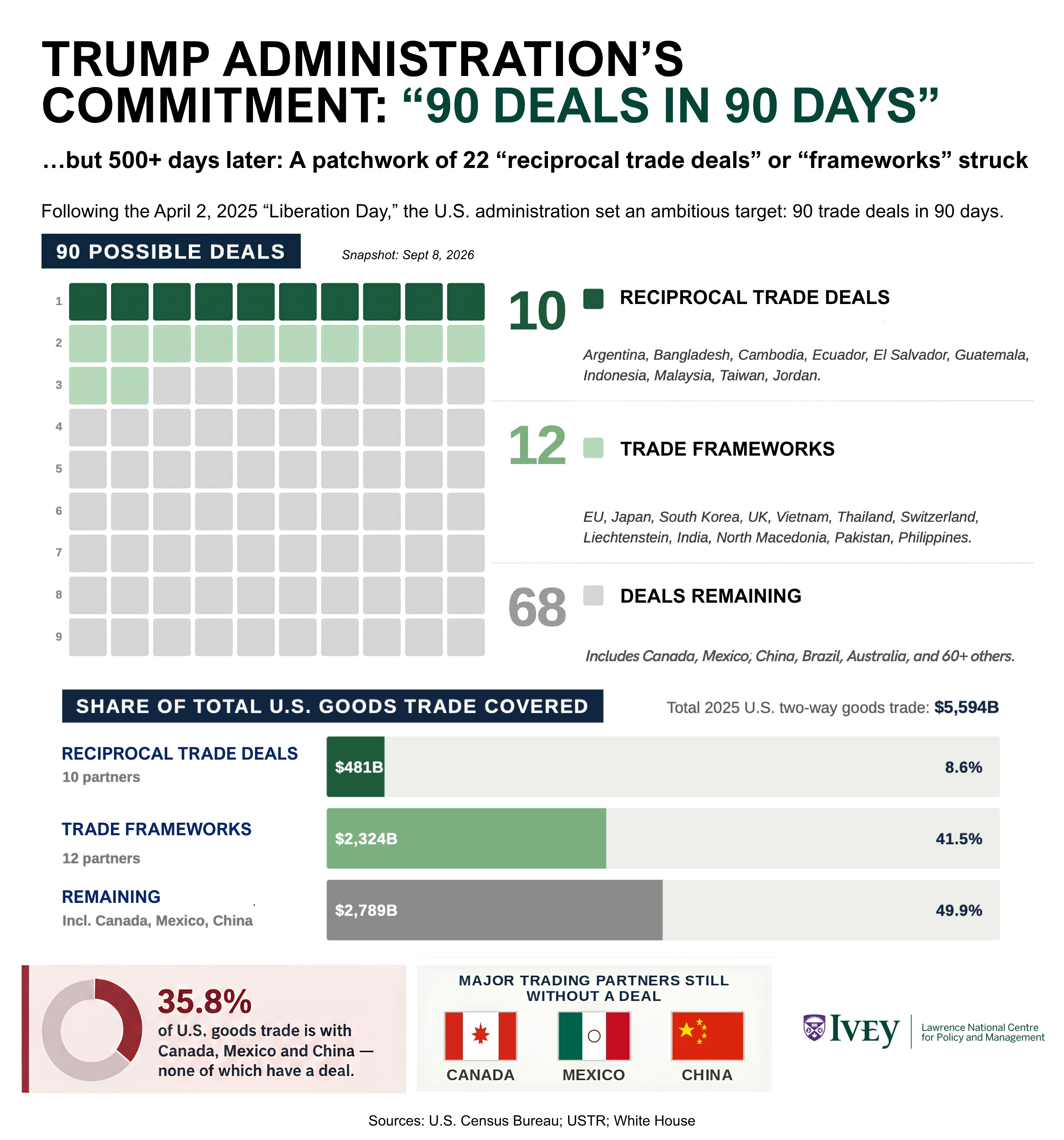
Following the global tariffs announced on April 2, 2025 ("Liberation Day") affecting 185 countries, the Trump administration vowed to secure “90 deals in 90 days.” More than 500 days later, a patchwork of 22 “reciprocal trade deals” and “frameworks” has emerged.
Beyond the headline, four key considerations put these agreements in perspective:
1. Durability remains uncertain
The administration’s 22 trade deals and frameworks bypass Congress entirely. Lacking legislative backing, these executive arrangements are vulnerable to sudden modification or termination. What happens if the political balance in Washington shifts after the upcoming November 2026 midterm elections — or under a future administration? For businesses making long-term supply-chain and investment decisions, durability is key.
2. Major trading partners remain without comprehensive agreements
These bilateral agreements involve countries accounting for roughly half of U.S. trade (driven heavily in part by the EU and Japan with headline U.S. tariff of 15%). To date, the U.S does not have comprehensive agreements with its three largest trading partners: Mexico, Canada and China, which represent over 35% of total U.S. trade, and have well established integrated supply chains (in the case of Canada and Mexico).
3. Uncertainty remains over tariffs and implementation of the agreements struck
The EU, for example, has built significant safeguards and suspension mechanisms into its arrangement with the U.S. India, meanwhile, has reached an interim framework with Washington, while negotiations over a broader bilateral trade agreement remain tense.
4. These arrangements extend beyond trade
These arrangements extend well beyond trade matters. Agreements negotiated to date include investment commitments, energy purchases, and access to critical minerals and other commodities — making them broader economic arrangements than conventional bilateral trade agreements. In fact, President Trump himself mused to impose additional tariffs on the EU for failing to support the war in Iran.
Ultimately, these trade deals and frameworks may be meaningful today, yet remain politically fragile tomorrow. The graphic below provides a snapshot of the trade arrangements negotiated to date.
This Trade Insight draws on analysis from Professor Romel Mostafa, Director of the Lawrence National Centre, and LNC Policy Fellow Mahmood Nanji, with research support from Clay Xavier Fernandes (MBA ’27) and Andrés Sánchez (MSc '25).