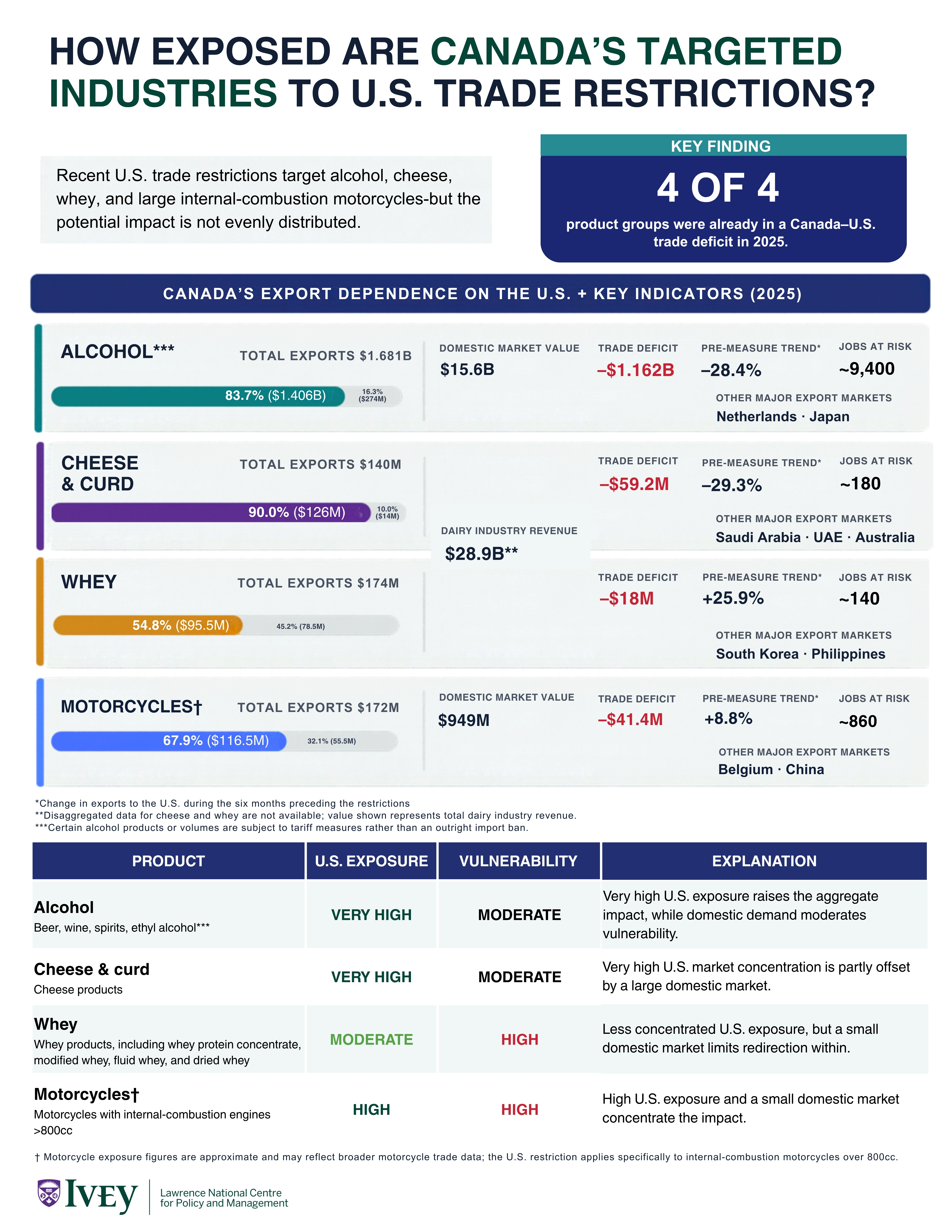
On September 29, the U.S. administration banned imports of certain Canadian alcohol and whey products, along with motorcycles with internal-combustion engines over 800cc. Certain cheese and curd products were already subject to an earlier 50% tariff.
The potential economic impact is unlikely to be evenly distributed. Vulnerability depends not only on an industry’s export exposure to the U.S., but also on the depth of its domestic market and its ability to redirect sales internationally.
Importantly, even before the latest restrictions, the U.S. already ran a trade surplus with Canada in all four product categories.
Four findings stand out:
1. Alcohol faces the largest aggregate impact. U.S. exposure is very high, making alcohol particularly important in terms of overall economic scale. Canada also has a substantial domestic market, although fragmented provincial liquor systems limit how quickly lost U.S. sales can be redirected domestically.
2. Cheese and curd face high exposure but moderate vulnerability. The U.S. accounts for a very large share of Canadian exports, while the domestic market is also substantial. But exports to other international markets have historically been limited. Some markets in the Middle East and Asia offer opportunities for greater diversification.
3. Whey faces moderate exposure but high vulnerability. About 55% of Canadian whey exports go to the U.S. The domestic market is relatively small, leaving fewer options to absorb lost demand. And because whey exports had been growing rapidly on the back of the global protein boom, the restrictions represent not only a loss of existing trade, but a missed opportunity for further growth in the U.S. market. The UK and Asian markets may provide important opportunities for further diversification.
4. The impact on motorcycles is likely to be highly concentrated. A large share of exports goes to the U.S., while the Canadian domestic market is small. The economic effects are therefore likely to be particularly concentrated. China is a major importer of motorcycles above 800cc, including three-wheelers, although its domestic market is dominated by smaller-engine motorcycles supplied largely by domestic producers.