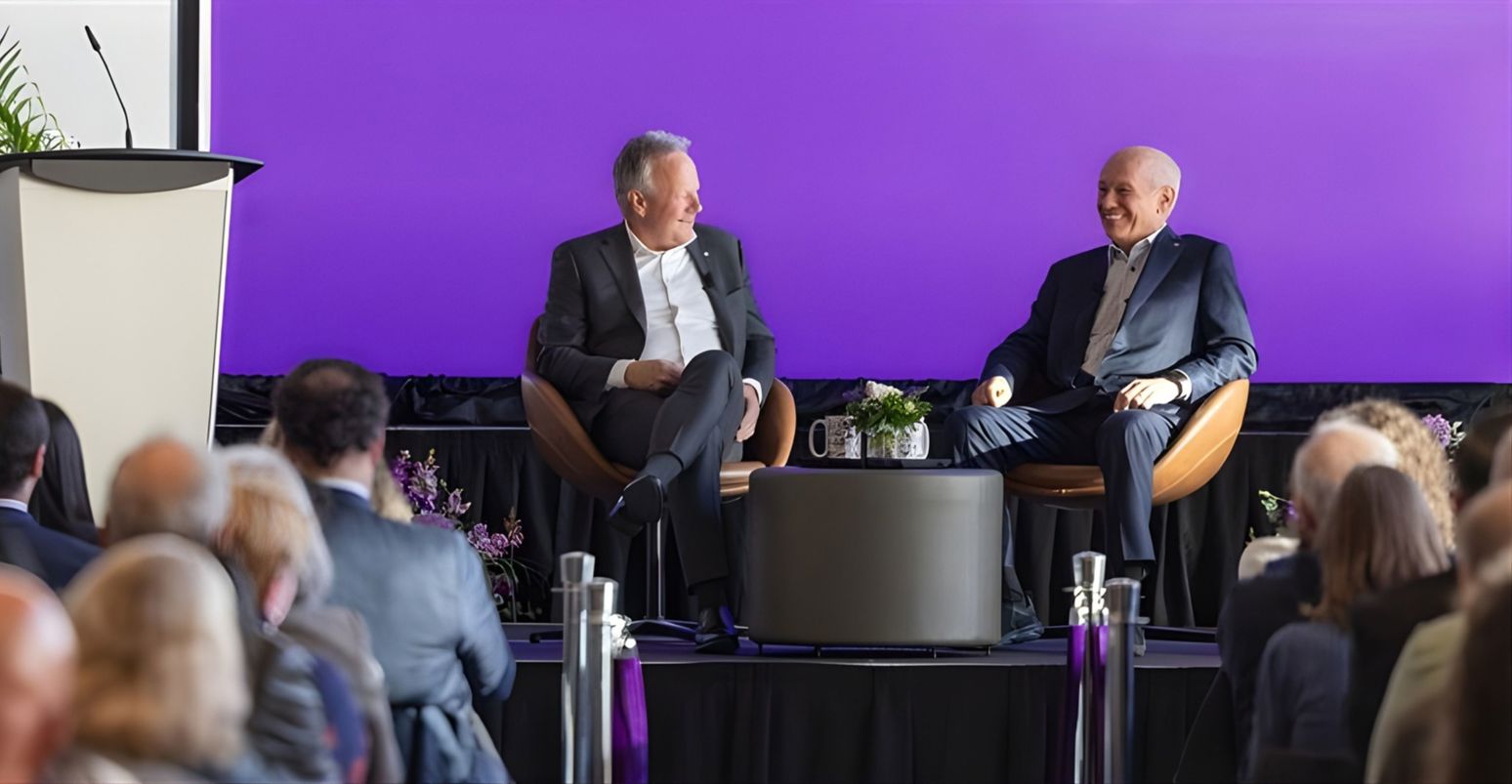
In a recent conversation hosted at Western University, Nobel laureate Peter Howitt returned to campus, where he taught for more than two decades, to join Stephen Poloz, Chair of the Lawrence National Centre and former Governor of the Bank of Canada, for a discussion on how economies grow — and how policy engages with that process in practice. The event took place in the context of Howitt’s 2025 Sveriges Riksbank Prize in Economic Sciences, awarded for his contributions to modern growth theory.
Central to that contribution is the idea of creative destruction, first developed by Joseph Schumpeter and later formalized by Howitt and Philippe Aghion. In this view, growth is driven by the introduction of new technologies that reshape production, firms, and labour. As innovations take hold, older ones recede, along with the investments and skills built around them.
Beyond the process itself, Howitt pointed to the role of competition in shaping how growth evolves. New technologies are often introduced by emerging firms that challenge established players. As these firms succeed, they become part of the incumbent structure, with incentives to preserve their position. The pace and direction of growth depend not only on the type of innovation, but also on how the tension between entrants and incumbents is managed.
This has direct implications for policymaking. Economic theory provides a framework for understanding how growth develops over time, while policy shapes the conditions under which innovation and competition take place, often before their effects are fully visible.
This process often unfolds unevenly. Some sectors expand while others contract, and while the gains from growth emerge over time, the costs of adjustment are more immediate and concentrated. The economic process, as Howitt noted, is also a social and political one, shaped by how institutions respond and how societies absorb change. In practice, this creates a gap between how economic change is understood in theory and how it is experienced and addressed through policy.
This gap becomes more visible in periods of technological transition. As Poloz noted, the current moment may be understood as a fourth industrial transition, defined by digitalization and the integration of artificial intelligence (AI) across economic activity. While AI is often framed as an immediate disruption, historical experience suggests its economic impact may unfold more gradually.
Electricity, for example, was introduced into factories decades before it produced measurable productivity gains. Those gains emerged only after firms reorganized production, shifting toward more flexible and distributed systems. A similar pattern can be observed in early computing, where initial adoption involved experimentation rather than efficiency. In both cases, productivity gains followed organizational change rather than technological introduction alone.
A similar dynamic may apply to AI. The current phase appears to be one of experimentation, with high investment and uncertain output. This raises a central policy challenge: decisions and resources are being committed in advance of measurable outcomes, with uncertainty over both their scale and timing.
The same tension is reflected in monetary policy. As Howitt described, the now widely adopted 2% inflation target emerged from a set of practical constraints debated in real time. In 1991, the Bank of Canada was among the earliest central banks to adopt inflation targeting, and the choice of a target reflected a balance between theoretical ideals and what could be sustained in practice. While zero inflation may appear desirable in theory, the costs of achieving it — and the limits of how inflation is measured — made a lower but positive target more appropriate.
Across these examples, economic change emerges gradually, unevenly, and with delay in how it is measured. Policy is therefore not simply reactive to these conditions, but actively formed within them: shaping how innovation diffuses, how competition is maintained, and how adjustment is managed over time.
Peter Howitt (MA ’69), now Professor Emeritus at Brown University, taught at several distinguished universities over the course of his career and helped shape generations of students at Western, including Stephen Poloz (MA’79, PhD’82, LLD’19), who later became President and CEO of Export Development Canada and the ninth Governor of the Bank of Canada.