Rethinking Real Estate
By Shelley White
Photography by Shlomi Amiga

It’s been said that real estate is a national pastime in Canada. Issues of housing prices, supply shortages, and interest rates are perpetually hot topics around water coolers and dinner tables, particularly amid the economic turmoil of the past few years. Yet the real estate industry itself can be slow to change.
With a willingness to approach things differently and an eye toward innovation, Ivey alumni are transforming the real estate industry across Canada and beyond. Whether changing our perceptions about renting, reinventing how we buy and sell homes, or taking a new approach to building operations and real estate investments, these leaders make it a habit to think outside the box.
Meet five alumni who are helping to reinvent real estate for the future.
Rental communities that feel like home
Adrian Rocca, HBA ’04, wants everyone to think differently about renting.
As CEO of Fitzrovia, a Canadian company that designs, develops, and builds purpose-built rental communities in Toronto and Montréal, Rocca is determined to lift the stigma that can persist around renting versus owning a home. Fitzrovia rental communities are designed for the long haul, he says. “We have created an environment where we can provide rental homes for someone's entire life, from young families to student housing to retirement living and everything in between.”
Rocca, a former proud renter himself, points out that in many U.S. and European cities, the majority of high-rise housing stock is used for rentals. For example, in Berlin, around 84 per cent of residents are renters. He sees purpose-built rentals as a key piece of the housing crisis puzzle in Canada and is driving that conversation by building communities where people want to get together and interact with their neighbours.
“You put yourself in the shoes of a prospective resident living in your building,” he says regarding designing and developing properties. “What do you want to see in all aspects of that experience?”
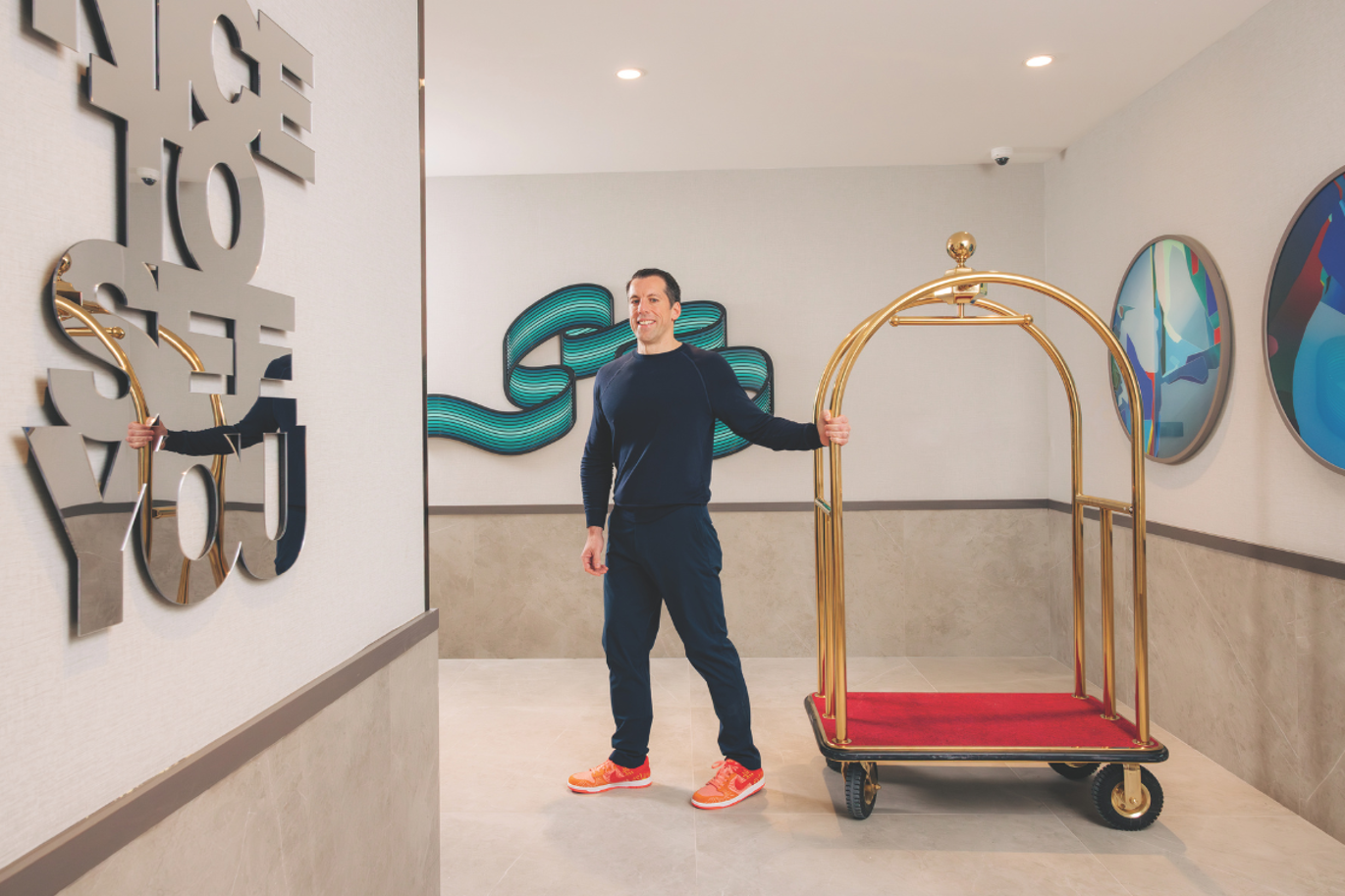
Rocca says Fitzrovia borrows examples that work well in the hotel space, like animated lobbies, high-end finishes and ample amenity packages. Dedicated management teams create programming from fitness classes in on-site gyms to roof-top pool parties and inter-building basketball tournaments. “We will target specific buildings to certain consumers and go deep,” he says. “Who works the front door? What type of music plays in the lobby?”
For example, Rocca says he’s heard competitors say they purposely put uncomfortable furniture in the lobby to minimize wear and cut replacement costs. “We take the opposite approach,” he says. “I want that to be an extension of your living room. And we have a coffee shop that flips to a cocktail bar in the evening.”
Sustainability is a must in their spaces, he adds, aligning with the pension plan partners who back Fitzrovia’s real estate investment funds and who have commitments to the Paris Accord. “We are very focused on being net zero [carbon emissions]. We are actively working on geothermal being rolled out on every project, for example.”
When it comes to future opportunity, it’s about expanding geographically across Canada and “doubling down on retirement,” Rocca says.
“We're very focused on seniors because [Canada] is completely undersupplied. We're bullish on student housing for the same reason.” There’s opportunity to create student rentals that have the amenities, security, and lifestyles students are looking for, “versus what you get in the single-family rental business.”
On the innovation front, Rocca says the company is leaning into AI, using the technology to quickly iterate design elements, from suite options to building facades.
“That’s going to be a game changer. My boldest call is in 12 to 18 months, we will have fully designed, fully coordinated, permit-ready drawings that we could pull and start construction in five minutes,” he says. “It's going to be very, very disruptive in the sector. But we're firm believers that if our consultants are not embracing AI, we do not want to work with them.”
Turning home-buying on its head
Buying a home can be tedious, frustrating and most of all, expensive. But Sunil Bansal, HBA ’10, MBA ’16, is working on changing that. He’s vice-president of operations at Zown, a digital real estate platform that was named one of the best inventions of 2025 by Time magazine.
“We want to do things in a different way that can cut through the idea of, ‘This is how it's always been done,’” he says.
Since its founding in 2021 by Rishard Rameez, Zown has been turning the traditional real estate sales process on its head to make the process more efficient and affordable. Licensed Zown agents are paid hourly rather than on commission; deals are handled remotely; buyers aren’t locked into representation agreements; and instead of commissions going into the pockets of agents, they get handed back to buyers.
“The core of Zown is we turn our commissions into our clients' savings, so that it can allow somebody to buy a bigger home or help them buy a home faster,” Bansal says.
He gives the example of buying a home for $1 million dollars in Toronto where the typical commission for a buyer’s agent would be around 2.5 per cent. “Of that 2.5 per cent, Zown gives a minimum of one per cent in advanced cash back to our clients. So, $10,000 of that $25,000 is going directly to our clients.” That money can be used to cover closing costs, effectively boosting the buyer’s down payment.

The company started in Toronto and has expanded to California and Texas and now has more than $300 million in transactions under its belt.
Bansal says the Zown model stems from the team’s core belief in helping people. He notes that both he and Rameez share ties to immigrant communities – Rameez is originally from Sri Lanka and Bansal’s parents are from India – where home ownership is a core value.
“When you come to Canada as an immigrant, owning a home is one of the most important things,” Bansal says. “We want to help people do that, however we can.” He adds that his personal passion for helping people began in his younger years.
“I was a teenager selling wedding gowns in my parents' store. That's just who I am. I love helping people. It's in my nature.”
The time has come to disrupt real estate transactions, Bansal says, because of how much the cost of real estate has skyrocketed in places like Toronto. It may have made sense when a home cost $350,000 for agents to be pocketing three to seven per cent of the sale price, but when a home costs $1.2 million, that kind of fee is excessive.
How is the Zown model achieved? It’s about volume and scalability, says Bansal.
“We've taken on that kind of enterprise SaaS prototype and brought it into real estate. We're turning real estate into a product-based business rather than a person-centered business,” he says. “Usually when someone calls a real estate agent, they're calling a specific person. When you call Zown, you want the Zown product, not a particular agent.”
He adds that Zown has expanded its services by working directly with lenders and mortgage brokers, partnering with venture capital-backed mortgage provider, Pine, to help clients receive financing. Now that they’ve proven their model can work, Bansal has ideas for what can come next.
“Let’s say there's a municipality in Southwestern Ontario that's trying to attract nurses,” he says. “What if that municipality says, ‘Listen, we'll give you a $10,000 incentive if you are a nurse and trying to move here.’ Zown could facilitate that incentive,” Bansal says.
The sky is the limit, he says, as long as they keep their clients’ interests at heart.
“I think the highest form of praise is when we get told, ‘I would not have bought a home without you.’”
Leveraging AI for efficiency and access
When it comes to disrupters in the real estate space, Zillow is at the top of the list. It’s become a go-to platform for the buying and selling of houses, with 250 million visitors in an average month.
“The Zillow brand is almost synonymous with real estate,” says Caroline Burton, HBA ’02, vice-president and general manager at StreetEasy, a Zillow brand dedicated to New York City. “Our platforms have been built on the things we hold near and dear to our hearts: accuracy, transparency, and access for all. We’re focused on always doing what’s right for the consumer, which ultimately benefits everyone.”
Burton says her StreetEasy team’s primary focus in helping New Yorkers navigate one of the most complex and competitive real estate markets in the world, with unique challenges like co-op boards, upfront costs, and fast-moving inventory. “Our purpose is to help make home a reality for more New Yorkers, whether that's renting, buying, selling, and really bringing more transparency and ease to the process.”
It’s a job Burton takes very seriously, and she says it’s rewarding in return.
“It’s such an important and meaningful moment in people's lives,” she says. “There's a strong sense of purpose here and always so much to do.”
To ensure the platform stays top of mind for potential homebuyers and sellers, Zillow continues to push the innovation envelope with the latest in tech tools, Burton says. She points out that Zillow pioneered the Zestimate 20 years ago – a tool that provides an automated estimate of a home’s value. “That was early AI, really, when you think about it,” she says.
“Now, we have AI-powered search, we have 3D home tours, interactive floor plans, and visualization tools. We're building AI into our integrated transaction experience that's simplifying buying, selling, and financing.”
Zillow is the first real estate app to be available in ChatGPT, allowing users to search for homes using natural language. When a user makes an inquiry like, “Find me a three-bedroom home in Calgary for under $700,000,” the Zillow app in ChatGPT displays relevant, real-time listings, including photos, maps, and pricing details to be displayed in the chat interface.
“The idea is that asking ChatGPT about a home is as natural as your recipe search or your travel plans,” Burton says.
The company raised the alarm in early 2025 about the rise in private listing networks in the U.S. Most homes for sale are listed on the Multiple Listings Service (MLS), a database shared by the real estate industry that feeds listings to consumer platforms including Zillow. But there has been a recent push by some in the industry to hide homes for sale on private networks that are only available to an exclusive group of agents.
“We think listings should be shared widely and buyers should get fair access,” Burton says. “When private listing networks start to pop up, that means buyers can miss out on homes, it means sellers can leave money on the table, it means agents lose the ability to advocate for their clients.”
She adds, “Why go backwards? It just doesn't make sense.”
When it comes to the future of home-buying, Burton says, “I think we're just on the cusp of it becoming more digital, personalized, and connected. Buyers are going to expect to be able to search, tour, finance, and close all from their phones.”
When that time comes, Burton will be ready for it. “It’s building that end-to-end ecosystem where all parties involved are in one place.”

Caroline Burton, HBA ’02
"I think we’re just on the cusp of [home-buying] becoming more digital, personalized, and connected. Buyers are going to expect to be able to search, tour, finance, and close all from their phones.”
Bringing fresh eyes to operations
 Anushka Grant, MBA ’05, didn’t start her career in real estate, but she believes that experience gives her a unique lens on the industry. In bringing her rich background in management consulting to the real estate operations space, she’s helping to evolve the industry and build on its strong legacy.
“I stumbled into real estate 10 years ago when I was at Deloitte,” says Grant, who, after five years at Rio Can Real Estate Investment Trust, is now five years in at Oxford Properties Group and currently their vice-president operational excellence and sustainability. “I was consulting for real estate companies and I absolutely loved it. I loved the tangible aspect of the business, the passion felt by the people, and the ability to really affect change.”
Oxford Properties is a leading global real estate investor, developer, and manager with a vast portfolio of assets including office, retail, industrial, residential, and hotels in cities across the world. Because Grant understands the fundamentals of the real estate business, while bringing a fresh perspective, she can apply her background in strategy to draw connections, understand broader trends, and push for new possibilities. “That's what I think makes me a little different, and what gets me really energized is the potential in this industry.”
Grant says one of the biggest opportunities in operations is the technological advances that have occurred in the past few years. She notes that many of the systems that had been built internally to manage complex retail and commercial buildings had become dated over the past 10 years. “[Considering] a lot of the people who built those systems internally were starting to retire, the skill set was becoming lost.” Sensing opportunity, PropTech companies began emerging, offering more advanced technology solutions that boost simplicity, efficiency, and transparency in performance.
“We want to help our businesses think about the future of operations,” Grant says. “With advances in technology and AI, the operating models of today will likely not be the same operating models five to 10 years from now.”
Grant says she and her team are using AI for data and analytics functions to eliminate common, time-consuming, repetitive processes. It’s an essential tool for sustainability reporting — a major part of her team’s responsibilities. For example, they use a number of tools and statistical methodologies to validate data and track discrepancies over the year. And AI is being used to do anomaly detection in operational transactions, detecting anomalies in spend from landscaping services to waste to security.
“We have all the individual transactions for our properties globally,” Grant explains. “Now we can benchmark our properties against any property in our global portfolio or within Canada. And through machine learning algorithms, we can identify those anomalies and see what the cost savings potential is.”
And while the technology isn’t quite at the stage where they can use predictive analytics to forecast future anomalies, that capability is right around the corner, she says.
Having found a home in the real estate world, Grant says she’s excited about what’s to come. She strives to live by the credo: “Be curious and listen first to where the business is.” In addition to her work at Oxford, she contributes to the greater community as a board member at Sunnybrook Hospital and an executive in residence at Ivey. “I have also raised a family along the way, with three kids ages 19, 17, and 14,” she adds.
“I love what I do now because I feel like I can affect change. I can grow legacy. And I think it’s an opportune time to do that.”
Embracing a contrarian investment strategy
There will always be trends that come and go in real estate, but Bob Petryk, MBA ’91, isn’t interested in following them.
In the 25 years he’s been managing director of Petwin Properties, a Calgary-based real estate firm that specializes in commercial and residential properties across North America, Petryk has chosen to follow his gut when making acquisitions – even when everyone else is going a different way.
It’s a philosophy Petryk says he got from his mother, who started investing in real estate when he was a child. Petryk’s dad, an immigrant from Ukraine, was a dentist and his mom was a teacher, but “she didn’t like it that much,” he says.
“She had a real knack and an interest in investing and business, very extroverted, very self-confident.” The couple bought a small portfolio of buildings in Calgary with the vision of paying their kids’ way through school.
When Petryk, a former lawyer, took over the real estate business in 2000, he kept it a family enterprise by forgoing outside equity, partners, and investors.
“I wanted to follow a contrarian strategy similar to what my mother had done: going to where the money is not going, and what’s not hot, and looking for value there.”
What does that contrarian strategy mean in practice? Petryk gives the year 2008 as an example, when the U.S. was in a financial crisis and the Canadian dollar was over par.
“There was a once-in-a-lifetime opportunity to invest there, and yet the sentiment was so negative that anybody I talked to said, ‘Don't do it. There are no jobs, there's no industry. Don't go there.’ I thought the opposite. There were really good bargains.” Petryk bought an apartment building in Las Vegas from the bank for a song, and 15 years later, Petwin owns properties in several U.S. cities including Phoenix, Scottsdale, Tempe, Las Vegas, and Honolulu.
Another example of Petryk’s acquisition philosophy is happening right now in Calgary, he says. While the downtown office vacancy rate is higher than elsewhere in Canada, “there are green shoots and there are opportunities.” One building, Petwin Midpark Centre, was 52 per cent occupied when the company bought it two years ago, and two years later, “it's 100 per cent occupied and has more than doubled in value,” Petryk says. “And that's in the face of real negative headlines. So, you can do that on a local level, it just takes a lot of effort and a willingness to take risks.”
Petryk is also the managing director of Petwin Private Equity, which he launched in 2022 as a way of diversifying their holdings. As with the real estate arm of the business, he stays away from what is trendy, focusing on stability and cash flow.
“We look for companies with extensive operating histories. They’re kind of boring and less prone to disruption,” he says. Their first three acquisitions – AGM Glass Fabricators, Pacific Radiator MFG, and Albert Wilbert Sales (which supplies water and wastewater septic systems) have produced over $50 million in annual revenue to date.
When it comes to future opportunities in real estate, Petryk says he plans to do “more of the same,” though he notes it’s impossible to predict where the opportunity will come from next. “Today, I see office as the biggest opportunity and a lot of people would laugh at that,” he says.
Whatever his next moves will be, Petryk’s instincts will be at the heart of those choices.
“Despite all the technology and everything that can help you, you get a feeling for what you think is going to happen,” he says. “I would never act purely on analysis without gut feel.”

Bob Petryk, MBA ’91
"I wanted to follow a contrarian strategy similar to what my mother had done: going to where the money is not going, and what’s not hot, and looking for value there.”