
Artificial intelligence is advancing quickly, raising practical questions for organizations about where it can create value, how emerging risks should be governed, and how structures and ways of working need to evolve alongside the technology.
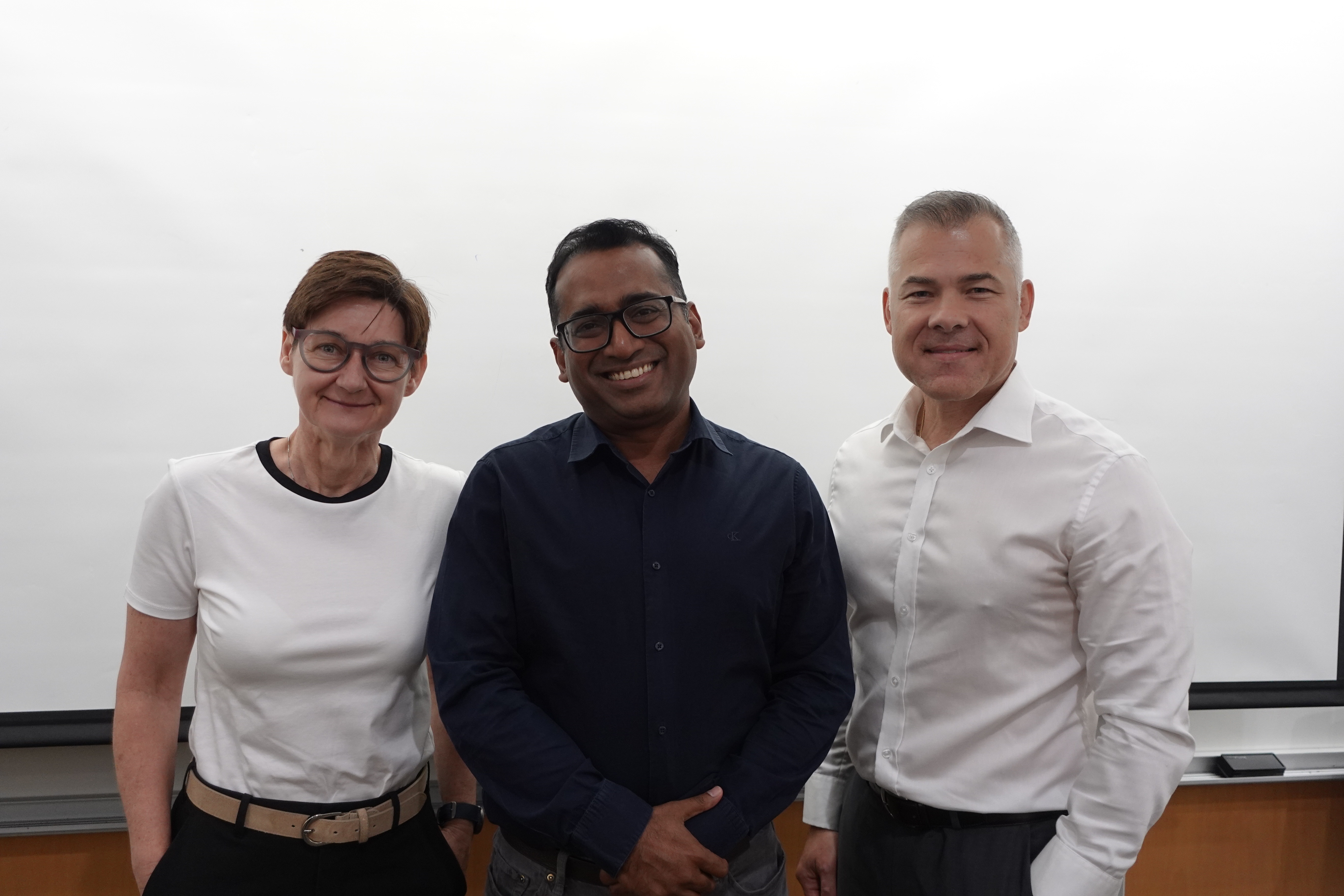
That question was at the center of a recent industry panel in Managing Disruption Strategically, the capstone course of Ivey’s inaugural Graduate Diploma in Management (GDM) cohort in Toronto. Professor, Romel Mostafa, welcomed Aneta Osmola, Vice President, Global Data & AI Risk at Scotiabank, and James Stojanov, EMBA '23, Vice President, AI Strategy and Growth at AXL Labs, to share perspectives from a large regulated financial institution and Canada’s AI startup ecosystem.
Managing risk while enabling adoption
For Osmola, managing disruption starts by changing the way organizations think about risk.
Drawing on her experience in data and AI risk at Scotiabank, she challenged the idea that risk management is primarily about preventing organizations from acting. Risk is unavoidable, she argued; the task is to understand what can be controlled, prepare for what cannot, and create the conditions for innovation to move forward responsibly. To illustrate the point, she referenced the Air Canada chatbot case, where incorrect information provided by an automated system ultimately remained the responsibility of the organization that deployed it.
That challenge is becoming more significant as AI evolves from systems that generate recommendations or content to systems capable of taking action. With agentic AI, Osmola noted, organizations must increasingly govern what AI systems are authorized to do, how quickly their actions can be detected, and whether those actions can be stopped or reversed.
For leaders, this creates a broader governance challenge. Organizations need to know where AI is being used, be able to detect when something goes wrong, establish clear escalation pathways, and understand how accountability extends across technology, privacy, compliance, risk, business teams, and external vendors. Organizational readiness must evolve alongside the technology, requiring investment in employee awareness, education, and dedicated opportunities to experiment with new tools.
Closing the gap between prototypes and production
Stojanov approached the same problem from the perspective of building and scaling AI solutions.
Drawing on examples from banking and telecommunications, he contrasted two high-performing solutions: one was successfully introduced into the business, while the other never reached production.
The difference ultimately came down to whether the organization could adopt and operationalize the technology. Stojanov encouraged students to assess AI opportunities through three connected questions: Is the problem economically meaningful? Is the organization willing to change how work gets done? Can the solution operate within existing governance and scale beyond a single application?
His examples illustrated a common challenge for innovation teams. A strong prototype can generate enthusiasm, but moving it into production requires operational ownership, changes to business processes, organizational buy-in, and a clear path for implementation. Without those pieces, even a technically impressive solution can become what Stojanov described as an “orphaned project.”
Generative AI has intensified that challenge. Because sophisticated prototypes can now be produced much more quickly, organizations may find themselves with more demonstrations and potential use cases than they can realistically absorb. The strategic challenge shifts from simply generating ideas to determining which ones can create repeatable value at scale.
Keeping human judgment in the loop
During the panel discussion moderated by Mostafa, students explored how these challenges are unfolding across health care, consulting, banking, and software development. Questions addressed privacy, bias, agentic AI, build-versus-buy decisions, professional pricing models, and the changing nature of entry-level work.
Across those discussions, one issue repeatedly surfaced: what happens to human judgment as more work is delegated to AI?
AI can accelerate routine work, but completing that work has traditionally helped professionals develop experience, recognize patterns, and learn how to assess complex situations. As Stojanov cautioned, people can use AI to enhance their work, but they cannot outsource the thinking that differentiates them.
Taken together, the panel showed what managing disruption looks like in practice. It requires governance that can keep pace with new forms of risk, organizational structures that can move promising ideas into production, and human judgment to guide where and how change should happen. Those are the same strategic choices at the heart of the capstone: how organizations prepare for uncertainty, respond as conditions shift, and decide when to stay the course, accelerate, or pivot.
About the Graduate Diploma in Management
Launched in 2025, the GDM brings together working professionals from non-business backgrounds as a pathway into Ivey’s Accelerated MBA. Through the capstone course, students examined how organizations respond to periods of major disruption and uncertainty, using scenario planning to consider forces including emerging technologies, changing consumer behaviour, and geopolitical and trade pressures. They developed strategic options, contingency plans, and indicators to help organizations determine when to stay the course, accelerate, or pivot. The capstone course was supported by the Lawrence National Centre for Policy and Management and Ivey’s Scotiabank Digital Banking Lab.
To learn more about the Graduate Diploma in Management program, see Ivey’s communication articles: