
The next phase of financial innovation will be driven by new technology, but its success will depend on how intentionally it is designed, implemented, and governed. This message shaped discussions at Ivey’s annual Financial Technology Workshop on January 30, which brought together more than 70 students and industry leaders to examine how financial technology is reshaping banking, payments, and the broader digital economy. Leaders from across the financial sector, including Scotiabank, BMO, RBCx, and Hiive, spoke about how these shifts are already affecting their work — from how financial products are designed, to how data is shared, to how money moves across digital networks.
Financial technology is moving directly into the core infrastructure that supports financial services. Speakers pointed to this shift through work in product design, open banking, and digital assets, where trust, regulation, and verification are now built directly into financial platforms.
Designing for Future Financial Systems
A particularly compelling perspective came from Jess Ching, Senior Manager, UX at Scotiabank, who challenged students to rethink how digital financial products are designed in an increasingly complex and regulated environment.
Rather than focusing only on current user needs, Ching emphasized the importance of designing for future contexts. She noted that people are often poor predictors of their own future behaviour, meaning design teams must instead focus on understanding the environments that shape behaviour, including regulatory change, new technologies, and shifting social expectations.

One of the most powerful ideas from her presentation was that regulation is increasingly becoming part of the product itself. Instead of treating compliance as something that happens after a product is built, financial institutions are beginning to design systems where trust is built directly into the user experience through transparency, verification, and user control over data.
In the future, Ching suggested financial institutions could play a broader role in digital ecosystems in helping verify identity, income, or financial credibility across services such as housing or lending. In this model, banks move beyond managing money to helping build digital trust across the economy.
Open Banking as the Foundation of Canada’s Digital Financial Infrastructure
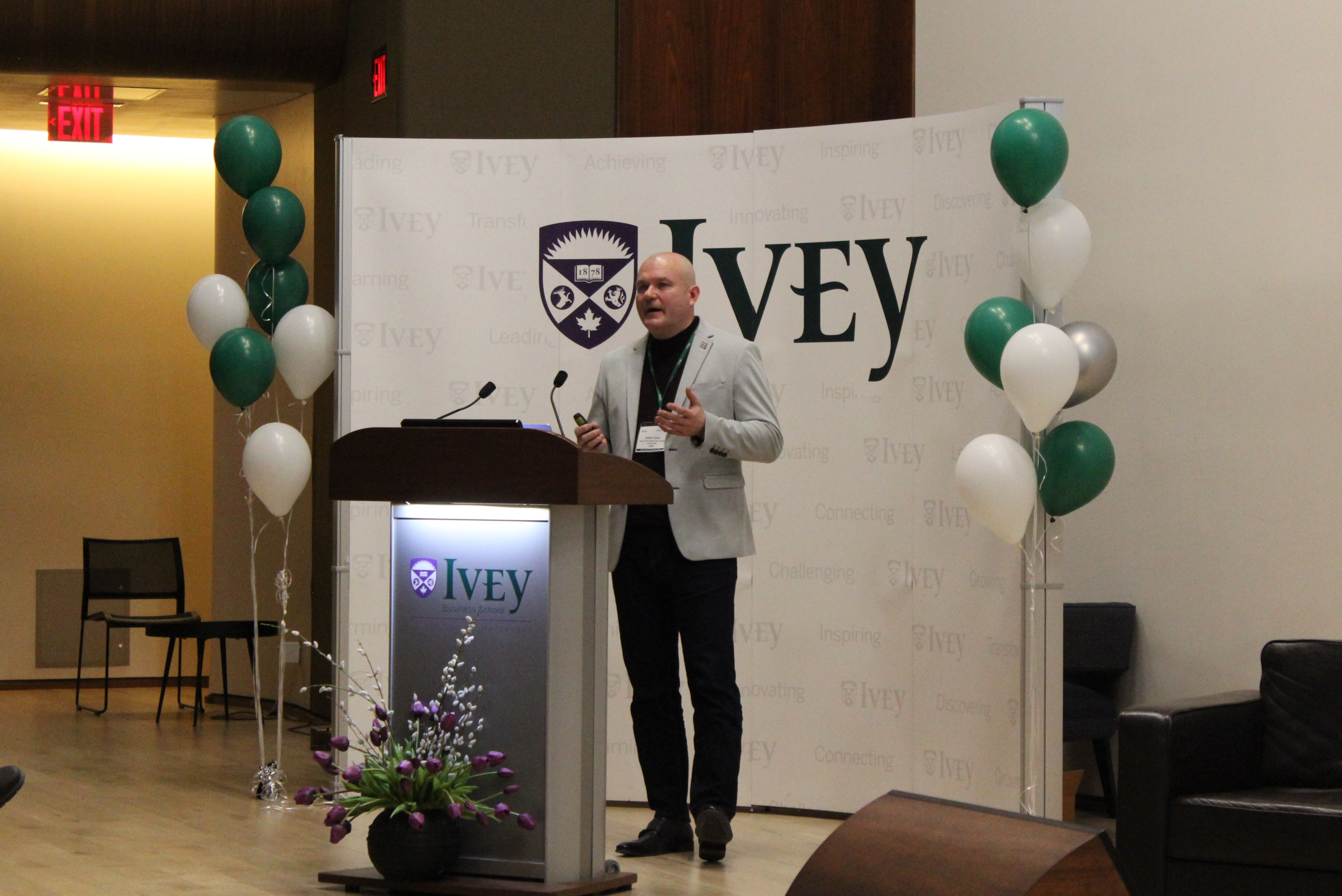
Andre Zybul, Head of Innovation & Strategic Partnerships at BMO, focused on open banking, known in Canada as consumer-driven banking, and what it means for the future of financial services. At its simplest, open banking allows customers to securely share their financial data with third-party providers to access new financial tools and services.
But Zybul emphasized that open banking is about more than convenience. It represents the first step toward a more connected financial ecosystem where data can move securely across institutions.
In Canada, open banking is being built around principles including security, consumer protection, competition, and data sovereignty. The goal is to give consumers more control over their financial data while also creating space for new financial products and services to emerge.
Looking ahead, open banking could eventually connect with real-time payments, artificial intelligence, and digital identity systems. Together, these technologies could make financial services faster, more personalized, and easier to use — while still maintaining strong security and consumer protections.
Stablecoins and the Evolution of Digital Money
Karim Hamasni, Head of Decentralized Strategy at RBCx, closed the speaker sessions by exploring how blockchain and digital assets are evolving from niche technologies into tools with real-world financial applications.
He described how improvements in blockchain speed and cost are enabling stablecoins — digital versions of traditional currencies — to be used for real financial activity. Today, stablecoins are used for global payments, transfers, and new financial products built directly on blockchain infrastructure.
While early cryptocurrency adoption was largely speculative, stablecoins are increasingly being used for practical purposes such as cross-border payments and digital settlement. As transaction costs fall and infrastructure improves, both fintech companies and traditional financial institutions are expanding into digital asset services.
Hamasni also emphasized that trust will play a key role in adoption. As more established financial institutions enter the space, digital assets may become more familiar and accessible to everyday users.
How Fintech Products Are Built in Practice
During fireside chats with fintech marketplace Hiive, students gained a closer look at how financial technology is built and scaled in real companies. Hiive, a fintech marketplace that facilitates secondary transactions of private equity and startup shares, operates at the intersection of capital markets and digital infrastructure requiring both sophisticated product strategy and robust engineering systems.
Josh Reding, Product Management, and Dalton McPhaden, Software Engineering, at Hiive, spoke about how the company balances innovation with risk management when building platforms that support private market transactions. They noted that moving fast in fintech only works if systems are designed to handle real financial activity — meaning security, compliance, and reliability have to be built in from day one.

Throughout the event, it was made clear that financial systems are increasingly being built to be trusted, resilient, and able to scale. From human-centred UX design to open banking infrastructure and digital asset platforms, speakers showed how trust, interoperability, and responsible implementation are shaping how financial services are designed and delivered.
By convening leaders from both major banking institutions and emerging fintechs, the workshop gave students a more grounded understanding of how fintech is built, scaled, and governed in practice.
The Ivey Fintech Club gratefully acknowledges the support of Ivey's Scotiabank Digital Banking Lab, whose contributions made this workshop possible. We also thank industry leaders from Scotiabank, BMO, RBCx, and Hiive, and Ivey faculty for their time and expertise.