
The first time I heard the words "client deliverable," it was in a classroom, not a boardroom. When I heard them for the third time, they came with a Microsoft Teams invite, a live prototype link, and a room of executives waiting to be pitched. Looking back now that it's done, I don't think I had a complete grasp of what the program was asking of us until I was standing in front of CIBC's senior leadership defending a tool my team had built four months earlier.
Our Process Zoomed Out
IDIS stands for Ivey Digital Innovation Studio, but the better way to describe it is as three consulting engagements done back to back throughout the term. We’re assigned a team, a client, and a deadline. Half of the work from each round was figuring out what the client actually needed, which is rarely the same as what they ask for in the kickoff meeting.
Every round followed roughly the same structure: understand the client's world, scope out a problem worth solving, build a framework, and then defend your project.
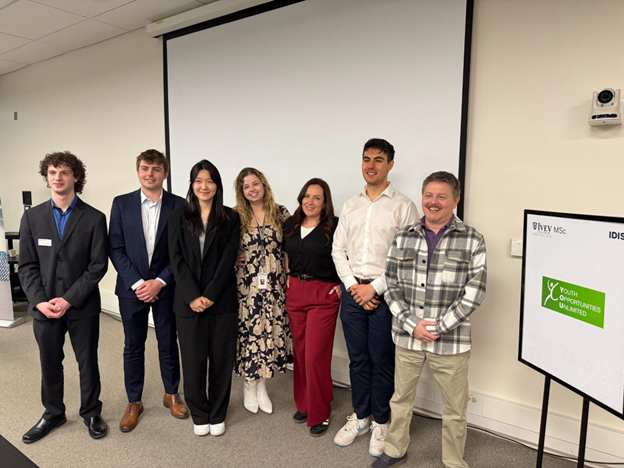
Round One: Compass, for Youth Opportunities Unlimited
My first client was YOU (Youth Opportunities Unlimited), a London, Ontario nonprofit supporting youth facing employment and housing barriers. The tool we pitched for this project wasn't something the public or YOU's own clients would ever touch. It was built to help staff coordinate more efficiently through an organization that ran entirely on Microsoft 365.
Compass is a prototype designed to help employees better manage their schedules, organize files more efficiently, and receive AI-generated summaries when necessary. It had the capacity to live inside the tools that YOU's staff already used. YOU cared deeply about data sovereignty and didn't want artificial intelligence mindlessly making decisions about vulnerable youth groups. For this reason, every design choice we made had to address that concern directly and not just work around it. We created a working prototype, a pitch deck, and a five-minute video that walked through our solution step-by-step.
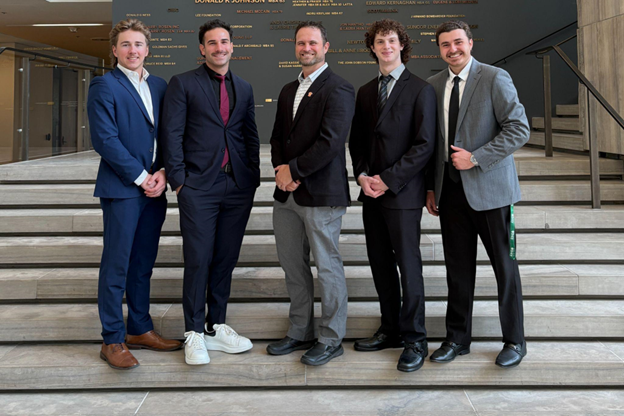
Round Two: Care Companion, for Southlake Health
Round two raised the stakes for our team. Our client was Southlake Health, and the idea was a dashboard to help care managers support patients living with advanced heart failure. Our prototype brought key patient information into one place, helping care managers track appointments, referrals, and high-priority tasks all at once.
This round taught me how to work around significant constraints. My role was to translate clinical urgency into a coherent pitch. We demonstrated what the tool did, why it mattered, and why care managers would actually use it as opposed to other dashboards they'd been handed.
We prepared a full pitch package with a timed voiceover video, a Q&A prep sheet anticipating the toughest questions Southlake's team could ask, and the kind of attention to detail that comes from knowing the people using this tool are making decisions about someone's heart.
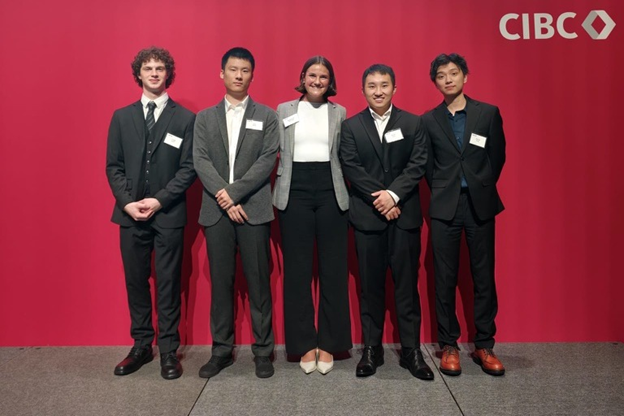
Round Three: AI Pulse Coach, for CIBC
The final round was the one that changed my lens on consulting. CIBC's opening question was broad: how do you build an innovative, adaptable culture in a tech-driven world? We were given a direction to follow and told to turn it into something buildable.
We narrowed the goal down to something more specific. CIBC already had a strong library of internal AI tools in their own language that were not being taken advantage of. That gap, between having the right tool and knowing to reach for it, became the problem our team chose to solve. Together, we built AI Pulse Coach: a workflow coach that surfaces the right recipe to an employee at the moment they need it, built around the ADKAR change management framework rather than just the tech stack underneath it.
The lesson that’s been consistent throughout our program is that the client's opening question will only ever be a starting point. From there, it has always been about navigating employee concerns, pitching the correct prototype, and making sure we were building the right tools.
Small inconsistencies are where trust quietly dies in a room full of executives.
What Actually Carried Through
Three clients, three industries, three completely different concerns, and the same muscle was exercised every time. We sat with each problem long enough to find the versions of them that were solvable. Nobody was handed the "right" answer in this program. We had to go find it, defend it, and be ready to be challenged on it.
The toughest skill that I’ve developed through IDIS wasn't building strategy or framework, it was learning to sit in an innovative room and earn the right to have my ideas heard.